PeakMetrics / Fact Checks
Has this been
fact-checked?
Paste a claim or upload an image to find existing fact checks. See what fact-checkers found and read the evidence before you share.
Search fact checks ↓API & integrations ↗Browse by topic
Explore fact checks by subject.
Search fact checks
Search by text or imageLatest fact checks
98,240 published reviews
Alfredo Castro dijo: “Más seguros vivíamos en el gobierno militar”
Publisher’s rating: Falso

तेजस्वी यादव ने मनीष कश्यप के डर से कहा कि उन्हें मुख्यमंत्री नहीं बनना
Publisher’s rating: FALSE
The review examined a viral five-minute video of Bihar Deputy Chief Minister Tejashwi Yadav speaking in the state assembly. It was shared to suggest that he did not want to become chief minister because he feared YouTuber Manish Kashyap. The review says the clip had been altered and taken out of context, and identifies Yadav’s speech as having been made during a Bihar Legislative Assembly session on 20 March. The review distinguishes two parts of the speech. It says Yadav discussed misinformation about alleged attacks on migrants in Tamil Nadu, and stated that Kashyap had stirred up a conspiracy to create tension between the states. But the remarks about not wanting the chief minister’s post came separately: Yadav was responding to speculation about a possible break in the JDU-RJD alliance and allegations that he wanted to become chief minister while Nitish Kumar wanted to become prime minister. In the complete video, the review places Yadav’s speech at 2:28:00 and says the Tamil Nadu misinformation discussion begins at 29:50:00; it locates his remarks about the chief minister’s post at 2:54:00. In those remarks, Yadav cited both parents having been chief ministers and his own roles as leader of the opposition and deputy chief minister, then said he would stand by Kumar. The review concludes that fear of Kashyap was not the reason for his remarks about the post.


In Nigeria und anderen afrikanischen Staaten gibt es Frischwasser nur noch mit QR-Code.
Publisher’s rating: Das Video zeigt ein Projekt in Malawi, das Menschen den Zugang zu Frischwasser erleichtern soll. Die Kartenzahlung läuft über RFID-Technologie, nicht über QR-Codes. Die Umrüstung machte Wasser dort erheblich günstiger. Wasserkioske ohne kontaktlose Bezahlmöglichkeit sind jedoch nach wie vor weit verbreitet. In Nigeria gibt es keine vergleichbaren Projekte.
The claim attached to the Facebook post was that fresh water was available only with a QR code in Nigeria and other African countries. The accompanying clip showed women holding a chip card to a reader, pressing a button, and collecting water. The investigation identifies the footage as a project in Malawi, so the scene does not establish that access to water across Nigeria or other African states had become dependent on QR codes. The review says the payment system shown uses RFID technology rather than QR codes. (S1: “Nun soll es laut einem Facebook-Posting in Nigeria und anderen afrikanischen Staaten eine weitere Hürde geben. «Frischwasser gibts nur noch mit QR-Code», heißt es darin. Dazu ist ein Video zu sehen, das Frauen zeigt, die erst eine Chipkarte an ein Lesegerät halten.”; “Das Video zeigt ein Projekt in Malawi” and “Die Kartenzahlung läuft über RFID-Technologie, nicht über QR-Codes.”) The review traces the clip to an official video presented by Malawi’s National Planning Commission in 2020. It says the on-screen details at the end identify the “eMadzi Project” and iMoSyS, the company responsible for the technical implementation. The project was in Lilongwe, Malawi’s capital, and involved automatic water kiosks where users paid with an RFID chip. These details connect the video to a particular Malawian water-access project, rather than to a QR-code system operating across the countries named in the post. (S1: “Am Ende des kurzen Clips zoomt die Kamera auf die Bedienfläche der Wasserausgabestelle. Dort sind Logos und die Begriffe «eMadzi Project» und «iMoSyS» zu erkennen.”; “Das Projekt in der malawischen Hauptstadt Lilongwe wird vom städtischen Wasserwirtschaftsamt betreut und auch von der EU gefördert. Die Nationale Planungskommission von Malawi präsentierte die Neuheit im Jahr 2020 mit einem knapp einminütigen Video, aus dem der Clip im Facebook-Posting stammt.”)

SAUDIA AIRLINES 78º Aniversário do Subsídio de Previdência do Governo Parabéns! Seu prêmio é: R$1.000,00
Publisher’s rating: Falso
Ang International Criminal Court ay walang hurisdiksyon sa Pilipinas. Walang legal o moral na obligasyon ang Pilipinas na makipagtulungan sa ICC.
Publisher’s rating: Kailangan ng konteksto
Research from related reporting provides a relevant qualification to the claim that the ICC has no jurisdiction in the Philippines. In reporting on Rodrigo Duterte’s challenge to the court’s authority, GMA News said the ICC Appeals Chamber rejected all four grounds of his appeal and confirmed the earlier decision. The report says the earlier chamber found that the prosecutor’s preliminary examination began before the Philippines formally notified the court of its withdrawal from the Rome Statute. Thus, the reporting describes the ICC as asserting jurisdiction over alleged crimes connected to Duterte’s case despite the withdrawal; it does not establish that the ICC has jurisdiction over every matter involving the Philippines. The supplied excerpts do not resolve the separate assertion that the Philippines has no legal or moral obligation to cooperate. They report litigation about the ICC’s jurisdiction and its proceedings against Duterte, but provide no analysis of the scope of any cooperation duty. The evidence therefore qualifies the claim about jurisdiction in this specific case, but is insufficient to determine the broader cooperation assertion.


01 ఏప్రిల్ 2023 నుంచి గూగుల్ పే, ఫోన్ పే, పేటీఎంల ద్వారా చెల్లింపులు జరిపితే ఛార్జీలు వర్తిస్తాయి
Publisher’s rating: MISLEADING
Video zeigt, wie ukrainische Soldaten russischsprachige Zivilisten drangsalieren.
Publisher’s rating: Das Video ist inszeniert, denn es ist gar nicht in ukrainisch kontrolliertem Gebiet aufgenommen worden. Es lässt sich anhand optischer Details in eine Gegend verorten, die bereits seit 2014 unter der Kontrolle der pro-russischen Separatisten im Osten der Ukraine steht und seit der Invasion 2022 von Russland kontrolliert wird. Ukrainische Soldaten sind dort nicht präsent.

The Nashville shooter was a transgender woman named Samantha Hyde
Publisher’s rating: False
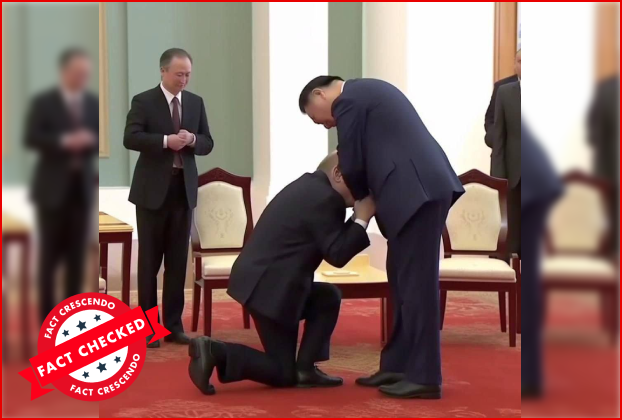
ปูตินคุกเข่าให้กับสี จิ้นผิง
Publisher’s rating: False
The review examined a social-media image said to show Vladimir Putin kneeling and kissing Xi Jinping’s hand during Xi’s March 20, 2023 visit to Russia. It describes the image circulating alongside a post claiming that Putin had knelt to Xi, and says the same image had also appeared on Twitter from March 20. The review’s conclusion concerns that specific image, not whether the two leaders met: it says the image was fabricated and may have been AI-generated. The publisher reports using reverse-image search but finding no reliable source for the image. It also relays observations from a DW.com examination: Putin’s shoes appeared unusually large, his lower legs elongated, his head disproportionate to his body, and both leaders’ ears looked misshapen; the hand of the man on the left also appeared to merge unnaturally. These are described as signs that the image may have been generated using AI, not as proof of a known creator or production method. The review further says that images and videos from the leaders’ actual meeting, published by reliable news sources, did not show them in the alleged pose. It points to differences between the circulated image and material from the event: the backgrounds differ, and Xi’s clothing does not match. According to the review, both leaders appeared before the media on March 20 in black suits, whereas Xi’s suit in the disputed image is navy blue. Together, the reported visual irregularities and comparison with event coverage support the conclusion that the image does not document Putin kneeling to Xi.
A viral photo depicting a sewage truck was posted on a Facebook page recently. It was seen that trucks become sewage trucks in the rainy season and sell clean water in the dry season. The above photo was reacted to and shared by Facebook users who are speaking Khmer. However, after running a Google Reverse Image search, it proves that the photo posted is digitally altered.
Publisher’s rating: Altered

वीडियो में पांच ग्रह बुध, बृहस्पति, शुक्र, मंगल और यूरेनस एक ही दिशा में स्थित देखे जा सकते हैं.
Publisher’s rating: FALSE
بیل گیتس ناگهان اعتراف کرد که واکسیناسیون اشتباه بوده است!
Publisher’s rating: شاخدار

1993 photo showing PM Narendra Modi posing along with Gujarat conman Kiran Patel.
Publisher’s rating: FALSE
The claim concerns a photo said to show Narendra Modi with Gujarat conman Kiran Patel in 1993. FACTLY identifies the man standing beside Modi, with his hands in his pockets, as G. Kishan Reddy, not Patel. It says the photograph was taken in 1994, when Modi visited the United States at the invitation of the American Council of Young Political Leaders (ACYPL).

Le PDG de Moderna admet que l'entreprise a produit 100 000 doses de vaccin contre le Covid-19 en 2019, soit avant la pandémie.
Publisher’s rating: Stéphane Bancel se réfère au nombre de doses totales élaborées par Moderna en 2019. Cela englobe tous les produits proposés par la compagnie à l’époque, a fait savoir son service de presse à la dpa. Cette interview ne prouve donc pas que le vaccin contre le Covid-19 ait été mis au point avant le début de la pandémie.
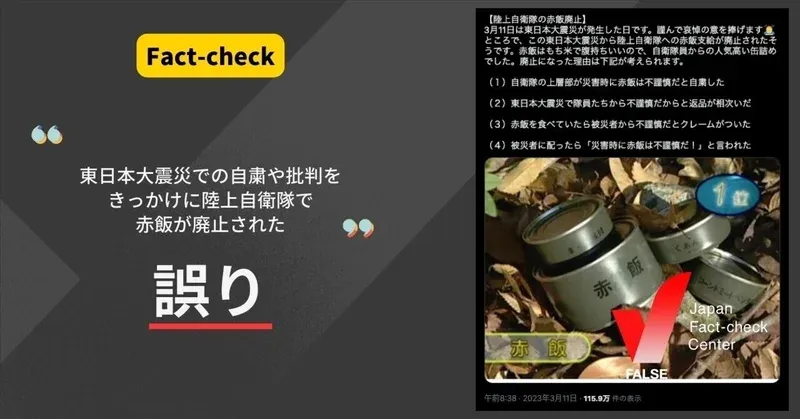
東日本大震災での自粛や批判をきっかけに陸上自衛隊で赤飯が廃止された
Publisher’s rating: 誤り
The review says the Ground Self-Defense Force did stop supplying red rice, but not because of the East Japan earthquake. It attributes the change to switching emergency rations from cans to retort pouches and changing the menu.

Four Bangladeshi freedom fighters recreate their 1971 photograph in the same Willy’s Jeep
Publisher’s rating: Fake

SEO na Fyrtlu – 3rd Edition happened on 23rd March 2023
Publisher’s rating: Correct

“Prohíben hablar de Jesús en Israel”.
Publisher’s rating: Falso
The viral Facebook post said that Israel had banned talking about Jesus and threatened people with years in prison. The review traces that claim to a proposed amendment introduced on January 9, 2023, by Knesset members Moshe Gafni and Yaakov Asher. The proposal concerned soliciting religious conversion and sought to extend restrictions on promoting the Gospel; it was a legislative proposal, not a rule then in force. The review says the proposal had not been approved or even debated. The proposed amendment was consequential if enacted: according to an English version cited by the review, it would have made personal conversations about Jesus and online videos explaining the Gospel to Jews or Muslims in Israel illegal, with prison terms of one to two years. That description helps explain how the post could refer to prison, but it does not establish that the restrictions had taken effect. The review distinguishes the proposal’s potential provisions from the claim that speaking about Jesus was already prohibited. The review also reports evidence that the proposal was not moving forward. Gafni said there were no plans to advance it, and the review cites a spokesperson’s account that it had been introduced as a procedural formality over the years. Prime Minister Benjamin Netanyahu said he would prevent approval and stated that no law against the Christian community would advance. Taken together, the review’s evidence supports the distinction between a proposed measure and an enacted prohibition.
Where the data comes from
Fact checks come from Data Commons and link to the organizations that published them.
What you’ll find
Each result links to the original fact check. Open it to read the publisher’s findings, with summaries and supporting sources where available.
Report an error
To report an error, send the page URL and supporting evidence.