PeakMetrics / Fact Checks
Has this been
fact-checked?
Paste a claim or upload an image to find existing fact checks. See what fact-checkers found and read the evidence before you share.
Search fact checks ↓API & integrations ↗Browse by topic
Explore fact checks by subject.
Search fact checks
Search by text or imageLatest fact checks
98,230 published reviewsजिम्बाब्वे क्रिकेट टीम के पूर्व कप्तान और महान ऑलराउंडर्स में शुमार हीथ स्ट्रीक का बुधवार को 49 साल की उम्र में निधन हो गया।
Publisher’s rating: False

El Grupo de Puebla, el Foro de Sao Paulo y la ONU, con su Agenda 2030, son los ideólogos de los libros de texto escolar que se distribuyen gratuitamente en México.
Publisher’s rating: Falso
The claim concerned the free textbooks distributed by Mexico’s Secretariat of Public Education (SEP) for the 2023–2024 school year. It alleged that the Grupo de Puebla, the Foro de Sao Paulo and the UN’s Agenda 2030 were their ideological authors. The review’s conclusion was that none of the three had participated in developing those books: “ni la Agenda 2030 de las Naciones Unidas, ni el Foro de Sao Paulo, ni el Grupo de Puebla, intervinieron en la concepción de los libros de texto distribuidos para la educación pública en México.” To examine who prepared the books, the review consulted the SEP’s Educational Materials Directorate and examined information published on Mexican government pages. The directorate said that defining the content was the responsibility of its staff and specialist teachers, and described the work as involving teachers and specialists: “la selección, construcción y definición de los nuevos contenidos estuvieron a cargo de”. The review also reported that the Grupo de Puebla said it had not participated in writing or developing the texts: “El Grupo de Puebla aseguró también a elDetector que no ha participado en la redacción ni el desarrollo de esos textos”. The review separately compared the stated aims of the other two organizations with the allegation. It reported that the Foro de Sao Paulo’s principles made no reference to intervening in schoolbook content, and that the Agenda 2030’s education goal concerned inclusive, equitable, quality education—not prescribing textbook content. It also described a keyword search that found no link between the three initiatives and the textbooks. These findings address the allegation of their involvement; they do not establish that the books were free of ideological content or errors.

Marília Gabriela gravou vídeo sobre fim da concessão da Jovem Pan e com ataques contra às FFAA
Publisher’s rating: Falso

Criatura demoníaca anjo negro foi filmada no Havaí por taxista no mesmo dia do incêndio
Publisher’s rating: Falso


صور أعمال بناء محطة الضبعة النووية
Publisher’s rating: خبر كاذب - الصور ترصد محطات نووية أخرى وليست محطة الضبعة النووية المصرية.

චන්ද්රයාන්-3 ව්යාපෘතියේ සිටි ඉන්දීය විද්යාඥවරියන් සම්බන්ධයෙන් තිලිණි ෂැල්වින් ප්රකාශයක් සිදු කළා ද?
Publisher’s rating: False
The claim concerned a social-media post attributing disparaging comments about Indian women scientists’ saris and independence to Sri Lankan teacher Thilini Shalvin. The post presented the remarks as hers and linked them to women scientists involved in the Chandrayaan mission. The review describes the circulating post as claiming that Shalvin said the scientists wore saris because of “very backward tribal cultural attitudes” and were not suited to the modern world. The investigation examined whether that statement had actually been published or made by her. The fact-checker searched the Facebook page named in the circulating post, “Ape Rata,” and reports finding no such post. It then contacted the page’s administrator, who said the page had not published a post containing the alleged statement and described the image as edited. The review also says it contacted Shalvin, who denied making the remarks and posted a response on her Facebook account. These checks directly address both the attribution and the post’s claimed source. The review further traces the image to an altered photograph of Shalvin. It says the original photograph had been posted in November 2022 in connection with her choosing ordinary, comfortable clothing suitable for school instead of wearing a sari to work during difficult economic conditions. The review suggests that footage of Indian women scientists wearing saris may have been used as the subject for a satirical false post, but presents that as an inference. Its conclusion is that Shalvin did not make the attributed statement and that the image used to support it was edited.

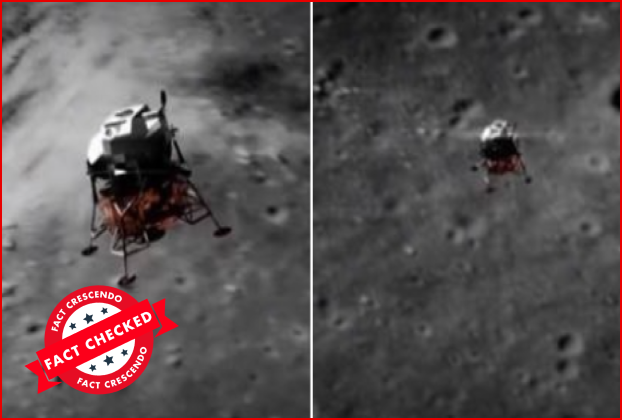
චන්ද්රයාන්- 3 යානය සඳෙහි දකුණු ධ්රැව ප්රදේශයට ගොඩබැස්වූ අවස්ථාවේ වීඩියෝවක් ද?
Publisher’s rating: Misleading
The review examines a social-media video presented as footage of Chandrayaan-3’s successful landing near the Moon’s south pole. It focuses specifically on the video’s opening portion, before 0:48, and asks whether that footage is genuinely from Chandrayaan-3. The investigation states that India achieved the landing on August 23, but concludes that the circulating clip was not footage of that event. To check the clip, the publisher compared it with landing videos released to the media and by ISRO, reporting that the clip did not appear in those materials. It then used reverse-image search on frames from the video. That search led to a YouTube video posted in 2021, whose creator, Hazegrayart, identified it as depicting the Apollo 11 Moon landing of July 20, 1969. The review also cites a 2018 post in which Hazegrayart described the videos as animated creations. The review’s conclusion is that the purported Chandrayaan-3 landing footage is an animation about Apollo 11, not a recording of Chandrayaan-3 landing. It distinguishes this clip from the genuine landing video posted by ISRO. Thus, the misleading element is the social-media presentation of an older animation as footage of the 2023 Indian mission.

Meningococcal Disease Has Been Spreading Virally In Galle, Sri Lanka!!
Publisher’s rating: False
The claim concerned alleged spread of meningococcal disease beyond Boossa Prison in Galle, Sri Lanka. The review says a viral WhatsApp message warned that an outbreak originating in the prison had crossed its walls and predicted more deaths. It separated that message into distinct claims, including spread within Galle and transmission to people outside the prison, rather than treating every part of the message as established by the prison cases alone. [S1]
फोटोग्राफर को दाद देनी पड़ेगी, खूबसूरत तस्वीर यातायात के चार साधन एक साथ, जलमार्ग, रेलमार्ग, वायुमार्ग, सड़कमार्ग।
Publisher’s rating: False



ඉන්දීය බිත්තර පරිභෝජනය නිසා හෘද රෝග ඉහළයාමේ ප්රවණතාවයක් ඇති බවට නලින් ද ජයතිස්ස ප්රකාශයක් සිදු කළා ද?
Publisher’s rating: Misleading

Where the data comes from
Fact checks come from Data Commons and link to the organizations that published them.
What you’ll find
Each result links to the original fact check. Open it to read the publisher’s findings, with summaries and supporting sources where available.
Report an error
To report an error, send the page URL and supporting evidence.