PeakMetrics / Fact Checks
Has this been
fact-checked?
Paste a claim or upload an image to find existing fact checks. See what fact-checkers found and read the evidence before you share.
Search fact checks ↓API & integrations ↗Browse by topic
Explore fact checks by subject.
Search fact checks
Search by text or imageLatest fact checks
98,223 published reviews
Von Elektroautos geht eine krebserregende Strahlung aus.
Publisher’s rating: Nach derzeitigem Forschungsstand gibt es keine Hinweise auf eine krebserregende Wirkung von elektromagnetischen Feldern in Elektroautos. Das bestätigten das Bundesamt für Strahlenschutz (BfS) sowie eine Expertin vom Forschungszentrum für Elektro-Magnetische Umweltverträglichkeit (femu) der Uniklinik RWTH Aachen gegenüber der Deutschen Presse-Agentur (dpa).
5 अगस्त 2022 को जब श्री राम जन्मभूमि का शिलान्यास हो रहा था तो विरोध स्वरूप कांग्रेस सांसद काले कपड़े पहनकर संसद भवन पहुंचे थे.
Publisher’s rating: False

Majority of cyber crime cases in Nepal are associated with TikTok.
Publisher’s rating: False
ویدیویی صحنهسازی نیروهای حماس در بمبگذاری ساختگی در یک ماشین
Publisher’s rating: نادرست

Estas fotos muestran una misteriosa criatura que fue encontrada en la costa de Tailandia.
Publisher’s rating: Falso
The claim concerned Facebook images said to show a mysterious creature found on the coast of Thailand. The review identifies the post as circulating in November 2023 and describes two figures in its pictures: one on land and another partly submerged. Its investigation found that the images showed artworks by Italian artist Laira Maganuco, not a creature discovered on the coast. The article describes the pieces as hyperrealistic silicone sculptures with animal and human features. (S1: “Una publicación que está siendo compartida en Facebook en noviembre de 2023 asegura mostrar imágenes de una ‘misteriosa criatura’ que fue ‘encontrada en la costa de Tailandia’, aunque en realidad lo que se ve en las fotografías son esculturas de silicona hechas por la artista italiana Laira Maganuco.”) To check the images, elDetector says it ran a reverse-image search on the first photograph. The results led to Maganuco’s Etsy shop, where the same figure appeared as “Dog Man” and was described as a silicone sculpture made by hand. For the other figure, the reviewers found a similar image among Etsy customer-review photos and identified the associated work as another Maganuco sculpture, named “delfín alimentado.” (S1: “En elDetector realizamos una búsqueda inversa de imagen en Google con la primera de las fotografías y encontramos entre los resultados un enlace a la tienda de la artista italiana Laira Maganuco en la plataforma Etsy, en la que aparece la misma figura con el título ‘Viral Artwork: Dog Man’ (Trabajo artístico viral: Perro hombre).” S1: “Al revisar el producto asociado a esa reseña, encontramos que esa pieza es también una escultura de la misma artista, que lleva por nombre ‘delfín alimentado’.”) The review also points to Maganuco’s biography, which describes her practice as hyperrealist sculpture, and notes that her work had previously been misrepresented online as a real creature. These details support the identification of the pictured forms as artworks; the article does not report evidence that either sculpture was found in Thailand. (S1: “En la biografía de Maganuco en su página web se explica que la artista nacida en Milán se dedica a la ‘escultura hiperrealista’” S1: “en 2019, verificadores de Africa Check, miembro como elDetector del International Fact-Checking Network (IFCN), desmintieron que otra de sus creaciones fuera algún tipo de ser vivo encontrado en Kenia.”)

This video shows weapons found by the IDF in Al-Shifa Hospital, Gaza
Publisher’s rating: MISLEADING


General Motors a arrêté la production de véhicules électriques et a abondonné définitivement la plupart de ses projets électriques.
Publisher’s rating: Non, GM a seulement annoncé freiner ses ambitions sur le segment électrique d'ici mi-2024. Mais son engagement en faveur d'un avenir entièrement consacré aux véhicules électriques reste intact, a fait valoir sa CEO Mary Barra.
The allegation circulating online in early November 2023 was that General Motors would stop producing electric vehicles and permanently abandon most of its electric-vehicle projects. The dpa review distinguishes that sweeping claim from GM’s documented decision to revise production ambitions and delay some launches. It reports that the review found no evidence of a decision to abandon the projects: the alleged decision was not found on GM’s official website or in its press releases, and the review said no credible media outlet was reporting it. GM had not immediately answered dpa’s inquiry. The concrete change identified by the review concerned a production target. At its quarterly-results presentation on October 24, 2023, GM dropped its goal of producing 400,000 electric vehicles between 2022 and mid-2024. The review says GM attributed the change to weaker North American demand and delayed several electric models to reduce spending, citing Automotive Dive. Those steps show a revision to timing and near-term ambitions; the review says they do not establish that GM was abandoning most of its electric projects. The review also quotes CEO Mary Barra saying the company continued to plan for annual North American electric-vehicle capacity of one million units by the end of 2025. It reports that GM’s longer-term plan was to sell only zero-tailpipe-emission vehicles by 2035 and pursue carbon neutrality across its products and operations by 2040. These stated plans provide context for why a near-term production adjustment should not be represented as a permanent end to GM’s electric-vehicle efforts.

Claim: misleading shared that dmk insulting its own party dalit members
Publisher’s rating: ஃபேக்ட் கிரஸண்டோ ரேட்டிங்: MISLEADING

Video shows three Israeli girls fighting 10 Arab boys.
Publisher’s rating: False
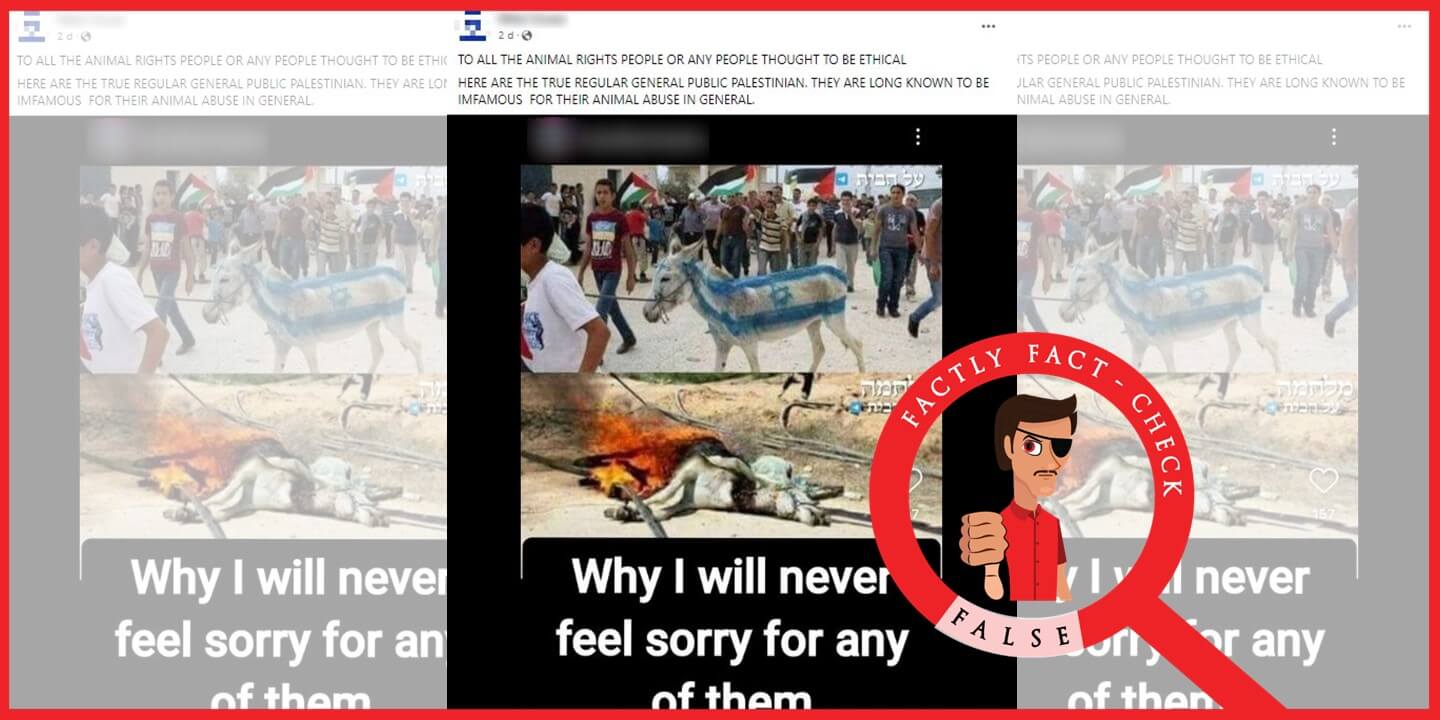
Palestinians in Gaza painted a donkey with the Israeli flag before subsequently burning the animal
Publisher’s rating: FALSE
The claim links two photographs as though they show the same donkey and a sequence of events in Gaza. FACTLY reports that the images are unrelated: the painted donkey was photographed on 23 September 2011 in Kfar Kadum, a West Bank settlement, while the burning-donkey photograph was taken near Rafah in Gaza on 06 August 2014. The different places and dates contradict the claimed setting and sequence. [S1: “The first was captured on 23 September 2011, in a West Bank settlement during a Palestinian demonstration. The second was taken on 06 August 2014, near Rafah in the southern Gaza Strip”] The review says a reverse image search of the painted-donkey photograph led to the same image on Alamy. Its accompanying description identifies the scene as a demonstration in Kfar Kadum supporting the Palestinian bid for statehood recognition at the United Nations. FACTLY also says AFP photographer Jaafar Ashtiyeh took the picture. The review found no evidence that this animal was later killed or burned. [S1: “Conducting a reverse image search on the photo of a donkey painted with an Israeli flag led us to the same image uploaded on Alamy, a stock image portal.”] [S1: “However, there is absolutely no mention or evidence indicating that the Palestinians ultimately burned or killed the animal in question.”] For the second photograph, FACTLY reports that a reverse image search led to a similar image on Getty Images. The associated description says the donkey burned near Rafah had been killed earlier by an Israeli air strike. Thus, the image documents a separate event in Gaza three years after the West Bank demonstration; it does not show Palestinians burning the painted donkey. The collage creates a misleading connection between two old images. [S1: “The description associated with the image reads ‘Palestinians burn the donkey, who was killed earlier by an Israeli air strike in Rafah in the southern Gaza Strip, on 06 August 2014.’”] [S1: “Hence, this proves that both these images are not connected, as the incident involving the burning of the donkey was documented in the Gaza Strip, occurring three years after the demonstration in a West Bank settlement where a donkey was painted in Israeli colors in 2011.”]



Un message de soutien à Israël a remplacé un message de soutien à l'Ukraine sur un panneau publicitaire à New York.
Publisher’s rating: Tout indique que la vidéo en question a été retouchée. La compagnie qui gère le panneau publicitaire a assuré à la Deutsche Presse-Agentur (dpa) n'avoir jamais diffusé un tel message. Les images récentes de l'écran montrent une publicité pour « Les Trolls 3 », et non un message de soutien à Israël.
The video shows Hamas attacking Israeli tanks.
Publisher’s rating: False
This footage depicts an Israeli official being assaulted amid the Israel-Hamas conflict.
Publisher’s rating: False
Where the data comes from
Fact checks come from Data Commons and link to the organizations that published them.
What you’ll find
Each result links to the original fact check. Open it to read the publisher’s findings, with summaries and supporting sources where available.
Report an error
To report an error, send the page URL and supporting evidence.