PeakMetrics / Fact Checks
Has this been
fact-checked?
Paste a claim or upload an image to find existing fact checks. See what fact-checkers found and read the evidence before you share.
Search fact checks ↓API & integrations ↗Browse by topic
Explore fact checks by subject.
Search fact checks
Search by text or imageLatest fact checks
97,834 published reviews
“So, under my leadership, economic growth is exploding to numbers unheard of. They’ve never had them before.”
Publisher’s rating: False

This nation is so badly divided, we don't need any external enemies. A telugu vlogger who travelled to more than 20 countries was attacked somewhere in North India for not speaking in Hindi. His money was stolen and he was beaten up by the so called Nationalist goons.
Publisher’s rating: misleading

The viral video shows female conjoined twins getting married to a man in Egypt.
Publisher’s rating: FALSE
FACTLY reports that the viral video is AI-generated, not footage of a real wedding in Egypt. It says the clip bears the watermark of an account that regularly posts AI-generated content, and that Hive indicated a 99.9% likelihood the video was AI-generated.
نشرت حسابات على موقع التواصل الاجتماعي فيسبوك مقطع فيديو أدعت أنه للمظاهرات التي شهدتها مدينة عتق عاصمة محافظة شبوة اليوم
Publisher’s rating: خاطئ
The book and his brain both are empty as always. 🤡 thought that he'd get away from the cameras
Publisher’s rating: false

The viral video shows a newly married Hindu woman being kidnapped in Pakistan.
Publisher’s rating: FALSE
FACTLY reports that the video is a scripted short film created by Rauf TV, not footage of a real kidnapping. The review says the video was uploaded on Rauf TV7 on 21 November 2025, included a disclaimer identifying it as a film scene, and was confirmed as staged by the team in December 2025.


Vehicle tax in Sri Lanka is charged based on the number of airbags in the vehicle.
Publisher’s rating: False
ادعای اینکه کشتهشدن ونوس منادی و ماجراهای پرونده او مربوط به اعتراضات دی ماه ۱۴۰۴ است.
Publisher’s rating: نادرست

పాకిస్తాన్లో ఒక హిందూ మహిళని తన భర్త ముందే కిడ్నాప్ చేస్తున్న దృశ్యాలు.
Publisher’s rating: FALSE
چین با ۱۶ هواپیما به طور مخفیانه به ایران ابزارهای جنگ الکترونیک داده است
Publisher’s rating: نادرست

బీజేపీ కార్యకర్తలు జాతీయ జండాతో తమ చెప్పులు తుడుచుకోవటాన్ని చూపిస్తున్న వీడియో.
Publisher’s rating: FALSE
தமிழ்நாட்டில் ஏப்ரல் 19 ஆம் தேதி சட்டமன்ற தேர்தல் நடைபெறும்.
Publisher’s rating: fake

河野太郎氏が不正に当選?
Publisher’s rating: 誤り
The review concerns posts alleging that Taro Kono, the Liberal Democratic Party candidate in Kanagawa’s 15th district, won dishonestly in the February 8, 2026, House of Representatives election. The posts pointed to an apparent lack of visible support, including a video showing people passing by while Kono spoke at a street rally, and argued that his decisive win was suspicious. The review notes that the posts spread widely on X and that some commenters treated the allegations as evidence of vote manipulation. (S1: “2026年2月8日、「支援者もいない 河野太郎がダントツ一位当選 おかしくないか」という投稿がXで拡散した。”; “拡散した投稿には、聴衆が河野氏の街頭演説に耳を傾けず素通りしている様子を映した動画がついている。”) To assess the assertion that Kono lacked supporters, the review checked reporting from broadcasters and newspapers. It says exit polls by multiple news organizations placed Kono first in the district by a wide margin over the second-place candidate. It also cautions that exit polls exclude early voting and can differ from final results, for example when voters do not answer truthfully or decline to respond. The review therefore treats the polls as evidence against the claim of having no support, not as a substitute for the final count. (S1: “報道各社の出口調査では、河野氏は神奈川15区で2位の候補に大差をつけて1位だった”; “出口調査は、期日前投票の結果を含んでおらず、本当のことを答えない人もいれば、回答を拒む人もいる。”) The review also reports that the Japan Fact-Check Center contacted the Kanagawa Prefectural Election Administration Commission. The official it consulted said no mistakes or other problems had been reported at polling stations in the prefecture. On the evidence described—exit-poll results and the commission’s response—the review found no support for the allegation that Kono’s win resulted from electoral fraud. Its account does not describe an independent recount or a direct audit of ballots; it reports the commission’s response and the published exit-poll findings. (S1: “日本ファクトチェックセンター(JFC)は神奈川県の選管に取材した。”; “担当者は「管内の開票所で、とくだんミスやトラブルなどの報告はあがっていない」と回答した。”; “河野氏は報道各社の出口調査で他の候補に大差で1位。神奈川県・選挙管理委員会も管内で開票作業にミスなどはなかったと回答している。”)
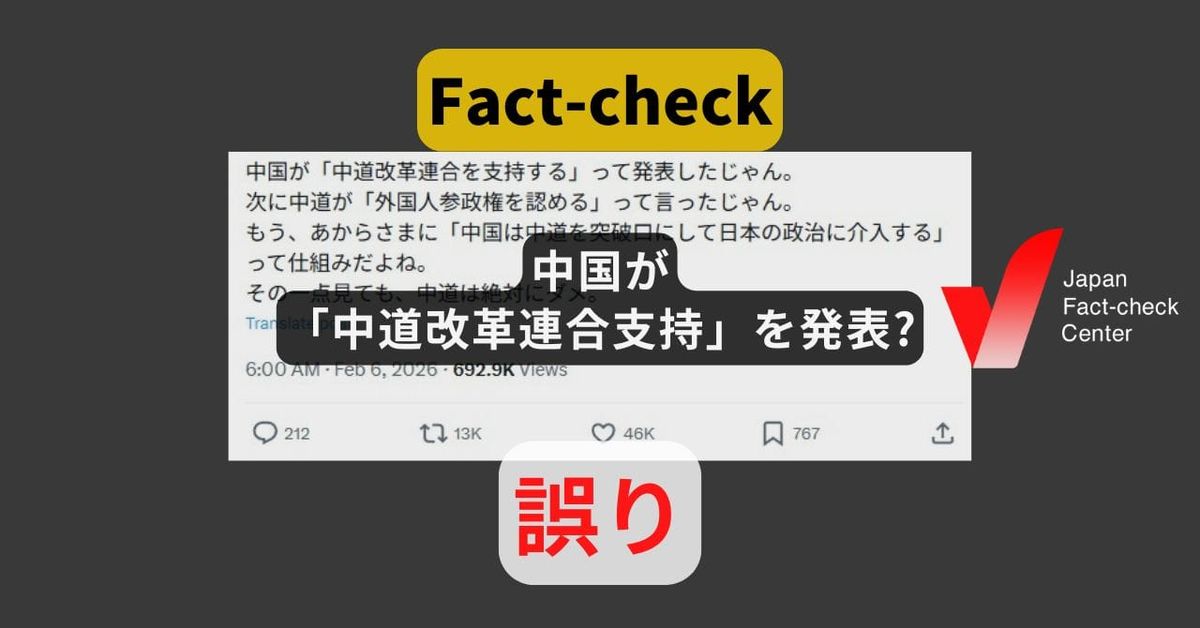
中国が「中道改革連合支持」を発表?
Publisher’s rating: 誤り
The review examines a post claiming that China had announced support for the Centrist Reform Coalition. It reports that the claim spread on X on February 6, 2026; by February 7, it had been reposted more than 13,000 times and viewed over 690,000 times. The review says the post was deleted by February 9, but similar posts continued to circulate. To check whether China had expressed support, the review consulted Chinese Ministry of Foreign Affairs press-conference records. In a January 15 exchange, a Japanese reporter asked about reports that Komeito was considering forming a new party with another party, and whether China would maintain its relationship with Komeito if the new party no longer used that name. Spokesperson Mao Ning replied that it was a Japanese domestic matter and that she would not comment. The coalition announced its name the following day, January 16. The review presents the January 15 response as a refusal to comment, not an endorsement of the coalition. The review also checked the Ministry’s record of its February 9 press conference, after the House of Representatives election. It says the spokesperson commented on the Liberal Democratic Party’s victory and the continuation of the Takaichi government, but made no comment about the Centrist Reform Coalition. The review reports finding no news coverage of a Chinese government announcement supporting the coalition as of February 10. Taken together, the cited official records and absence of reported support led the review to conclude that the claim of an announcement was unsupported by the evidence it examined.
ویدیوی مربوط به دختری که محل کشته شدن پدرش در اعتراضات دی ۱۴۰۴ را گلباران کرد
Publisher’s rating: نادرست

A newspaper clipping resembling The Indian Express reports that Prime Minister Narendra Modi destroyed all evidence of his marriage to Jashodaben.
Publisher’s rating: FALSE
FACTLY reports that the viral newspaper clipping is fabricated: The Indian Express denied publishing the article, and the photograph came from an older, unrelated report. It also says its searches found no credible reporting supporting the allegation attributed to Jashodaben.
Where the data comes from
Fact checks come from Data Commons and link to the organizations that published them.
What you’ll find
Each result links to the original fact check. Open it to read the publisher’s findings, with summaries and supporting sources where available.
Report an error
To report an error, send the page URL and supporting evidence.