PeakMetrics / Fact Checks
Technology & AI fact checks
Explore claims publishers have checked about technology & ai. Read their original ratings and follow the evidence.
Search fact checks
Search by text or image1,815 published reviews in this topic
Windows 11 - Retail & Volume version | Software & License
Publisher’s rating: 5
Microsoft Partner for Windows 11, Windows 10. Windows Server 2022, 2019 ..etc. Software & Licensing
Publisher’s rating: 5

Am 25. August tritt der Digital Service Act in Kraft, der die Meinungsfreiheit in der EU beendet. Die Tagesschau hat darüber nicht berichtet.
Publisher’s rating: Die Behauptung ist falsch: Das europäische Digitalgesetz sieht keine Zensur von Internetplattformen vor.
The claim came from a video shared in a Luxembourg Facebook post. A man in a car said that the EU’s Digital Services Act would take effect on August 25, end freedom of expression, and lead major platforms to censor content. He also alleged that Tagesschau and other major media had not reported on the law. The dpa review addresses these claims directly, including the video’s date and its claims about platforms and news coverage. The review explains that August 25, 2023, was not the law’s general entry-into-force date. It says the law had already entered into force on November 16, 2022, and would apply across EU member states from February 17, 2024. August 25 instead marked the deadline for 17 designated very large online platforms and two very large online search engines to comply with their obligations; the Commission had designated them four months earlier, on April 25. The review defines the relevant size threshold as more than 45 million monthly users. On censorship, the review says the regulation does not provide for platform censorship. It describes provisions concerning user information about recommendations, limits on using certain sensitive data for advertising, child protection, risk assessment, reporting illegal content, and enforcement under the national law where a user is located. It also notes that the regulation expressly protects freedom of expression from interference by its monitoring and enforcement mechanisms. The review further refutes the claim of silence by reporting that searches of Tagesschau’s website found repeated, sometimes detailed coverage of the law.
گوگل در اقدامی غیرحرفهای در سرویس جستوجوی خود برای کاربران ایرانی اختلال ایجاد کرده است.
Publisher’s rating: نادرست
به دنبال مهیا کردن شرایط فعالیت استارلینک در کشور به صورت قانونی هستم.
Publisher’s rating: این ادعا از اساس با «بنیادیترین» اسناد بالادستی فضای مجازی در جمهوری اسلامی تناقض آشکار دارد

WEF fordert, dass KI die Bibel umschreibt.
Publisher’s rating: Das WEF hat nie ein Umschreiben der Bibel verlangt. Der Autor Harari hat zwar über die Möglichkeit gesprochen, dass Künstliche Intelligenz zur Schaffung religiöser Texte eingesetzt werden könnte. Aber auch er hat das weder befürwortet noch gar gefordert. Zudem spricht Harari nicht für das Weltwirtschaftsforum.
The claim ties two ideas together: that the World Economic Forum (WEF) wanted AI to rewrite the Bible, and that Yuval Noah Harari was speaking for the organization. The investigation traces the rumor to an article by The People’s Voice, which cited Harari’s discussion of AI and religion. It reports that the article’s account distorted what he said: in an interview, Harari described a possible future in which AI could produce a new Bible or religious texts, rather than calling for that to happen. The review says he neither endorsed nor urged the idea. The review identifies the interview as a broadcast by a Portuguese foundation on May 19, 2023; Harari later published the full video on his YouTube channel on June 6. The religion passage begins at 07:20. In it, he contrasts the printing press’s ability to reproduce the Bible with AI’s potential to write a new one, and discusses the possibility that religions with AI-created holy books could emerge. The review characterizes these as future scenarios, not a proposal or demand. The attribution to the WEF is also unsupported by the evidence described. The review says Harari had attended WEF conferences but held no position in the organization, and reports that a WEF spokesperson told USA Today the organization had never called for the Bible to be rewritten using AI. It also reports that the alleged WEF post calling the Bible “fake news” could not be found on the forum’s account, its website, or through Google. These details address both the alleged request and the claim that Harari spoke on the WEF’s behalf.
URGENTE APP THREADS, ALERTA! APLICATIVO Threads VAI HACKEAR SUA CONTA BANCÁRIA E SEUS DADOS FINANCEIROS NÃO INSTALE
Publisher’s rating: Falso
The EU’s Digital Services Act is a censorship law
Publisher’s rating: FALSE
Theo thư mời sự kiện Galaxy Unpacked tháng 07/2023 thì Galaxy Z Fold5 sẽ chính thức trình làng vào ngày 26/07/2023.
Publisher’s rating: Đúng
Theo thư mời sự kiện Galaxy Unpacked tháng 07/2023 thì Galaxy Z Flip5 sẽ chính thức trình làng vào ngày 26/07/2023.
Publisher’s rating: Đúng
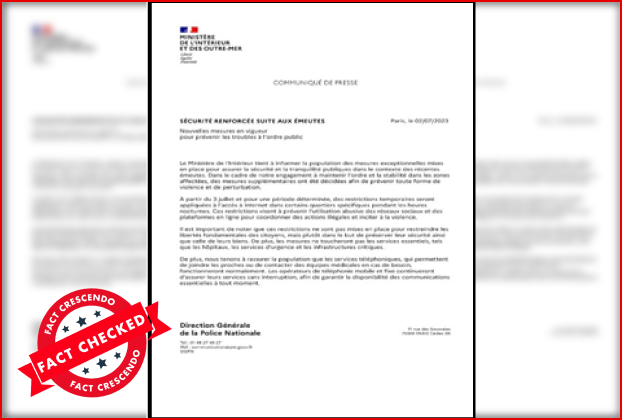
France Has Announced An Internet Shut Down Amid The Violence In Paris !!
Publisher’s rating: False
The claim concerned a purported French government announcement suspending internet service during the unrest in Paris. The circulated notice was attributed to the Direction Générale de la Police Nationale and said service would be suspended at night in certain areas from July 3 to prevent social media from being used to coordinate illegal actions and incite violence. The review says that, despite the violence, the French government had not ordered either a total or partial shutdown. (S1: “It says that internet services will be temporarily suspended from 3 July during night hours in certain areas to ‘prevent misuse of social media and online platforms to coordinate illegal actions and incite violence.’”; “Despite the violence in Paris, the French government has not ordered total or partial internet shutdowns.”) The unrest described in the review began in Nanterre after police fatally shot 17-year-old Nahel during a traffic stop. Against that backdrop, the review describes a viral circular claiming to be from France’s Ministry of the Interior. The review reports that the circular was fake; it does not provide evidence that internet service was actually suspended. (S1: “Riots started in Nanterre, a suburb of France’s Paris, after the police reportedly fatally shot a 17-year-old boy named Nahel during a traffic stop.”; “In this backdrop, a press release, allegedly issued by France’s Ministry of the Interior discussing the ongoing protests in the country’s capital city of Paris, has gone viral on social media.”; “The press release is fake.”) To check the announcement, the investigators searched French government websites for official communication about shutdowns and checked the National Police website and official Twitter account. They report finding no shutdown announcement in those places. They also cite a July 3 clarification from the official Twitter account of the French Ministry for Europe and Foreign Affairs, which dismissed the viral circular as fake news. (S1: “We looked for official communication regarding internet shutdowns in France on the French government‘s websites, but could not able to find any such releases.”; “The National Police’s website and official Twitter account, too, had no notifications on cutting off internet services in the country.”; “the official Twitter account of the French Ministry for Europe and Foreign Affairs tweeted out a clarification on July 3, 2022, regarding the viral circular, dismissing it as fake news.”)
Collage of images showing Elon Musk romancing and dancing with female humanoid robots
Publisher’s rating: FALSE
Claude E. Shannon's wrote "A Short History of Searching" in 1948.
Publisher’s rating: False
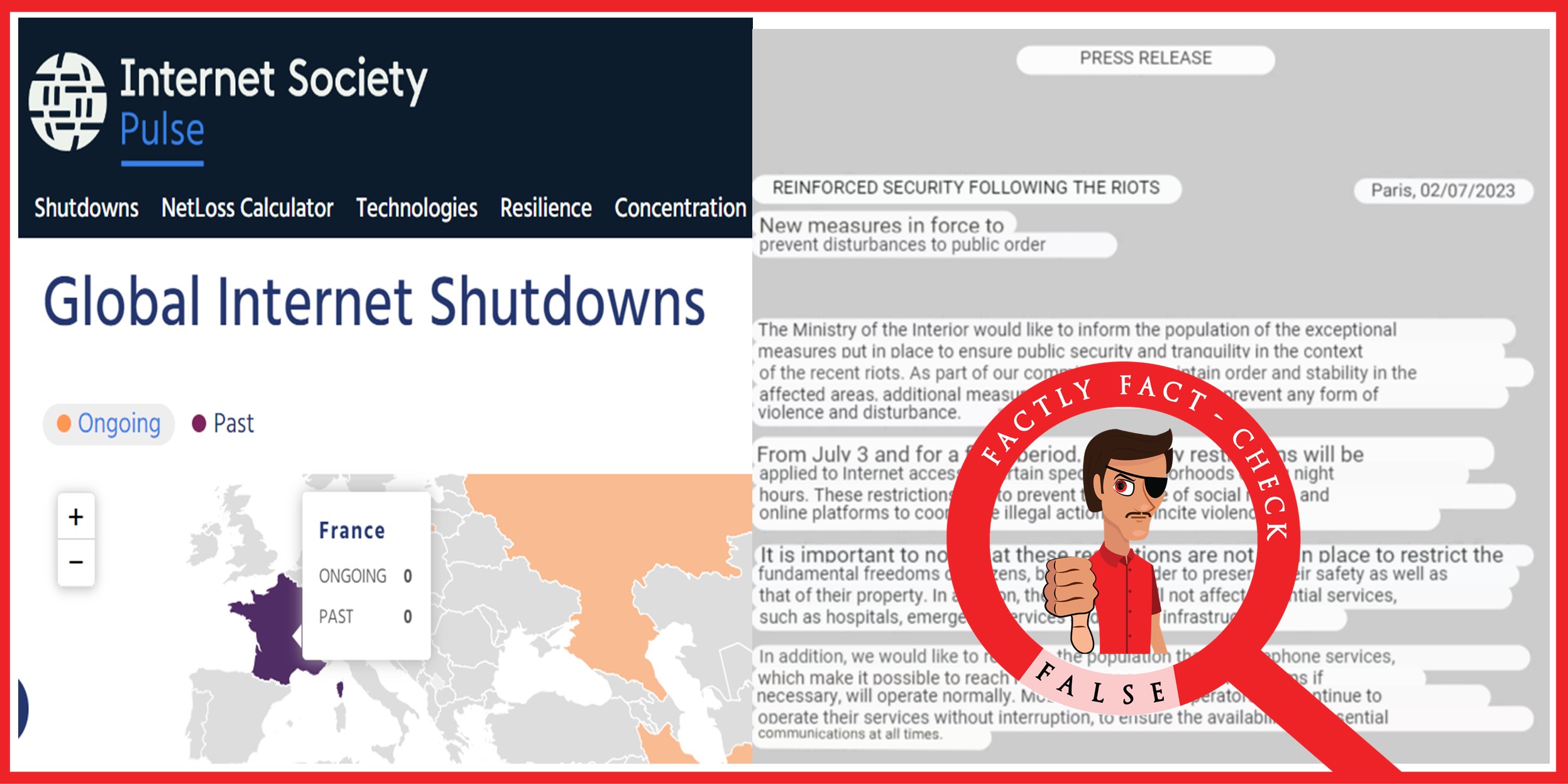
French Ministry of Interior, in a press release, has announced a partial ban on internet access starting from 03 July 2023 to curb the misuse of social media platforms for coordinating illegal activities that incite violence
Publisher’s rating: FALSE
The claim concerned a purported press release saying that France would begin a partial internet-access ban on 3 July 2023 to curb the use of social media to coordinate illegal activities inciting violence. The review places the claim amid unrest in France following the death of a teenager at the hands of a police officer. Its subject was the alleged ban and the authenticity of the circulating letter, not a report that access restrictions had actually taken place. The review says it searched online using relevant keywords and found a French Ministry of Interior statement issued on 2 July 2023. According to the review, that statement explicitly rejected the letter as false and said the government had made no decision to impose an internet ban in connection with the unrest. It also reports a corresponding statement from the Ministry for Europe and Foreign Affairs on 3 July that dismissed the viral letter. The investigation further notes that local media and internet-shutdown trackers reported no internet shutdowns in France at that time. Taken together, the official denials directly address the purported document and the alleged government decision, while the reported absence of shutdowns provides additional context. The review concludes that no official decision to impose the claimed ban had been made; the excerpts do not provide the text of the purported letter or the full statements themselves.
The U.N. is plotting increased censorship for online platforms to combat misinformation.
Publisher’s rating: False

Cette vidéo montre une réelle interview de Bill Gates.
Publisher’s rating: Aucun de ces propos ne figure dans l’interview d’origine, réalisée en janvier 2023 par la chaîne australienne ABC News. Cette séquence trompeuse était apparue en ligne en mars, et avait déjà été signalée comme fausse à l’époque.
The claim concerns a widely shared video that appears to show Bill Gates getting irritated by a journalist’s questions and abruptly ending an interview. The dpa review says the clip resurfaced on social platforms from late June 2023, with the interviewer appearing to challenge Gates over Microsoft’s creation and his promotion of Covid-19 vaccines. Its conclusion is that the video is fabricated: those remarks do not occur in the original interview, and Gates does not end that interview. To locate the original, the review reports using the InVID tool to search the video. It identifies the source as an interview by ABC News presenter Sarah Ferguson, broadcast on 29 January 2023 (Sydney time). The roughly 12-minute conversation covered subjects including disinformation, artificial intelligence, and Gates’s relationship with Jeffrey Epstein. The review states that the viral sequence is absent from this interview and that neither Gates nor Ferguson says the words attributed to them in the clip. The review also describes signs of manipulation in the circulating video: poor image quality, unnatural transitions between phrases, and lip movements that do not always match the spoken words. In some versions, subtitles are positioned over the speakers’ mouths rather than at the bottom of the image. It reports that specialists had raised such concerns with other fact-checking organizations, and that ABC News and Gates representatives had also denied the video’s authenticity. The review concludes that the evidence indicates a deepfake, while noting that its creator and the specific software used could not be established.
قريباً.. الواتساب يتيح خدمة معرفة من قام بتصوير الشاشة أو تحويل رسالتك للغير
Publisher’s rating: خطأ