PeakMetrics / Fact Checks
Science & space fact checks
Explore claims publishers have checked about science & space. Read their original ratings and follow the evidence.
Search fact checks
Search by text or image1,577 published reviews in this topic
Pedra gigante em formato de golfinho é encontrada em ilha
Publisher’s rating: Falso
La NASA dejó de explorar el océano en 1978.
Publisher’s rating: Falso
A photo shows the world's largest horse.
Publisher’s rating: False: This is not a genuine photograph. It's an AI-generated image.
De aarde staat niet 150 miljoen kilometer afstand van de zon, maar de zon zweeft vlak boven de wolken, zo bewijzen crepusculaire stralen.
Publisher’s rating: De aarde staat weldegelijk op ongeveer 150 miljoen kilometer van de zon. Het feit dat zonnestralen soms niet parallel aan elkaar lijken te lopen, komt door het perspectief van de waarnemer op aarde. In feite lopen die zonnestralen wel parallel aan elkaar.

Photo of Pagoda or Maha Molu flower that blooms once every 400 years in the Himalayan mountains of Tibet
Publisher’s rating: FALSE
A few days back, Ladakh’s skies were illuminated by the Aurora Borealis, also known as the Northern Lights. A rare event!
Publisher’s rating: Misleading
*A partir de amanhã, às 05h27, vivenciaremos o FENÔMENO APHELION, onde a Terra estará muito distante do Sol.*
Publisher’s rating: Falso

Imágenes muestran ovni captado en Nueva Jersey.
Publisher’s rating: Falso
The claim concerns a Facebook clip showing people stopped on a New Jersey highway filming what was described as a UFO. The review says the footage instead shows a Goodyear blimp. It reports that the images were recorded on September 14, 2020, and that the claim they showed an unidentified flying object circulated again in 2023. The investigation’s conclusion is that the footage does not show a UFO. To check the clip’s provenance, the review describes a reverse-image search that led to a Caracol Radio report citing an AFP Factual verification from February 2023. That earlier verification identified the object as a Goodyear blimp over New Jersey in September 2020 and said the footage was unrelated to objects reported shot down around that time in Canada and the United States. The review also reports searching English-language keywords and finding coverage from when the images first went viral in 2020. The review’s strongest corroboration is a report that Insider spoke with a Goodyear representative, who confirmed the company flew a blimp over New York and northern New Jersey on September 14, 2020, during a Pittsburgh Steelers–New York Giants football game. This matches the date and location attributed to the footage. The review therefore identifies a specific, documented aircraft flight as the source of the supposed UFO images, rather than treating the clip’s appearance alone as evidence of an unidentified object.
Este video muestra como la NASA engaña sobre sus viajes espaciales.
Publisher’s rating: Falso
Esta imagen muestra uno de los últimos raza de gigantes vivo en 1901.
Publisher’s rating: Falso
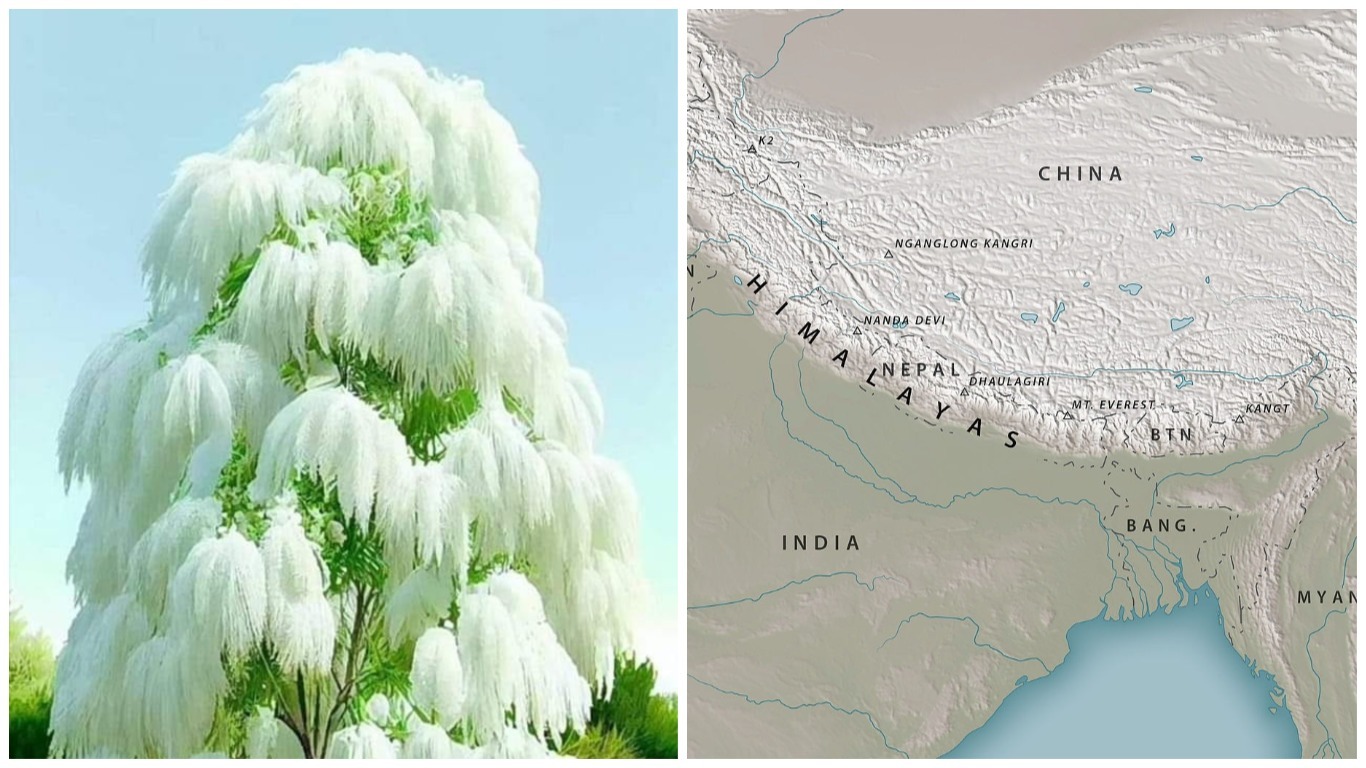
Claims Of Flowers Blooming In The Himalayas Once In 400 Years!
Publisher’s rating: False
The review investigated social-media posts showing a large tree with unusual white flowers, captioned as “Flor do Pagode” or “Maha Molu” and said to be an auspicious Tibetan flower that blossoms in the Himalayas once every 400 years. It reports that the image circulated on Facebook and WhatsApp, where some users treated it as a real plant and described themselves as lucky to see its rare bloom. The review’s conclusion is that the viral artwork does not depict a known real-life plant, and no flower is reported to bloom on a four-century cycle. [S1: “A beautiful image of the large tree with unique white flowers is circulated with the caption, ‘Flor do Pagode’ or ‘Maha Molu,’ a unique auspicious flower in Tibet. The flowers of the pagoda in the Himalayas bloom every 400 years.”; “The image was viral among WhatsApp users also, narrating that our generation was lucky enough to see the Pagoda blossoming, which happens once in 400 years only.”; “We also did not find any real-life plant resembling the viral artwork image claiming to be a flower blooming once in 400 years.”; “there is no plant reported to have a blooming period of 4 centuries.”] The review distinguishes the viral image from a real plant called the Pagoda flower, identified as *Clerodendrum paniculatum*. It says that plant is native to parts of Asia, including the area between India and southeast China, and flowers annually from mid-summer to autumn—not once every 400 years. It also says the plant’s appearance does not match the viral image, so the existence of a flower with a similar name does not substantiate the post’s claim. [S1: “its scientific name is Clerodendrum paniculatum, and it is native to Asia, particularly in the area between India and southeast China.”; “this plant does not bloom every 400 years. Instead, its flowering takes place every year, from mid-summer to autumn.”; “the Pagoda flower’s outlook does not match the viral image.”] For the broader claim about flowering intervals, the review reports that experts consulted by the Australian Associated Press fact-checking project said no known plant anywhere in the world flowers every 400 years. It also says Fact Crescendo contacted Dr. M. Sabu, a botany professor in Kerala, who called the claim a hoax. As a comparison, the review identifies the Guinness Book of World Records’ slowest-flowering plant as being from Bolivia, with an interval of 80–150 years. These details support the review’s rejection of the claimed four-century interval; they do not identify the viral artwork as a real flower. [S1: “several experts consulted by the Australian Associated Press fact-checking project clarified that there is no known plant anywhere in the world that flowers every 400 years.”; “Our Factcrescendo team also contacted Dr. M. Sabu, a Botany Professor in Kerala, who confirmed, ‘The claim that plants bloom just once every 400 years is a complete hoax.’”; “The Guinness Book of World Records for the slowest flowering plant is from Bolivia. That is between 80-150 years.”]

Une vidéo d'un ballon ne flottant pas dans l'espace prouve que la Station spatiale internationale n'existe pas.
Publisher’s rating: L'extrait ne démontre pas que la Station spatiale internationale n'existe pas. Il suffit de regarder la vidéo dans son entièreté pour voir que le ballon en question flotte, et donc que l'ISS se trouve bien dans l'espace.
The review investigates a social-media excerpt showing an ISS crew member with a balloon that appears not to float. The accompanying claim used that apparent behavior to argue that the station was a hoax. The review traces the excerpt to a NASA Earth Day question-and-answer livestream from April 22, 2021, featuring five ISS astronauts and hosted by Shawn Mendes. It describes the clip as only a few seconds long, making the apparent downward movement an incomplete view of what happened. The review checks the footage at specific points in the livestream. At 18:35, astronaut Mike Hopkins loses a globe-shaped balloon that had been tucked under his forearm; it descends slowly, and Mark T. Vande Hei reaches for it. But the footage continues: at 18:53, the balloon rises on its own in front of the camera. The review also points to an earlier moment, at 16:15, when the balloon can be seen floating. These observations address the video itself, rather than relying only on a general assertion about the ISS. The misleading impression comes from treating the balloon’s initial descent as the whole event. The later movement in the same livestream shows the balloon floating, so the brief excerpt does not support the claim that the station does not exist. The review also gives the station’s construction and crewed-operation history as background, but its direct examination of the video is the evidence relevant to this claim.
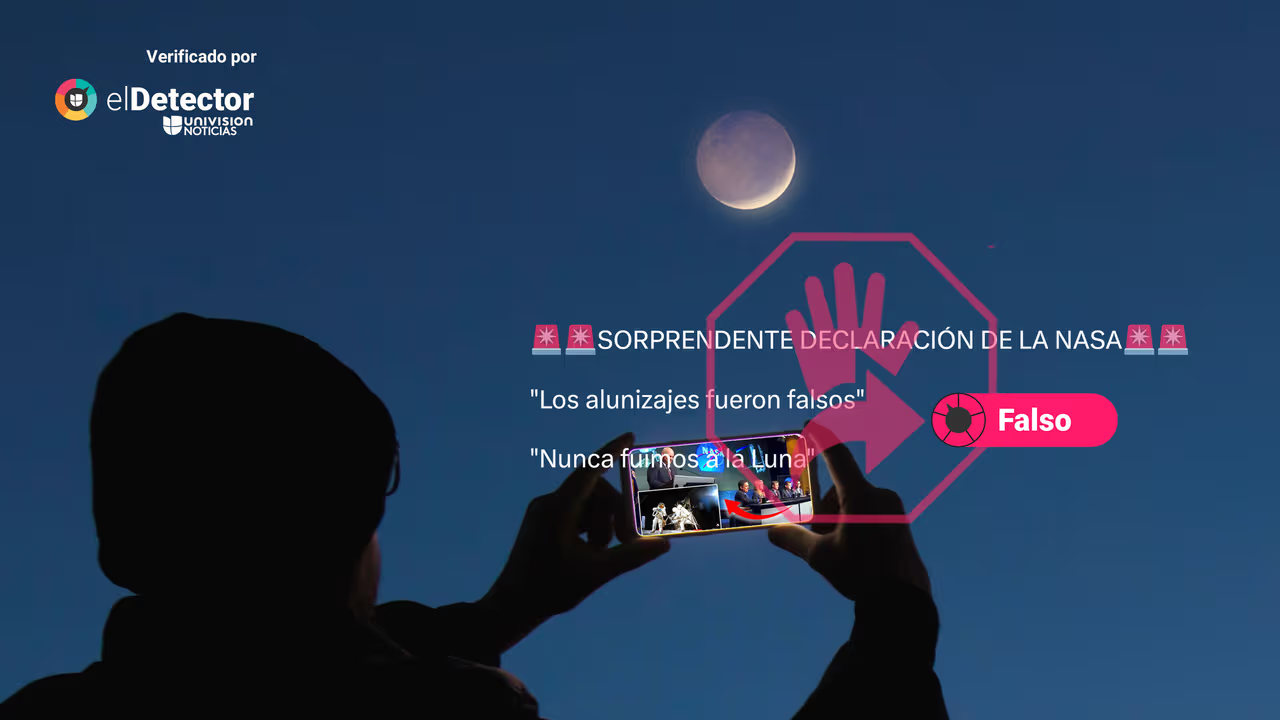
La NASA hizo una “sorprendente declaración”: "los alunizajes fueron falsos" y "nunca fuimos a la Luna".
Publisher’s rating: Falso
The claim concerned a message on Twitter asserting that NASA had made a “surprising statement” admitting the Moon landings were fabricated and that humans had never reached the Moon. The review says the tweet had been viewed more than 154,000 times and that the claim was also sent to the outlet’s WhatsApp chatbot. NASA denied having issued such a statement. The investigation searched NASA’s website for the term “alunizajes” in English and reports finding no result in which the agency admitted that it had not reached the Moon or that the landings were false. The review also says NASA’s press office replied by email that the agency had not published any document making that claim. These checks address the alleged NASA declaration directly, rather than relying only on general arguments about the feasibility of lunar travel. As further evidence against the claim that the landings never occurred, NASA’s press office described evidence from the missions: 12 astronauts went to the Moon between 1969 and 1972, and returned lunar rocks studied by scientists around the world. The review also reports that Apollo 17 crew members installed seismometers, which detected moonquakes, and that the Soviet Union tracked Apollo 11 and congratulated the United States after the first human landing. The review’s conclusion is that the alleged NASA declaration does not exist and that evidence from the missions supports that people reached the Moon.

Macro Image of a Bee !!(PHOTO)
Publisher’s rating: False
The claim concerns a close-up image shared as a macro photograph of a bee. The review says a Facebook user posted it on April 20 in the “Wonderful Nature” group with the caption “Really Cool Macro Shot of a Bee!”; it reports that the post received more than 2,000 shares and 11,000 reactions, and that the same claim also circulated on Twitter. The review’s conclusion is that the image was AI-generated, not a genuine macro photograph. To investigate the image’s provenance, the publisher says it used reverse image search and traced the picture to Adobe Stock Photos, where it was labeled “Generated with AI.” This finding links the reviewed image to a stock-image listing that identified it as AI-generated, rather than relying only on the image’s appearance. The review also compared the viral image with a bee-eye photograph by photographer Rose-Lynn Fisher, whose microscopic work is described as showing hexagonal structures in bees’ eyes. It says those hexagons were absent from the eye in the viral image. As an additional check, the publisher reports that an image detector program called Hugging Face indicated the picture was likely an artificial creation. Together, the stock listing, the described visual comparison, and the detector output support the review’s conclusion that the image was not an authentic macro shot of a bee.

Afyonkarahisar’da kaydedilen yıldırım görüntüsünün güncel olduğu iddiası
Publisher’s rating: Yanlış
By subjecting water to immense pressure and directing it through a minuscule nozzle, it can effectively cut through the hardest materials, including rocks, metals, bulletproof glass, and even diamonds
Publisher’s rating: MISLEADING
FACTLY examined a social-media video and the accompanying claim that water alone, forced through a tiny nozzle at high pressure, can cut rocks, metals, bulletproof glass and diamonds. Its central distinction is between water-only cutting and abrasive waterjet cutting. The review says pure waterjets are used for softer materials, while hard materials require abrasive particles mixed into the water stream. The review gives a pressure of about 60,000 psi (4,100 bar) for pure waterjet cutting and lists examples of softer materials it says this method can cut, including rubber, foam, textiles, paper, wood and thin metal foils. For harder materials, it explains that particles such as garnet or aluminium oxide are accelerated by the water and erode the material on impact. It identifies metals, glass and ceramics as materials cut with abrasive waterjets—not with water alone. The discussion of diamonds is qualified: the review says some advanced abrasive-jet machines can cut certain types of diamonds, while other methods, including laser cutting, are also used. Thus, its evidence does not support treating high-pressure water alone as sufficient for the full range of hard materials in the claim. The key omitted qualification is the addition of abrasives for cutting harder substances; the diamond example is also limited to certain types and advanced machines.
แมลงสาบนับล้านออกมาจากใต้พื้นดินในนครเมกกะ
Publisher’s rating: False