PeakMetrics / Fact Checks
Religion & belief fact checks
Explore claims publishers have checked about religion & belief. Read their original ratings and follow the evidence.
Search fact checks
Search by text or image3,371 published reviews in this topic

Photo collage showing spurt in Muslim population from 2010 to 2022 in Nainital
Publisher’s rating: FALSE
The collage was shared as evidence of a spurt in the Muslim population in Nainital, comparing one image said to be from 2010 with another said to be from 2022. The review finds that the images do not show the same place: it identifies the upper image as Upper Mall Road in Nainital, but the lower image as a gathering in Bangladesh. The comparison therefore cannot support the claim that the collage documents population change in Nainital. To investigate the first image, the review reports using reverse image search and checking image metadata. It found the image was of Upper Mall Road and that its metadata placed it in June 2019—not 2010. The review also notes a visible “Alka” sign and says a hotel by that name is on Upper Mall Road; an image of a nearby Domino’s outlet showed a similar view. For the second image, the review says reverse image search traced it to a 2018 article about Bishwa Ijtema, an annual Muslim gathering in Bangladesh. It describes the event as taking place on the banks of the Turag River, about 35 km from Dhaka. The review’s central finding is thus a mismatch of both location and provenance: one image is from Nainital, while the other depicts an event in Bangladesh, rather than Nainital in 2022.


Video of Muslims turning Telangana Jogulamba temple into a mosque
Publisher’s rating: MISLEADING
The claim concerns a video presented as showing Muslims turning Telangana’s Jogulamba temple into a mosque. FACTLY identifies the site in the footage as Shah Ali’s Dargah in Alampur, in Jogulamba Gadwal district—not a new mosque conversion at the Jogulamba temple. Its review says the dargah was built among the Navabrahma temples and that these temples are in the same complex as the Jogulamba temple. To investigate the video’s provenance, the review reports conducting reverse-image searches on screenshots. Those searches found the same video in a tweet by Telangana BJP MLA Raja Singh. The review says Singh’s tweet and a letter to the Archaeological Survey of India (ASI) raised concerns about non-Hindu religious structures in temple premises; neither established that Muslims were then turning the temple into a mosque. The review quotes Singh’s letter describing a dargah that had appeared “long back,” rather than reporting a new conversion. The review places the dargah within a much older local history: it dates Shah Ali’s Dargah to the 15th–17th centuries, while dating the Hindu temples to the 7th–9th centuries. It also reports that an ASI area official told FACTLY there was no new dargah construction at the Jogulamba temple. On this evidence, the video shows an existing dargah, and the claim that it depicts Muslims converting the temple into a mosque is misleading.

विविध सोशल मीडिया प्लॅटफॉर्मवर 16 सेकंदाचा व्हिडिओ खूप व्हायरल होत आहे. व्हायरल व्हिडिओमध्ये पाण्यात वसलेले शिवलिंग दिसत आहे. व्हिडिओच्या पार्श्वभूमीवर भक्तिसंगीताचाही वापर करण्यात आला आहे. सोशल मीडिया यूजर्स या व्हिडिओला वाराणसीच्या ज्ञानवापी सर्व्हेचे शिवलिंग असे वर्णन करून व्हायरल करत आहेत.
Publisher’s rating: FALSE
The claim concerns a 16-second video showing a shivling in water, shared with devotional music and described by social media users as showing a shivling found during the Gyanvapi survey in Varanasi. Vishvas News investigated that specific video and reported that it had no connection to Gyanvapi. Its account also distinguishes this video claim from the wider question of what the survey found: the review says it was not confirming or rejecting claims by either Hindu or Muslim parties about the survey’s findings. [S1]

المسيح لم يُعلِن أنه هو الله
Publisher’s rating: المسيح أعلنَ صراحةً أنه الله.
أن يسوع ليس هو ابن الله
Publisher’s rating: المسيح يسوع هو ابن الله.
ज्ञानवापी मस्जिद में शिवलिंग मिलने पर जश्न मनाते लोगों का वायरल वीडियो
Publisher’s rating: FALSE
पीएम मोदी का 'यहां भी खुदा वहां भी खुदा' कहते हुए वीडियो ज्ञानवापी मस्जिद के मामले से जुड़ा है
Publisher’s rating: FALSE

PM Modi’s speech claiming God is omnipresent in Uttar Pradesh – Modi predicting God in Gyanvapi
Publisher’s rating: MISLEADING
The post linked a 29-second clip of Narendra Modi speaking at a public gathering in Varanasi to the reported discovery of a Shivling in the Gyanvapi Mosque. In the clip, Modi uses the words “khuda” and “khudega,” which can be heard as references to God and a future discovery. The review finds, however, that this was an excerpt from his 2017 assembly-election campaign speech in Varanasi, not a prediction about Gyanvapi. To check the clip’s meaning, the review examined the speech transcript on Modi’s personal website and considered the viral excerpt alongside the surrounding remarks. It reports that Modi was paraphrasing a state MP’s satirical criticism of road conditions. The wordplay turned on “Khuda” sounding like “खुदाई” (digging); the review says Modi was discussing Varanasi’s development and the previous governments’ handling of infrastructure. The surrounding speech further points to roads, not a religious site: according to the review, Modi went on to criticize the state government for failing to repair roads after underground electric-cable work, and connected this to his earlier promise to remove hanging cables. The review therefore concludes that the clip was taken out of its original context and linked to Gyanvapi despite having been delivered years before the reported mosque developments discussed in the post.
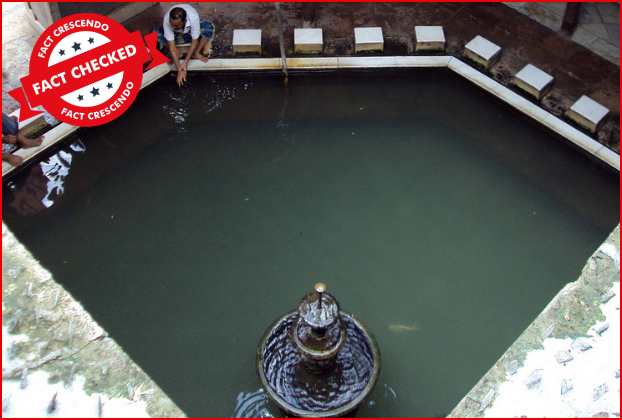
यही वो शिवलिंग है जो ज्ञानवापी मस्जिद के वुजुखाने में मिला है, दर्शन कर लीजिये।”
Publisher’s rating: False


The Ram bhajan sung by PM Modi can be heard in the video
Publisher’s rating: FALSE
The claim concerns the Ram bhajan heard in a social-media video and attributes its singing to PM Modi. FACTLY reports that it searched the internet for similar videos and found results linked to a YouTube video titled “Pujya Prembhushanji Maharaj *Bhajan * Ram Naam Ke Sabun Se Jo (Contact +916394157463)”. The review says it compared the audio by listening to that video and concluded that the audio in the posted clip was taken from a bhajan conducted by Pujya Prembhushanji Maharaj. It adds that there is no mention of PM Modi in the YouTube video. On that basis, the review concludes that Modi did not sing the bhajan heard in the posted video.

ಮುಂಬೈನ ರಸ್ತೆಯೊಂದರಲ್ಲಿ ಧ್ವನಿವರ್ಧಕಗಳನ್ನು ಬಳಸಲು ಅನುಮತಿ ನೀಡದ ಕಾರಣ ಜನರು ಆಜಾನ್ ಪಠಿಸುವ ಇತ್ತೀಚಿನ ವೀಡಿಯೊ.
Publisher’s rating: FALSE
ज्ञानवापी मस्जिद में शिवलिंग मिलने को लेकर भावुक होते मुस्लिम शख्स की है ये फोटो
Publisher’s rating: FALSE
काशी विश्वनाथ मंदिर में ज्ञानवापी की ओर मुंह किए नंदी की फोटो वायरल
Publisher’s rating: FALSE
വാരണാസിയില് ഗ്യാന്വാപി പള്ളിയുടെ പുറത്ത് ആഹ്ലാദം പ്രകടിപ്പിക്കുന്ന ഭക്തന്മാരുടെ വീഡിയോ
Publisher’s rating: FALSE

A collage of two images, in one picture one can see a Nandi idol which is being claimed that it is from Kashi Vishwanath temple in Varanasi and in second image one can see the Gyanvapi mosque.
Publisher’s rating: MISLEADING
The claim concerned a collage that presented a Nandi idol as being at the Kashi Vishwanath temple in Varanasi, alongside an image of the Gyanvapi mosque. Vishvas News reported that it investigated the collage and found the Nandi attribution misleading: the idol pictured was at Kashi Vishweshwar temple in Wai, Satara district, Maharashtra, not at the Varanasi temple. The article identifies the post as one shared by Facebook user Raja Chandra and says the collage text claimed that Nandi’s wait was over at Kashi Vishwanath Temple. To check where the image came from, the review says it separated the Nandi picture from the collage and performed a reverse image search. It found the same image on Alamy, where the caption placed the Nandi statue at Kashi Vishweshwar temple in Wai, Satara, and found another image of the idol from a different angle on Tripadvisor. The article also reports a direct confirmation: Kedar Gokhale, whose family members were trustees at the Wai temple, viewed the viral picture and confirmed the idol was on the temple premises. These checks support the review’s distinction between the two locations: the Nandi image was from Wai in Maharashtra, although the collage associated it with the Varanasi temple and Gyanvapi mosque. The article’s conclusion is specifically about the provenance of the Nandi image; the supplied text does not describe a separate investigation into the mosque image.
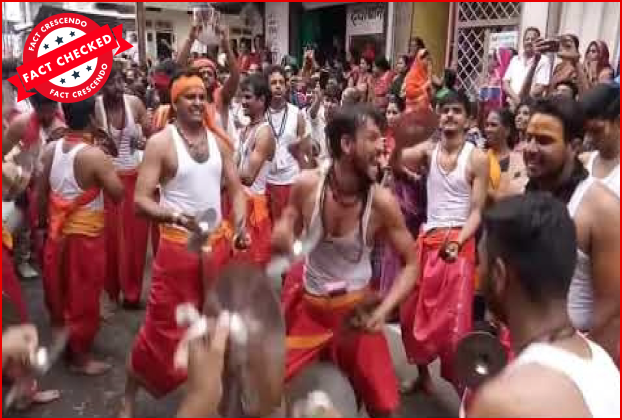
ज्ञानवापी मस्जिद में शिवलिंग मिलने की खुशी में वाराणसी में लोग जश्न मना रहे है
Publisher’s rating: False