PeakMetrics / Fact Checks
Religion & belief fact checks
Explore claims publishers have checked about religion & belief. Read their original ratings and follow the evidence.
Search fact checks
Search by text or image3,371 published reviews in this topic

అయోధ్యలో నిర్మించిన దైవిక కూడలి – ఇప్పుడు జై శ్రీ రామ్ అనండి
Publisher’s rating: FALSE
The claim attached to the viral photo said that a junction decorated with a large mace, bow and arrow had been built in Ayodhya. Vishvas News examined whether the pictured junction was actually there. Its conclusion was that the photo showed Gada Circle in Vadodara, Gujarat, rather than a junction in Ayodhya, Uttar Pradesh. The review describes a reverse-image search that led to the photo on Dreamstime, where it was identified as Gada Circle in Vadodara. It also found the image on Pinterest with a Vadodara location attribution. The investigators then used Google Street View to locate Vadodara’s Gada Circle and said they could see the same mace, bow and arrow sculpture there. These steps connect the image in the post to a specific location outside Ayodhya. As another check, the review says it contacted Rama Sharan, an Ayodhya reporter for Dainik Jagran, who said there was no similar junction in Ayodhya. The investigators also searched for images of such a junction in Ayodhya and reported finding none. Taken together, the image search, Street View comparison and local reporter’s statement support the conclusion that the photo was miscaptioned as showing a newly built Ayodhya junction.
Poster dengan kutipan yang berisi peringatan bagi warga keturunan Arab di Indonesia yang diklaim bersumber dari Gus Mus
Publisher’s rating: Keliru

Claim: This Muslims praying picture not related with Delhi farmer protest
Publisher’s rating: False
The claim concerned a photograph circulated as showing Muslims praying amid the Delhi farmers’ protest, with Sikhs standing behind them. The post used the image to suggest that Muslims were involved in the protest. Fact Crescendo says it investigated when and where the photograph was taken, rather than treating the social-media caption as established context. The review describes uploading the image to a reverse-image search. It says that search found the same photograph in news reports from May 2020, identifying the setting as a gurdwara in Malerkotla, Punjab. The reports described Muslims being allowed to hold Ramadan prayers there during the COVID-19 lockdown. The review also says the image was claimed by The Tribune as its photograph. That provenance contradicts the claim that the picture shows prayers during the Delhi farmers’ protest: the review identifies it as a Ramadan image from Punjab in May 2020. It also notes that India’s farm laws were passed in September 2020, after the photograph had appeared in May. The image therefore predates the events it was said to depict.

Muslim man disguised as a sikh person for farmers protest
Publisher’s rating: FALSE
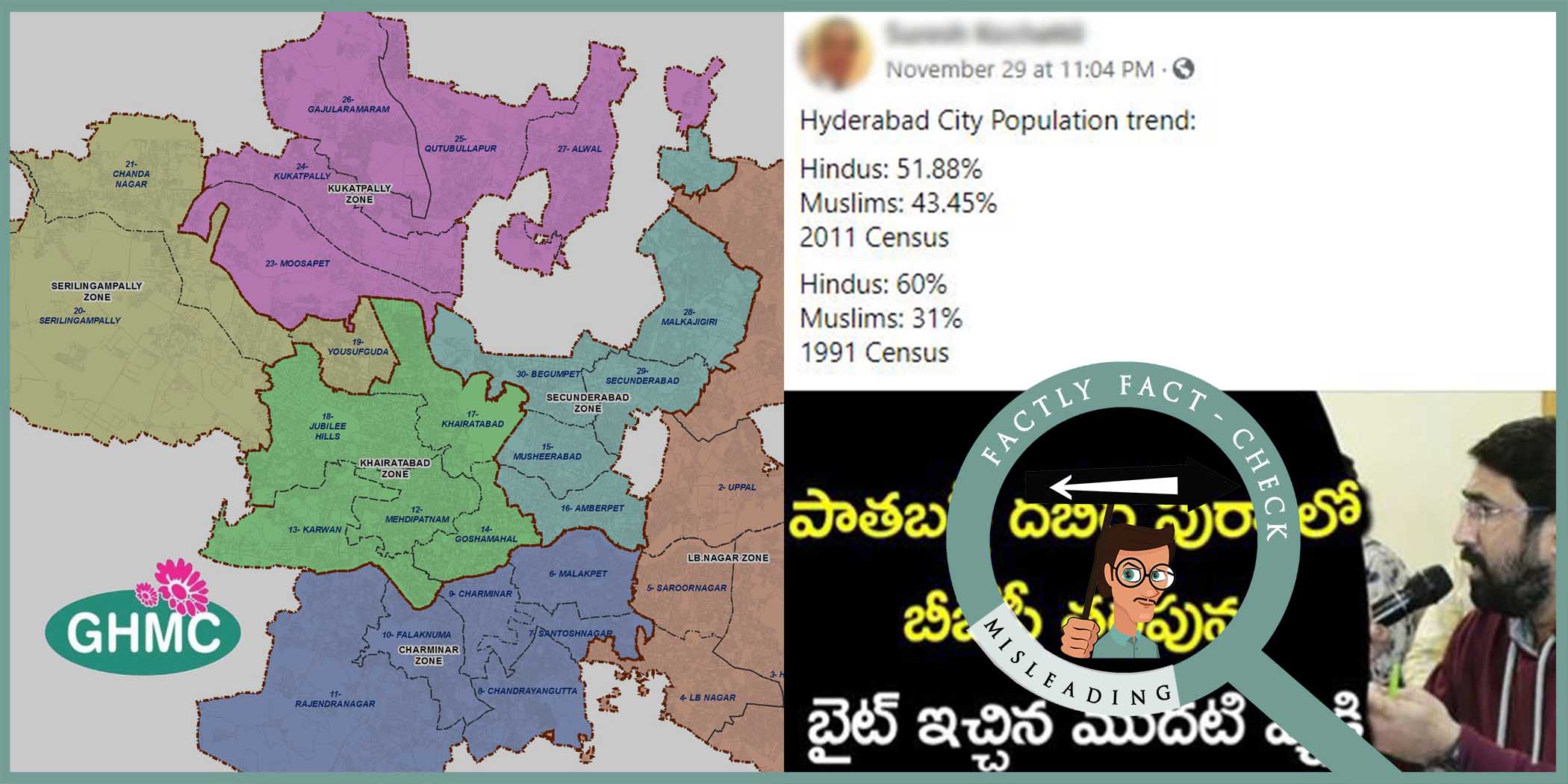
While the Muslim population in the Hyderabad City has increased from 31% (1991 Census) to 43.45% (2011 Census), the Hindu Population has decreased from 60% (1991 Census) to 51.88% (2011 Census)
Publisher’s rating: MISLEADING
The claim compares Muslim and Hindu population shares in “Hyderabad City,” alleging that the Muslim share rose from 31% in 1991 to 43.45% in 2011 while the Hindu share fell from 60% to 51.88%. FACTLY’s review finds that the figures do not describe one consistent area or accurately represent the cited 1991 data. It says the 2011 percentages in the claim are for Hyderabad District, not the Greater Hyderabad Municipal Corporation (GHMC), which the review identifies with Hyderabad City for this comparison. It also reports that the Muslim share in Hyderabad District in 1991 was about 39%, rather than 31%. The review checked the figures against census data. For GHMC, it reports that the 2011 Census figures were 64.93% Hindu and 30.13% Muslim—not the claimed 51.88% and 43.45%. The review further explains why the district and municipal figures cannot simply be substituted for each other: GHMC spans parts of four districts, so Hyderabad District alone does not represent the whole municipal area. There is also a historical comparability limitation. According to the review, GHMC in its existing form was established only in the 2000s, so data for the exact same area are not available for earlier comparison. Thus, the claim’s 1991 and 2011 percentages do not establish the stated change in the population of the same Hyderabad City area.
Facebook user Soso Jajanidze published a post accompanied by the photo of Matt Hancock, British Secretary of State for Health and Social Care, wearing a face mask with an inscription “666 NWO.” Soso Jajanidze claims in his post that anti-Christian forces do not hide their faces that is confirmed by the British Health Minister’s face mask depicting the Mark of the Anti-Christ Beast 666 and a Latin abbreviation NWO, meaning a Zionist-Masonic ideological term “New World Order.”
Publisher’s rating: The photo has been doctored. Namely, an authentic inscription on the mask has been changed in the photoshopped image. In fact, the British Health Minister calls on citizens to wear masks to prevent the spread of COVID-19. The authentic inscription calls for protecting the National Health System (NHS).

Attracting the attention of the world. Panchavarnswamy Temple is located in Tamil Nadu, India. According to archaeologists, the temple is about 2000 years old. Statues of bicycles, dressed in astronauts and cell phones are carved on the walls of the temple. Modern science says that the bicycle was invented by Macmillan in Europe 200 years ago. Panchavarnasamy Temple is a famous Shiva temple. It is located in Uraiyur, a suburb of Tiruchirappalli. It is believed that Shiva depicts five different colours (panchaputhas), hence the name Panchavarnasamy. Panchavarnasamy is a famous place where the 7th century Tamil Hindu vegetarian spiritual works were sung by Thevaram (Nayanars).
Publisher’s rating: Fake

ముస్లిం అబ్బాయిలు ముస్లిమేతర అమ్మాయిలను పెళ్ళి చేసుకోవడంపై నిషేధం విధించిన రష్యా
Publisher’s rating: FALSE

இது பூரி ஜகந்நாதர் ஆலயத்திலிருந்து எடுக்கப்பட்ட சாலிகிராம். நம் பூமியில் பெருந்நோய்த்தொற்று ஏற்படும்போதெல்லாம் இது வெளியே எடுக்கப்படுகிறது. இதற்குமுன் இது 1920 ஆம் ஆண்டில் வெளியே எடுக்கப்பட்டது, தற்போது 2020 ஆம் ஆண்டில் வெளியே எடுக்கப்பட்டுள்ளது
Publisher’s rating: FALSE
The viral post claimed that a Saligram from the Jagannath Temple in Puri is taken out whenever a pandemic affects the world, and that it had last been brought out in 1920 before being brought out again in 2020. The review examined the claim attached to a Facebook photo and a similar video, rather than treating the post’s caption as proof of what the images depicted. The investigation searched online for reports of the event and found a New Indian Express report published on March 30, 2020, about a temple deity being brought out to alleviate disease. The review noted that the report did not mention a Saligram. It also checked the post’s reference to a 1920 pandemic against a CDC statement about the 1918 H1N1 influenza pandemic, known as Spanish flu; that historical comparison does not itself establish that a Saligram was taken out in either year. The most direct evidence came from the temple priest the review contacted, Biswabasu Binayakdas Mohapatra. He said the photo-and-video claim was false, explained that a Saligram is not brought out during a pandemic, and identified the deity brought out on such an occasion as Lord Nrusingha. The review therefore found that the post misidentified the temple object and did not substantiate its claimed 1920 and 2020 history.

এজন ব্যক্তিক ৰাজপথত নামাজ পঢ়াত সুবিধা কৰি দি গুজৰাটত এজাক সিংহই বাট আগুছি ধৰিছে
Publisher’s rating: সালসলনি কৰা হৈছে
இந்து அறநிலயத்துறை சம்பளம் கொடுப்பதில்லை. கிராமத்தில் தட்டு வருமானம் இல்லை. இறைவனும் கண்டுகொள்ளவில்லை. வயது முதுமை. பெரிய கோவில்களில் நடப்பதும் பெரிய பெரிய படிகளில் ஏறி இறங்குவதும் முன்போல் முடியவில்லை. ஆனால் தான் வராவிட்டால் பகவான் பட்டினி கிடப்பானோ என்ற கவலை. அதனால் தான் இருக்கும்வரை பகவான் கைவிட்டாலும் பகவானை கைவிடுவதில்லை என்று வாழும் மகான்கள் பலர்.
Publisher’s rating: Misleading
Joe Biden mengatakan orang Kristen melanggar hak LGBT hanya dengan mereka ada
Publisher’s rating: Keliru
The Hindu Charity Department does not pay salaries. There is no income in the village. The Lord did not see either. Old age. Walking in the big temples and climbing up and down the big big steps was not possible as before. But he worries that God will starve him if he does not come. That is why there are many saints who say that even if the lord give up, they will not give up the Lord.
Publisher’s rating: Fake
Miracle at Natarajar Temple – Rainy scene on the statue
Publisher’s rating: Fake

అయోధ్యలో దీపావళి పండగ సందర్భంగా వందలాది భక్తులు రోడ్డు పక్కన దీపాలతో నిలిచున్న దృశ్యం
Publisher’s rating: FALSE

‘ಖುರಾನ್ ಎಲ್ಲ ದುಷ್ಟತನಗಳ ಮೂಲ’ ಎಂದು ಆರೋಪಿಸುತ್ತಿರುವ ಫ್ರೆಂಚ್ ಸಚಿವರು.
Publisher’s rating: FALSE
Jumlah mualaf di Prancis naik dua kali lipat usai Presiden Emmanuel Macron disebut menghina Islam
Publisher’s rating: Keliru