PeakMetrics / Fact Checks
Religion & belief fact checks
Explore claims publishers have checked about religion & belief. Read their original ratings and follow the evidence.
Search fact checks
Search by text or image3,371 published reviews in this topic

BÍBLIA SERÁ PROIBIDA NO BRASIL. Bolsonaro faz denúncia sobre o que o STF irá fazer
Publisher’s rating: Falso

Video of Muslims offering Namaz on the streets of France
Publisher’s rating: FALSE
The claim concerns a video presented as showing Muslims offering Namaz on the streets of France. FACTLY reports that the footage instead shows thousands of Muslims praying outside the Moscow Cathedral Mosque in Russia, during Eid prayers. The review says Muslims in Moscow gather for prayers outside the mosque during Ramzan, but it could not establish the exact date and time when this particular video was recorded. To check the footage, the review describes conducting reverse image searches on screenshots from the social-media post. It found the same video in a 3 May 2022 tweet by journalist Hammoud Al-Tuqi, who identified it as Eid Al-Fitr prayers in Moscow, and in Turkish news coverage that likewise located the prayers in Moscow. The review also says Benjamin Strik, director of the Centre for Information Resilience, confirmed the mosque’s identity. The review further reports comparing images of Moscow Cathedral Mosque with the mosque visible in the video. It concludes that the footage shows prayers outside that mosque in Moscow, not France. Although the precise recording date and time remained unverified, the reported location evidence directly contradicts the claim’s French setting.

या व्हिडिओमध्ये चौरस्त्याच्या चारही बाजूला हिरवा इस्लामी ध्वज दिसतो. राजस्थानमधील जोधपूर येथील जालोरी गेट येथे एका विशिष्ट समुदायाच्या लोकांनी स्वातंत्र्यसैनिक बालमुकुंद बिस्सा जी यांच्या पुतळ्यावरून तिरंगा ध्वज काढून इस्लामी ध्वज लावल्याचा दावा करत सोशल मीडिया यूजर्स हा व्हिडिओ व्हायरल करत आहेत.
Publisher’s rating: MISLEADING
The claim concerned a 45-second video showing green flags at a Jodhpur intersection. Social media users said that people from a particular community had removed the Indian tricolour from the statue of freedom fighter Bal Mukund Bissa at Jallori Gate and raised an Islamic flag instead. Vishvas News concluded that this account was misleading: the dispute was over saffron and green flags, and the report says there had not previously been a tricolour at the statue that could have been removed. The review describes several checks. It searched Google for reports of a tricolour being removed and says it found none. It then cited a Dainik Jagran report about a violent clash at the Bal Mukund Bissa Circle over an Islamic-symbol flag being raised instead of a saffron flag. The review also refers to an ABP News report uploaded on 3 May, which said the administration installed a tricolour at Jallori Gate after the flag-related disturbance. To check the site-specific allegation, Vishvas News says it contacted the Jodhpur police control room, which stated that there had been no permanent flag beside the statue and that a tricolour was installed there after the violence. Dainik Jagran reporter Ranjan Dave likewise told the outlet that a tricolour had not previously been flown at the intersection and that the dispute had been about saffron and green flags. These details support the review’s conclusion: the video was being presented as showing the replacement of an existing national flag, but the investigation found that the tricolour was put up afterward.

স্যোশাল মিডিয়াতে একটি ভিডিও শেয়ার করে দাবী করা হচ্ছে যে, মুসলিম সম্প্রদায়ের কিছু লোক ধীরে ধীরে নদীতে নামাজ পড়া শুরু করে দিয়েছে, যাতে আস্তে আস্তে নদী এবং তার আশেপাশের এলাকা কব্জা করতে পারে। বিশ্বাস নিউজের তদন্তে ভাইরাল হওয়া দাবিটি ভুয়ো প্রমাণিত হয়েছে।
Publisher’s rating: MISLEADING

‘As per article 330 & 342 of the Indian Constitution SC/ST/OBC’s are not Hindu’s but are natives of India’
Publisher’s rating: FALSE
The post asserted that Articles 330 and 342 of the Indian Constitution establish that SC/ST/OBC people are not Hindu but are natives of India. FACTLY’s review examined what those two articles say and whether the Constitution contains the claimed religious exclusion. It reports that Article 330 provides for reserved seats for Scheduled Castes and Scheduled Tribes in the House of the People, while Article 342 concerns specifying tribes or tribal communities as Scheduled Tribes for constitutional purposes. The review says neither article contains a clause declaring SCs, STs or OBCs not to be Hindu. [S1] The review also considered the claim in light of Constituent Assembly debates. It says those debates addressed matters such as religious freedom and rights, rather than deciding which castes constitute the Hindu religion. In a debate concerning provisions for inclusion in or exclusion from the lists of Scheduled Castes and Scheduled Tribes, the review says assembly members referred to Scheduled Castes as Hindus. This evidence contradicts the post’s assertion that the cited articles establish the claimed religious distinction. [S1] The review’s conclusion is specifically about the claim that Articles 330 and 342 establish that these groups are not Hindu. The excerpts do not provide support for the separate “natives of India” wording, nor do they establish a general legal definition of the religious identity of every person in the groups mentioned. [S1]

मुस्लिम लोगों ने मिलकर इस हिंदू आमदी को पीटा।
Publisher’s rating: False

इस रमजान में मुंबई में सड़क पर नमाज अदा करते मुस्लिमों की फोटो वायरल
Publisher’s rating: FALSE
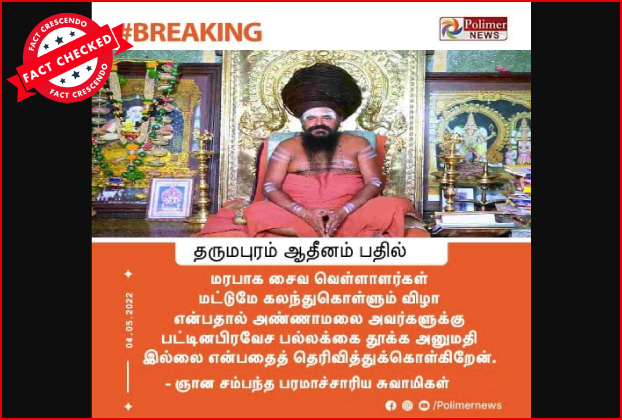
Claim: Dharmapuram adheenam not made this comment on annamalai
Publisher’s rating: FALSE
खाने के लिए आपस में लड़ते मुस्लिमों का वीडियो वायरल
Publisher’s rating: FALSE

The day when Prophet Mohammed consummated with his minor wife, Ayesha, is celebrated as Eid
Publisher’s rating: MISLEADING
The post linked Eid to an alleged event in Prophet Muhammad’s marriage to Aisha, and further claimed that the month of fasting before Eid supported a fast she was forced to undertake. FACTLY’s review says it could find no credible evidence connecting the alleged consummation to the celebration of Eid. Its account instead describes Eid al-Fitr as marking the end of Ramzan, the month of fasting.

Muslims still cannot accurately state the dates of their festivals
Publisher’s rating: MISLEADING
FACTLY investigated a social-media post contrasting Muslims’ practice of looking for the moon with a claim that Hindus could know festival dates 100 years in advance. Its review says the post’s broader assertion—that Muslims still cannot accurately state festival dates—overlooks both the calendar basis for those dates and the availability of astronomical calculations. The review explains that the Islamic calendar follows lunar cycles and that Ramadan moves earlier by about 11 days each year relative to the Gregorian calendar. The review distinguishes the beginning of a lunar month from the ability to calculate when the new moon occurs. It says precise scientific calculations can identify that timing, while some Muslim scholars nevertheless prefer to wait until the crescent is visible, citing a saying attributed to Prophet Mohammed. It also notes that clouds and difficulty seeing the moon can lead groups to begin fasting on different days. These qualifications describe a continuing difference in religious practice, not an inability to calculate dates. FACTLY further says Muslims determine dates for other festivals, including Muharram. It contrasts this with Hindu festivals, which use a lunisolar calendar and can vary by region and calendar tradition. On that evidence, the review concludes that the claim is misleading: it presents moon sighting as a blanket inability to state dates, while the review describes calculated lunar dates, differing scholarly practices, and festival-specific methods.
ബംഗാളില് തീവണ്ടി കാരണം നിസ്കാരം തടസപ്പെട്ടപ്പോള് മുസ്ലിങ്ങള് റെയില്വേ സ്റ്റേഷന് ആക്രമിച്ചു
Publisher’s rating: MISLEADING

ಕರ್ನಾಟಕದ ಮಂಗಳೂರಿನಲ್ಲಿ ಈಗ ಮಸೀದಿಯಾಗಿ ಪರಿವರ್ತನೆಯಾಗಿರುವ ಪುರಾತನ ದೇವಾಲಯದ ವಿಡಿಯೋ.
Publisher’s rating: FALSE
തമിഴ്നാട്-തെലങ്കാന സര്ക്കാരുകള് ഇത്തവണ റംസാന് കിറ്റ് വിതരണം നടത്തി
Publisher’s rating: FALSE

අරගල භූමියේදී බෞද්ධ ස්වාමින් වහන්සේ නමකට කතෝලික පියතුමෙකුගෙන් ප්රහාරයක් ?
Publisher’s rating: Misleading



तिरुपति बालाजी मंदिर के पुजारी ने कहा - मंदिर का पैसा हिंदुओं पर नहीं मुस्लिम और ईसाईयों पर खर्च हो रहा
Publisher’s rating: FALSE