PeakMetrics / Fact Checks
Politics & government fact checks
Explore claims publishers have checked about politics & government. Read their original ratings and follow the evidence.
Search fact checks
Search by text or image12,754 published reviews in this topic
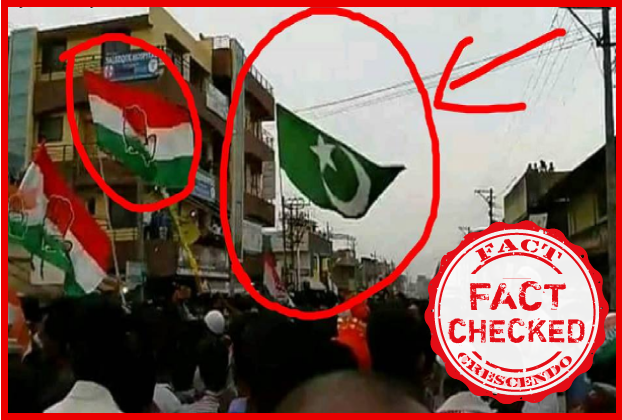
Claim by Facebook user: Pakistan flags waved during Congress rally
Publisher’s rating: Fact Crescendo Rating: False.

交通新規定 乘客不得由左後門上下車
Publisher’s rating: 部分錯誤
The claim says a new traffic rule bars passengers from getting out through a car’s left rear door. The review traced the circulating message to a news website report from 2011 and checked the relevant rule with Taiwan’s Directorate General of Highways. The agency said the rule requiring people to board and alight from the right-side door had already been in force since 2007; it allows use of the left-side door where parking on the left is permitted on a one-way street. Thus, the left-side restriction was not a newly introduced, absolute prohibition as the message implied. The review also examined the message’s claim that, if a passenger opened a left-side door and hit a motorcycle, only the car’s driver would be prosecuted and fined. The cited Road Traffic Management and Penalty Act provision applies when a driver or passenger fails to open or close a door as required and this causes an accident. The review says the fine is NT$1,200 to NT$3,600, so responsibility is not invariably limited to the driver. It notes an exception: a taxi driver or hired driver who has fulfilled the duty to inform passengers may leave the passenger subject to the penalty. Overall, the circulated message combines a real right-side boarding rule with misleading claims about its novelty, the one-way-street exception, and who may be penalized after a door-related crash.

Two posts claim that Rahul Gandhi's birthday was being celebrated in style while ISRO was facing hardships.
Publisher’s rating: FALSE
उमा भारती ने प्रधानमंत्री मोदी को बताया ‘विनाशपुरुष’
Publisher’s rating: False

Agreement on real time information sharing with Switzerland
Publisher’s rating: TRUE
George Washington said “A free people ought not only be armed and disciplined, but they should have sufficient arms and ammunition to maintain a status of independence from any who might attempt to abuse them, which would include their own government.”
Publisher’s rating: False

Il vero problema per il Paese e per gli italiani è che sono state bloccate e sono tutt’ora bloccate 28 grandi opere e 600 opere tra grandi e minori
Publisher’s rating: C'eri quasi
The claim was made by Anna Maria Bernini, Forza Italia’s Senate group leader, in a Facebook video posted on March 21. She said that 28 major public works and 600 works of various sizes were still blocked. Pagella Politica examined those figures against data from the Ministry of Infrastructure and Transport (Mit) and the construction-industry association Ance, which supplied figures from its Sblocca Cantieri portal. The review explains that “blocked” or “incomplete” works can include projects left unfinished for varied reasons, such as lack of funding, technical issues, or the contractor’s failure. The figure of about 600 works was broadly supported: Ance’s portal counted approximately 600 incomplete works in Italy in March 2019. Separately, the Mit’s latest published update, dated July 5, 2018, counted 647 incomplete works as of December 31, 2017, down from 752 a year earlier. These figures use different dates and sources, so they are not identical snapshots. The claim’s major-works figure was out of date. Ance defined major works as projects worth more than €100 million and reported 49 incomplete major works as of March 26, 2019, rather than 28. The review traces the 28 figure to a December 2018 newspaper report based on Ance data: it listed 27 major projects that were stopped, uncertain, or frozen. Adding the Turin–Lyon rail link could produce 28, but the review says that link should not count as blocked because tenders for the base tunnel had begun. The review’s verdict was “C’eri quasi”: the approximate total of 600 works was right, but the number of major works was not current.

Modi on the cover of TIME magazine. The cartoon represents Modi feeding Media with donations to keep them in line.
Publisher’s rating: FALSE
The review examines a shared image claiming that Modi appeared on a TIME magazine cover in a cartoon depicting him feeding media with donations to keep them in line. It reports that the image was edited: the cover’s original cartoon showed a woman, whose face was replaced with Modi’s in the circulated image. To investigate the image, the review says it used Google Reverse Image search to find the original cartoon, then searched for a TIME cover about corporate campaign donations and found the original Los Angeles Times article. It identifies the cartoon as a 2012 work by Horsey. This evidence addresses the image’s provenance and the specific alteration described in the post; the review does not provide further details about the original cover’s publication or the edit’s creator.

“Si al PSOE le dan los números para gobernar con Cs, ya lo ha dicho Ábalos, siempre con Cs”
Publisher’s rating: Falso
Rahul on the cover of TIME magazine. The cartoon represents Rahul feeding Pakistan by giving donations to terrorist organizations.
Publisher’s rating: FALSE
The claim concerns a circulated image said to show Rahul on a TIME magazine cover, with a cartoon depicting him feeding Pakistan by donating to terrorist organizations. FACTLY reports that the image was edited: the original cover had a cartoon of a woman, and Rahul’s face was substituted in the shared image. The review therefore concludes that the purported cover is not authentic. The investigation describes using Google reverse-image search on the shared image. It says the search results revealed the original cartoon, then reports that a Google search for “Time cover on corporate campaign donations” led to the original Los Angeles Times article. The review identifies the cartoon as drawn by Horsey in 2012 for the Los Angeles Times. This provenance supports the central finding: the image being presented as a TIME cover with Rahul was an altered version of an earlier cartoon, not the original cover.

“Vox defiende al mundo de la caza (…) Los demás partidos, no”
Publisher’s rating: Falso

On March 23, 2019, the Facebook page Meanwhile in the Philippines posted what is supposedly a screenshot of a Manila Bulletin report published on March 21, 2019 with the byline of Tonyo Cruz. The headline says, “Robredo to pass a law to put netizens behind bars for bashing her.”
Publisher’s rating: The Manila Bulletin denied publishing a story with this headline. The publication's online news site has released a statement labeling the post a "hoax."
लालू, सोनिया सहित मायावती और मुलायम सिंह के पास अरबों रुपये की संपत्ति कहाँ से आई
Publisher’s rating: FALSE
South Africa’s President Cyril Ramaphosa ‘dancing like nyaope boys’
Publisher’s rating: Fake

Israel’s Prime Minister Benjamin Netanyahu said Biafra would take over from Nigeria as the giant of Africa
Publisher’s rating: False
Photo of convoy is President Uhuru Kenyatta going for haircut.
Publisher’s rating: False

“Los partidos que llevaban en sus programas la salida de la UE han reformulado esa intención”
Publisher’s rating: Verdad a medias
The statement concerned parties that had advocated leaving the European Union and whether they had subsequently reformulated that intention. The review says it consulted several experts and found examples of parties moderating or reframing their positions, but not a general pattern applying to every party. It also notes that rising support for EU membership was attributed to more than Brexit alone: expert Pol Morillas pointed to the growth of Eurosceptic parties as another factor. France provided a qualified example. After the 2017 presidential election, Marine Le Pen’s party became less explicit about leaving the EU, and one researcher considered it fair to say the party had set that proposal aside. But the review says the party retained a promise to leave the euro, which the researcher described as effectively entailing a French exit from the EU under the applicable treaties. He cautioned that setting aside EU withdrawal did not by itself show that the party had moderated its anti-European ideology. The review also identifies parties that had not abandoned withdrawal proposals. It reports that the UK Independence Party continued to describe itself as supporting a complete departure, while Germany’s AfD retained a conditional proposal for Germany to withdraw or for the EU to be dissolved if fundamental reforms could not be achieved. In the Netherlands, the FVD’s programme called for referendums on EU membership and related issues, and the PVV continued to advocate Dutch independence from the EU. These counterexamples mean the broad statement was not true of all parties, even though the review found genuine cases of reformulation.