PeakMetrics / Fact Checks
Politics & government fact checks
Explore claims publishers have checked about politics & government. Read their original ratings and follow the evidence.
Search fact checks
Search by text or image12,754 published reviews in this topic

A photo of the Civil Secretariat building in J&K's Srinagar claims that the flag of J&K has been taken off the building.
Publisher’s rating: FALSE
The claim concerned a collage of two photos of Srinagar’s Civil Secretariat: one appeared to show both the Indian and Jammu and Kashmir flags on the building, while the other appeared to show only the Indian flag. The collage was circulated after the Centre’s announcement on Article 370, with the accompanying claim that Jammu and Kashmir’s flag had been taken down. The review reports that this interpretation was false: the image showing only the Indian flag had been edited. The review describes a visual comparison of the photos. It says the same cars appeared in the same places, the same people stood in the same positions, and the camera angle was identical. Those matching details led the review to conclude that the original building photo had been altered to create the apparent difference in flags, rather than documenting a separate scene in which the flag had been removed. The review also points to video released by the news agency ANI on 7 August. It says the video showed both flags still flying atop the Civil Secretariat, directly contradicting the collage’s implication that the Jammu and Kashmir flag had been taken down. It further notes that ANI released photos of the building. The excerpt does not provide the images or describe their capture circumstances, so the specific provenance of the collage’s photos cannot be established from the supplied text.
Nairobi Governor Mike Sonko has been ranked as the best performing governor by CoRG
Publisher’s rating: False.
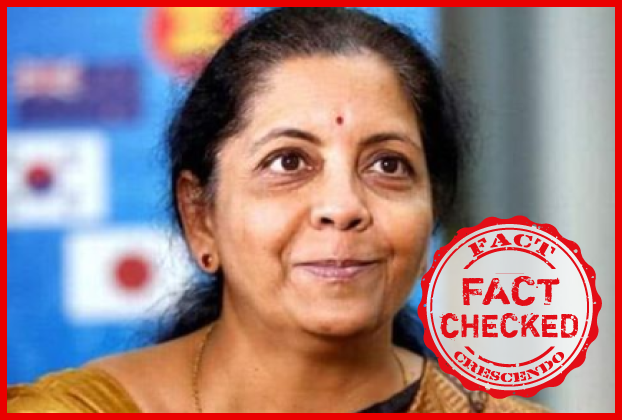
Claim: Who is Indias first woman defence and finance minister
Publisher’s rating: MIXTURE
The review examines a Facebook post that congratulated Nirmala Sitharaman as “இந்தியாவின் முதல் பெண் பாதுகாப்பு துறை அமைச்சர்” and “இந்தியாவின் முதல் பெண் நிதி அமைச்சர்” (“India’s first woman defence minister” and “India’s first woman finance minister”). It says the post was published by Agri Vel Murugan on May 31, 2019, and that the claim was being widely shared as true. To check the claim, the review says it began searching for who had first held the finance-minister position. It reports finding that former prime minister Indira Gandhi held that distinction, and that she served as finance minister from 1970 to 1971 and presented a budget. It also says Indira Gandhi, not Sitharaman, had previously held the defence portfolio, listing periods in 1975, 1980 and 1982. The excerpt mentions consulting linked news reports, but does not reproduce their contents; those details are therefore reported here as the review’s findings. The review’s qualification is that Indira Gandhi held these portfolios while serving as prime minister, as additional responsibilities, whereas Sitharaman served as a full-time minister responsible for each portfolio. It concludes that Sitharaman could be described as the first woman full-time minister in finance and defence, but not as the first woman minister in either area. On that distinction, the Facebook post was not wholly true.

சற்றுமுன் கிடைத்த தகவல்படி, ஜம்மு-காஷ்மீர் கவர்னராக விஜயகுமார் ஐபிஎஸ் வாழ்த்துவோம்.
Publisher’s rating: Fake

RTI laws are not applicable in Kashmir.
Publisher’s rating: MISLEADING
The review assesses the claim in the context of Jammu and Kashmir’s special constitutional status, but its finding about RTI is specific: the state had its own Right to Information law, and the central RTI law applied to Central Government offices in the state. Those two points mean it would be inaccurate to say that RTI laws did not apply there at all. The review’s conclusion is qualified by the distinction between the state’s own law and the central law’s stated application to Central Government offices. The excerpt does not give the state law’s name, provisions, or further details about how the two laws operated. It therefore supports rejecting the blanket claim, but does not establish that the central law applied to every office or authority in Jammu and Kashmir.

Claim: Ladakh MP Tsering Namgyal argued with Kanimozhi
Publisher’s rating: FALSE

President Ram Nath Kovind has said ‘now there is no need for reservations; to progress, there is no necessity for reservations’
Publisher’s rating: FALSE
FACTLY examined a Facebook post that paired a newspaper clip with the claim that President Ram Nath Kovind had said “now there is no need for reservations” and an image attributing to him the statement “to progress, there is no necessity of reservations.” The review’s conclusion is that Kovind did not make either statement: it reports that it found no credible source authenticating them and that the newspaper clip was digitally created. The review describes several checks. It searched for the clip, which was dated December 16, 2017, but found no matching report. It also searched for supporting information about the alleged statements and found none. Separately, it traced the photograph used in the post by cropping it and conducting a reverse image search. That search located the image in a YouTube video of Kovind addressing Andhra University in Visakhapatnam on December 7, 2017; according to the review, he did not make the attributed statements in that video. The evidence thus challenges both the clip’s authenticity and the attribution attached to the image. The review notes that, given the sensitivity of the alleged remarks, it would expect major Indian newspapers and television channels to have reported them if they had been made. That is presented as supporting reasoning, while the review’s direct checks are the unsuccessful searches and its identification of the photograph’s source. It also mentions a separate 2010 position Kovind took on a reservations proposal, but that does not establish that he made the statements in this post.
“Azərbaycanda söz və mətbuat azadlığı tam təmin olunur”
Publisher’s rating: yalan
Panchayats in Kashmir do not have any powers.
Publisher’s rating: FALSE
The claim concerns whether panchayats in Jammu and Kashmir had any powers. FACTLY examined it as one of 13 claims in a social-media post explaining Jammu and Kashmir’s special status under Article 370. The review’s discussion is specific to J&K panchayats and identifies the 2018 “Jammu and Kashmir Panchayati Raj (Fourth Amendment) Act” as the legal change through which they “got powers.” This directly contradicts the absolute assertion that they had none. The review adds two details to support its conclusion: elections were held after the act was passed, and the then Union Home Minister announced that the government had increased panchayats’ financial powers in J&K. Taken together, the account describes both a legal basis for powers and subsequent elections and a reported increase in financial authority. It therefore concludes that the claim is false, rather than presenting panchayats as wholly powerless. The excerpt says FACTLY relied on an article published by The Statesman for the account of the act and the powers, but it does not provide the article’s text, quote the relevant provisions, or give details of the elections or the minister’s announcement. The conclusion can be reported from the supplied review; the excerpt does not allow independent examination of those underlying materials or establish the extent of the powers.
Hindu, Sikhs, Jains and other minorities do not get the 16% reservation provided under the Constitution
Publisher’s rating: UNVERIFIED
The review treated this as Claim 12 in a post listing claims about Jammu and Kashmir’s special status. It assessed the assertion that Hindus, Sikhs, Jains and other minorities did not receive “the 16% reservation provided under the Constitution.” The review said the Constitution did not require every state to provide reservations on the basis of religion. It also noted that some states had provided religion-based reservations, and that a proposed 12% reservation for Muslims in Telangana had yet to be implemented. Separately, it reported that the Central Government had proposed a 4.5% sub-quota for minorities within the 27% OBC reservation, which was then before the Supreme Court. Those points do not establish whether the claimed 16% reservation existed or whether the named communities received it. The review explicitly said it found no further information on this specific claim and left it unverified; its text does not provide evidence resolving the claim’s premise.

Claim arnab goswami said kill thousands after abrogation of article-370
Publisher’s rating: FALSE
CAG (Comptroller and Auditor General) of India cannot audit the documents related to J&K.
Publisher’s rating: FALSE
FACTLY examines the claim that India’s Comptroller and Auditor General (CAG) cannot audit documents related to Jammu and Kashmir as one of several assertions circulating in a post about Article 370. It identifies this as “Claim 9” and gives a direct rebuttal rather than discussing a different audit or a different jurisdiction. The review says it checked the Accountant General, J&K website, where it found that “the jurisdiction of the CAG was extended to J&K in 1958.” It also reports that “the documents related to J&K can be found on the CAG website.” Those two points address both the CAG’s authority in J&K and the availability of J&K-related documents through the CAG. On that stated evidence, the review rejects the broad claim that the CAG cannot audit J&K-related documents. The excerpt does not identify particular documents or describe a specific audit; its support is the reported jurisdictional extension and the presence of related documents on the CAG website.
Jammu and Kashmir state has separate flag.
Publisher’s rating: TRUE
The claim concerns whether Jammu and Kashmir had a separate flag under its constitutional arrangements. FACTLY’s review addresses this as one of several claims circulated in a social-media post about the region’s special status under Article 370. For this claim, the review points to the Jammu and Kashmir Constitution and reports that it contained a provision for a separate flag. It therefore concludes that the claim was accurate in the setting the review examined. The review describes its approach as assessing the claims individually. For the separate-flag claim, it identifies the state constitution as documentary support and points readers to a Frontline article for more information. The supplied excerpt does not reproduce the constitutional provision or detail the Frontline article’s evidence, so the conclusion here is limited to what FACTLY reports having found; it does not establish further details about the flag’s design, use, or later status.
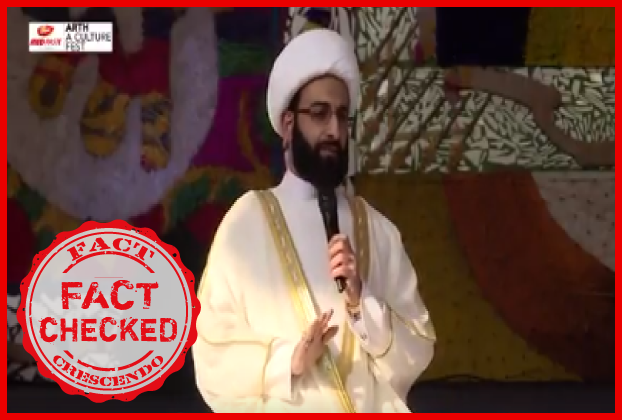
Claim: Saudi Prince Bin Salman supports India in Kashmir Issue
Publisher’s rating: FALSE
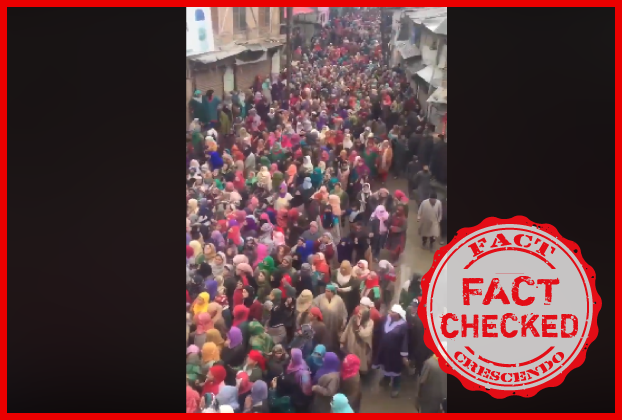
Claim: Kashmir women held a mass rally against the bifurcation
Publisher’s rating: FALSE
The claim concerned a video of women marching that was being presented as a mass rally in Kashmir on August 6, 2019, against the removal of Article 370 and the division of Jammu and Kashmir into two union territories. The review describes the accompanying post as saying the march had happened “yesterday”; it therefore treated August 6 as the alleged event date. The post also claimed that large numbers of Kashmiris were marching to free their land from India.

Imagen de Fernando Grande-Marlaska con un pin de la bandera de la república
Publisher’s rating: Falso
The claim concerns images circulated as showing Spain’s acting interior minister, Fernando Grande-Marlaska Gómez, wearing a pin with the Republican flag. Newtral says the images showed him in a black T-shirt and that the pin was being presented as the Republican flag. The review identifies the setting as Madrid’s 2019 Pride festivities and concludes that the pin’s colors belong to the LGBTI flag, not the Republican flag. To check the image, Newtral reports using a reverse-image search and finding the original image in several media outlets. It attributes that original to the Efe photo service. The review also points to other images of Grande-Marlaska from the same day, which it says show the pin’s colors more clearly, and to photographs posted by the official PSOE account from the Madrid Pride parade on 6 July 2019. Thus, the review’s stated evidence addresses both the image’s provenance and the event context: it identifies the pin as LGBTI colors and the photograph as taken at Pride, rather than establishing that he wore a Republican-flag pin.
Tenure of the Jammu and Kashmir Assembly is 6 years.
Publisher’s rating: TRUE
The review addresses the specific claim that the Jammu and Kashmir Assembly has a six-year tenure. It reports that the fact-checkers checked the Jammu and Kashmir Legislative Assembly website and found that Assembly members serve six-year terms. On that basis, the review concludes that the claim is true. The stated evidence supports the claim about members’ terms; the excerpt does not provide the website’s underlying text, a link to the relevant page, or further detail about how the term is set. The conclusion here is therefore the review’s reported finding and method, rather than an independently documented examination of the Assembly website.
Indian Supreme Court has no jurisdiction in J&K.
Publisher’s rating: FALSE
FACTLY examined the claim in a post about Jammu and Kashmir’s special status under Article 370. Its conclusion was that the Supreme Court does have jurisdiction in the state; the claim that it has none is false. The review says it checked the Jammu and Kashmir High Court website for the 1954 Constitution Application Order, which brought the state under the Supreme Court’s jurisdiction. [S1]