PeakMetrics / Fact Checks
Health & medicine fact checks
Explore claims publishers have checked about health & medicine. Read their original ratings and follow the evidence.
Search fact checks
Search by text or image13,677 published reviews in this topic


Having cold drinks immediately after eating mangoes can create a deadly chemical reaction in the stomach.
Publisher’s rating: FALSE

Cancer can be prevented by stopping your sugar intake, drinking hot lemon water and having coconut oil.
Publisher’s rating: FALSE
The Quint’s review addresses a viral message claiming cancer can be stopped by eliminating sugar and labels that claim false. The available excerpt does not include the review’s reasoning or evidence, or show how it assesses hot lemon water or coconut oil; those details cannot be established from this text.

乾燥麵條、罐頭食品、雞蛋、麥片、麵包、餅乾過了保存期限還能吃
Publisher’s rating: 部分錯誤
The Taiwan FactCheck Center examined a circulating claim that dry noodles, canned food, eggs, cereal, bread and biscuits remain edible after their date if they have been stored properly and show no obvious changes in appearance, smell, texture or color. Its conclusion is not that all six foods are safe or unsafe after the date: the review says the answer depends on the food and its storage, and that there is no general rule that any listed food must be edible—or inedible—past its date. For dry noodles, unopened cereal and biscuits, the review reports that their low water activity and suitable dry storage can mean they remain edible beyond the date, but emphasizes that product and packaging conditions differ and that risk remains without professional testing. For canned food, it says freshness declines after the date and risk may increase. For eggs, sinking in water indicates relative freshness, not a reliable decision about safety; the review recommends relying on the package date. For bread, freezing can extend storage, but does not guarantee safety because microorganisms may survive and become active after thawing and heating. The review explains why visible inspection alone cannot settle the question: food may deteriorate or support microbial growth in ways that are not readily apparent. It reports that the date is set for a product under specified storage conditions, and that consuming food within its valid date is the safer course because the food has undergone testing for that period. The viral claim therefore overstates what can be concluded from proper storage and normal appearance: some dry foods may still be edible, but none of these observations establishes that every item is safe after its date.

House to house screening of TB symptoms covering 5.5 crore population under active case finding.
Publisher’s rating: TRUE
The claim concerns the scale of tuberculosis active case finding in India: that house-to-house screening of TB symptoms covered 5.5 crore people. FACTLY examined the claim against government programme documents, including the Ministry of Health and Family Welfare’s annual report for 2017–18, a 2018 Lok Sabha response and the India TB Report of 2018. The review says the annual report described active screening among high-risk populations, while the parliamentary response reported that active case finding had reached vulnerable populations in more than 500 districts. The decisive figures in the review come from the India TB Report of 2018. It says three phases of active case finding among vulnerable populations had taken place by December 2017. In the third phase, 378 districts were covered, approximately 5.5 crore people were screened and 26,781 TB cases were diagnosed. Those figures support the claim’s stated screening total and led FACTLY to mark it true. There is a qualification to the claim’s wording: the cited programme description does not say that all screening occurred through house-to-house visits. It describes screening through house visits or visits to targeted settings, such as slums, prisons and old-age homes. Thus the evidence supports the 5.5-crore screening figure under active case finding, while the review’s account indicates that screening included more than one kind of visit.
Treatment for drug sensitive TB is provided through 4,00,000 DOT centers.
Publisher’s rating: MISLEADING
The claim concerns the number of centers providing treatment for drug-sensitive tuberculosis in India. FACTLY reports that the government infographic said treatment was provided through 4,00,000 DOT centers, and compares that figure with the Ministry of Health and Family Welfare’s 2017–18 annual report. As quoted in the review, the report describes treatment as available in every village through “4 lakh DOT centers.” This supports the number of centers, but does not establish that it was a recent expansion or achievement. The key qualification in the review is historical: it says a Lok Sabha response from 2012 had already reported close to four lakh centers—3.97 lakh, according to the article. The review therefore treats the infographic’s figure as true in itself, but misleading because it presents an existing scale of provision without the context that a nearly identical number had been reported years earlier. The review’s conclusion is specifically about that framing and timing. Its stated evidence does not show that the number of centers was false; rather, the earlier parliamentary figure undermines any implication that reaching 4,00,000 centers was a new development. The excerpt does not provide the underlying Lok Sabha response itself, so the 2012 figure is reported here as the fact-check article describes it.
500 rupees monthly nutritional support to patients for the duration of treatment through DBT.
Publisher’s rating: TRUE
FACTLY examined a claim about monthly nutritional support for tuberculosis patients, stating that the support would be ₹500 per month for the duration of treatment and delivered through direct benefit transfer (DBT). Its cited evidence includes a 2018 Lok Sabha response, which said that nutritional and financial support of ₹500 per TB patient per month had been proposed in the 2018 General Budget. FACTLY also says a government press release from March 2018 confirmed the support and that guidance on nutritional care and support for TB patients had been launched on World TB Day, 24 March 2017. The review marks the claim TRUE. Its excerpt, however, does not reproduce the press release or the guidance document, nor does it give details showing how long payments were made or how DBT was administered. The quoted parliamentary response supports the stated monthly amount as a budget proposal; the excerpt’s account of the press release provides the review’s stated confirmation of the support. Thus the review’s conclusion is clear, while the supplied text gives limited detail about implementation and duration.
Labor health spokesperson Catherine King claims one in five senior Australians have none of their own teeth and one in two suffers from moderate to severe gum disease.
Publisher’s rating: True - The checkable claims are all true.

Claim did baba ramdev undergo knee surgery in germany
Publisher’s rating: Fact Crescendo Rating FALSE

146 districts have reported improvement in institutional deliveries
Publisher’s rating: MISLEADING
The claim concerns institutional deliveries in 146 districts, in the context of government claims about the Beti Bachao Beti Padhao (BBBP) scheme. The review says a Lok Sabha response reported that 146 districts had seen improvement. It therefore accepts that the district-level improvement was reported; the issue it raises is whether that progress should be presented as an achievement of BBBP or the BJP government. The review adds that support for institutional deliveries was provided under Janani Suraksha Yojana (JSY) and Janani Shishu Suraksha Karyakaram (JSSK). It notes that JSY was introduced more than a decade before the government claim being assessed, and concludes that attributing the improvement to the BJP government’s schemes is misleading. Thus, the rating does not reject the reported figure; it qualifies the implication of the claim about who drove the improvement. As context for the programs, the review describes JSY and JSSK provisions for pregnant women delivering in public health institutions, including free antenatal check-ups, delivery and post-natal care. It also cites national increases in institutional deliveries and a decline in the Maternal Mortality Ratio. These figures provide broader background, but the excerpt does not establish that they explain the specific improvement in the 146 districts.

Hot coconut water can help in curing cancer. Mixture of coconut flakes and hot water releases an anti-cancer substance.
Publisher’s rating: FALSE


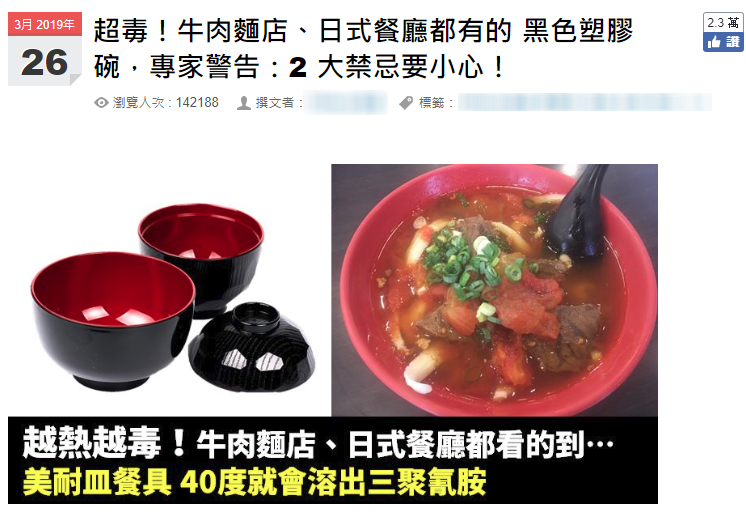
超毒!牛肉麵店、日式餐廳都有的 黑色塑膠碗...高雄醫學大學以 80 多名學生為研究對象...研究發現超過 40 ℃就會溶出三聚氰胺
Publisher’s rating: 部分錯誤

El médico cubano pegando a un paciente en una camilla
Publisher’s rating: Falso
The post combined a video of a doctor striking a patient on a hospital bed with a photograph of a different doctor, and described the pictured man as Cuban. Newtral reports that its checks found the doctor in the photograph was not the person shown in the video and was not Cuban. The review identifies him as Ariel Amaru, a Bolivian doctor associated with OncoClinic, an oncology center in La Paz. To investigate the video’s origin, Newtral says it used reverse-image search to locate earlier publications. It found Russian public television reports published on 4 July 2013 about footage of an assault at the Perm Institute of Heart Surgery. The review says the reported patient was 61 and died a week after the incident. It also cites The Moscow Times for the anesthesiologist’s name, Andrey Votyakov, and for the date the security-camera video was recorded: 21 February 2013. The review further reports that Russian public television said the doctor was dismissed. According to the account attributed to him, he had worked 36 hours straight and lost his temper after the patient insulted him. These details concern the Russian hospital incident; they do not support the post’s identification of the man in the accompanying photograph as the doctor in the video. OncoClinic’s Facebook account said Amaru was a Bolivian professional and called the circulating post false.

A medicine called Imitinef Mercilet cures blood cancer and is available for free in a hospital in Pune, Maharashtra.
Publisher’s rating: FALSE

De cada 500.000 embarazos, 100.000 acaban en una interrupción voluntaria
Publisher’s rating: Verdadero


A claim that Nigeria has surplus doctors
Publisher’s rating: This claim is False,Nigeria does not have surplus doctors as claimed.