PeakMetrics / Fact Checks
Health & medicine fact checks
Explore claims publishers have checked about health & medicine. Read their original ratings and follow the evidence.
Search fact checks
Search by text or image13,677 published reviews in this topic

Noa Pothoven, une jeune femme de 17 ans a été euthanasiée aux Pays-Bas
Publisher’s rating: FAUX.
The claim was that Noa Pothoven, a 17-year-old in the Netherlands, had been euthanized. The review says she died there, but not by euthanasia: “La jeune femme n'a pas été euthanasiée.” It reports that the Levenseindekliniek, the end-of-life care clinic to which she had applied, denied the claim and relayed a statement from her friends explaining that she had stopped eating and drinking to end her suffering. The review also says Pothoven’s request for euthanasia had been refused. It connects that request to psychological suffering following three sexual assaults, as described in her autobiography. Thus, the fact that she had sought euthanasia does not establish that it was carried out; the review distinguishes her rejected request from the circumstances of her death. The article describes how the false account spread: headlines in some media characterized her death as euthanasia, while journalist Naomi O’Leary observed that Dutch media had not reported it that way. According to the review, some English-language outlets, particularly in the United Kingdom, promoted that interpretation, which then circulated internationally. The review’s account therefore corrects the claim by identifying the clinic’s denial, the friends’ statement, and the reported refusal of Pothoven’s request.

Cool drinks were contaminated with HTC poison and their consumption led to the death of people
Publisher’s rating: FALSE
The post warned people not to drink cool drinks, alleging they were contaminated with “HTC poison” and that people had died after consuming them. The review traced some of the images accompanying the warning to a 2015 raid on a counterfeit soft-drink factory in Gujranwala, Pakistan. That provenance shows the images depicted a factory raid, not documented deaths from poisoned drinks. The review says it used Google Reverse Image Search to investigate the images. It also found that the same images had circulated in 2017 with an Ebola-related caption and had been presented as evidence of poisoned drinks in Nigeria, South Africa and other countries. The changing captions indicate that the pictures were being reused to support different claims; they do not establish that the drinks shown caused deaths. The post also included a video of a bleeding woman, presented as an effect of drinking contaminated beverages. The review identifies that video as footage from Telangana, where a woman was beaten by her husband after questioning him about an extramarital affair. Thus, the review's account identifies a different event as the video's subject, rather than a poisoning incident. The supplied excerpt does not describe evidence of deaths caused by contaminated drinks beyond these image and video checks.
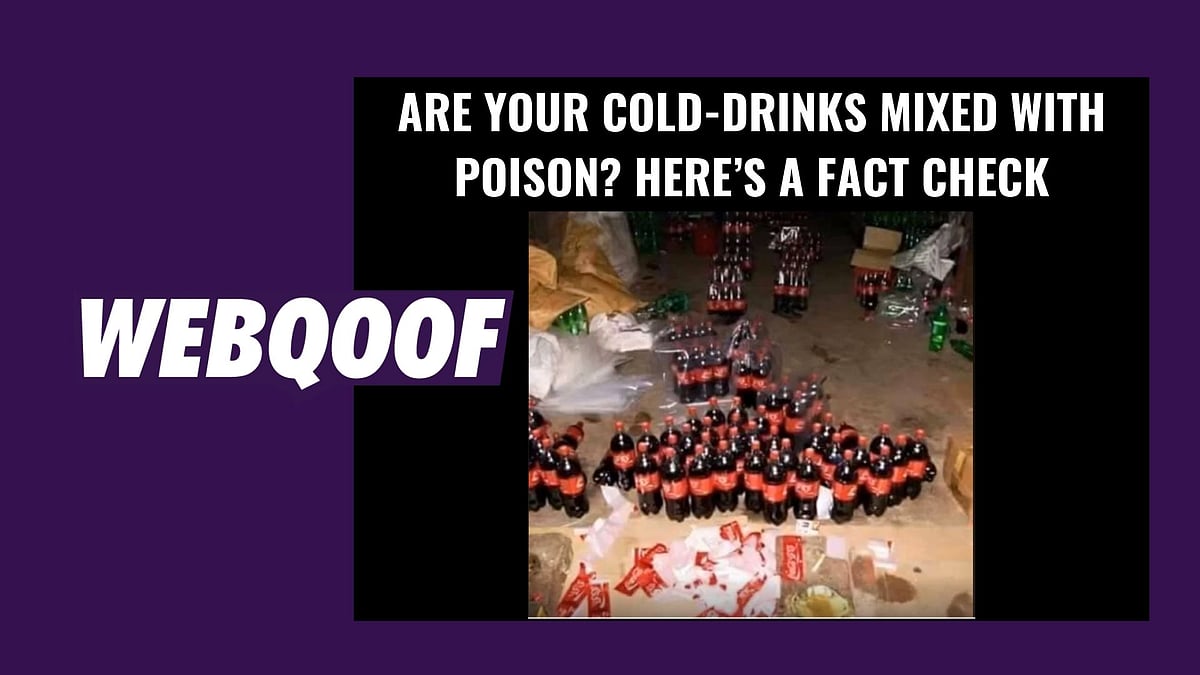
Don’t drink any cool drinks it has (been) mixed with HTC poison which leads to death.
Publisher’s rating: FALSE
The review assessed a social-media warning that cold drinks had been mixed with “HTC poison” and would cause death. It concluded that the posts’ videos and images came from separate incidents and did not show poison in drinks. It also reported that its Google search found no poison called HTC; the article identifies HTC as an abbreviation used for Hydrothermal Carbonisation, a process used in coal production. The review traced the viral material to unrelated events. It identified footage of two injured women as a 2018 incident in Hyderabad, Telangana, in which a police officer beat his wife and mother-in-law after being caught having an affair. The review noted that the same video had previously been misrepresented as showing Hindus attacking Muslims. Separately, it says reverse image searches connected images in the viral post to reporting about a fake-drinks factory in Gujranwala, Pakistan, and to a fatal road collision in Lakhimpur Kheri, Uttar Pradesh—not to poison in drinks. The underlying reports described different circumstances from the warning. The Gujranwala account concerned authorities finding chemicals, food colours and flavours at a factory for manufacturing cold drinks. The Lakhimpur Kheri image concerned a van colliding with a parked truck on 28 April 2018; the review, citing PTI through The Indian Express, says at least 12 people died. These incidents do not establish that drinks were poisoned. The review’s conclusion rests on the mismatch between the viral warning and the events identified in the material, as well as its finding that “HTC poison” was not a poison.
Slices of onion on feet ‘cure diseases overnight’
Publisher’s rating: Incorrect

LINE 流傳「台灣悲哀(同志雜交)感染(愛滋病)非常高」、「這樣中裕製藥才能大撈特撈」、「知道為何同婚一定要過的原因」謠言訊息,並附上相關影片或新聞。
Publisher’s rating: 不實
First eye stem cell surgery helps woman regain eyesight
Publisher’s rating: TRUE

Popular myth that a tattooed individual cannot donate blood.
Publisher’s rating: This claim is not entirely true.

網傳「美國醫生協會/美國醫學會已經找到癌病起因的答案:塑膠...塑膠接觸熱會產生52種癌病的化學物質」
Publisher’s rating: 錯誤
The claim attributes a finding about cancer to the American College of Physicians (ACP) and the American Medical Association (AMA), and says that plastic exposed to heat produces chemicals that cause 52 kinds of cancer. The review examined the versions circulating in messaging apps and online, including wording about leukemia and cancer, and a version saying heated plastic releases chemicals causing 52 cancers. The review reports searching the ACP and AMA websites and finding no statement that cancer originates from plastic. It also cites Taiwan’s Food and Drug Administration, which said the two associations had never published material asserting that plastic causes cancer. That agency’s cited explanation also distinguishes plastic-bag restrictions in the United States from the viral message’s rationale: the restrictions it describes were for environmental reasons, not because plastic was identified as the cause of cancer. The medical experts quoted in the review explain why the broad claim is not established by the evidence described. Plastics include different materials with different heat tolerances and different substances that may leach when heated; whether a particular substance is harmful or carcinogenic requires separate assessment. The review notes that some substances have shown carcinogenic effects in animal experiments, but that this does not establish that all plastics cause cancer or that heated plastic produces chemicals causing 52 cancers. It concludes that the viral claim is too sweeping to represent a rigorous medical finding.


LINE 流傳「蘋果外皮別吃進肚,難怪這麼多癌症」謠言訊息,並附上一段影片,內容是用熱水淋在蘋果上,將外皮白色的蠟洗退。
Publisher’s rating: 不實

வீட்டில் இருக்கும் குழந்தைகளுக்கு மேங்கோ ஜூஸ் போன்றவற்றை வாங்கி தர வேண்டாம். frooti குளிர்பானத்தில் ஒருவகையான விஷம் கலந்து உள்ளதால் பலர் இறந்து உள்ளனர். இந்த செய்தியை உடனடியாக பகிரவும் என ஆடியோ பதிவு ஒன்று வாட்ஸ் அஃப் இல் ஃபார்வர்டு செய்யப்பட்டு வருகிறது.
Publisher’s rating: Fake

El tequila rejuvenece y ayuda a adelgazar
Publisher’s rating: Falso
The claim that tequila rejuvenates and helps people lose weight misrepresents research about agavins, carbohydrates found in the agave plant. The review traces the claim to a 2014 study presented at the American Chemical Society, which it says was cited by online posts. But the study examined agavins, not tequila, and the review distinguishes the plant compounds from the alcoholic drink made from agave. The research described in the review involved experiments in mice. Mice given agavins had lower blood glucose levels, ate less and lost weight; further tests in obese and overweight mice also found weight loss. The review reports that researcher Mercedes Guadalupe López linked increased production of the satiety-related hormone GLP-1 to the results. These are animal findings, not evidence that drinking tequila produces the same effects in people. The review says researchers hoped the effects might also occur in humans, but were still testing that possibility. It also reports López’s explanation that neither alcoholic beverages nor agave syrup contain agavins: during tequila production, agavins are fermented into ethanol. Thus, the evidence described concerns agavins and preliminary animal research, not rejuvenating or weight-loss effects from tequila consumption.

Drinking bottled water from a brand named ‘Dew’ has killed almost 200 people.
Publisher’s rating: FALSE
Every single person with cancer has pH that’s too acidic
Publisher’s rating: False
Margarine is one molecule away from plastic and shares 27 ingredients with paint
Publisher’s rating: Incorrect
El mensaje que asegura que hay una nueva forma de identificar el ictus
Publisher’s rating: Falso
Newtral examined a viral message shared on Facebook and through instant messaging. It urged readers to forward it to ten people and presented tongue position as a newly discovered way to recognize a stroke. The investigation focused on two distinct propositions: whether tongue deviation was a new identification method, and whether it could indicate a stroke at all. Newtral consulted María Alonso de Leciñana, a neurologist at Madrid’s Hospital Universitario La Paz and coordinator of the Spanish Society of Neurology’s cerebrovascular-disease study group. She said the proposed method was not new; tongue deviation itself is possible but uncommon and depends on the location of the brain injury. The article therefore warns against treating this rare sign as a reliable way to identify a stroke. (S1: “La novedad de la cadena es el descubrimiento de una supuesta nueva señal para reconocerlo: la forma en la que la persona afectada coloca la lengua.”; “María Alonso de Leciñana, neuróloga del Hospital Universitario La Paz de Madrid y coordinadora del Grupo de Estudio de Enfermedades Cerebrovasculares de la Sociedad Española de Neurología, responde a Newtral que es falso que ésta sea una nueva forma para identificar el ictus.”; “El hecho de que la lengua se desvíe es un síntoma muy raro, puede ocurrir pero en un pequeñísimo porcentaje de los casos.”) The neurologist described more frequent signs that the message’s focus on the tongue could distract from: loss of strength or sensation on one side of the body, including uneven facial movement or difficulty raising an arm or leg, and problems speaking or understanding language. She explained that these symptoms may occur individually or together. This information helps clarify the article’s central distinction: tongue deviation can occur in some strokes, but the source does not present it as a newly established or dependable screening sign. (S1: “Pérdida de fuerza o sensibilidad en un lado del cuerpo: ‘Es lo más frecuente y puede afectar o no a la cara”; “Otro síntoma, que afecta a muchos pacientes es la dificultad en el lenguaje: ‘bien para expresarse, o bien para entender lo que le están diciendo.’”; “pueden producirse de forma aislada o todos juntos”) The article also assessed the message’s claim that a stroke’s effects can be fully reversed if a neurologist treats the patient within three hours. Alonso de Leciñana described the time-sensitive point as partly correct, but cautioned that passing three hours does not mean nothing can be done; earlier treatment is better because neurons continue to die without appropriate treatment. Newtral’s closing methodology excerpt lists “Falso” as its category for content it considers false. (S1: “aunque el hecho de que haya pasado más tiempo de tres horas no quiere decir que no se pueda hacer nada”; “cada minuto que pase más neuronas mueren si no se pone el tratamiento adecuado. Eso quiere decir que cuanto antes tratemos al paciente mejor”; “Falso El contenido es falso”)

LINE流傳「葡萄屬於強鹼性食品, 這個一定要看。癌症, 就這樣慢慢消失, 公德就這樣悄悄累積」的謠言訊息。
Publisher’s rating: 不實