PeakMetrics / Fact Checks
Health & medicine fact checks
Explore claims publishers have checked about health & medicine. Read their original ratings and follow the evidence.
Search fact checks
Search by text or image13,677 published reviews in this topic

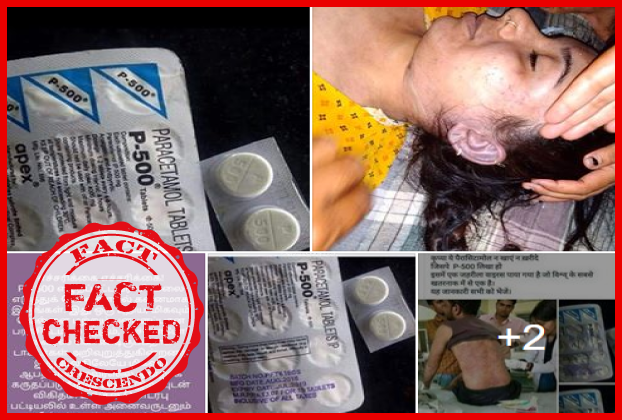
Paracetamol P-500 contains Machupo virus
Publisher’s rating: False
The claim concerned a Facebook warning that Paracetamol tablets marked P-500 contained “Machupo,” described in the post as a dangerous virus. The warning urged readers not to take the tablets and was shared with two photos. Vishvas News concluded that the claim was false. The review describes checking the virus claim against an advisory on the Singapore government’s Health Sciences Authority website, dated August 2, 2017. It says that advisory identified the warning about Paracetamol P-500 as a hoax. The review also reports consulting statements from Malaysia’s government and Indonesia’s Food and Drug Administration: the Malaysian statement said the virus was found in South America and could not live in a dry environment such as paracetamol tablets, while BPOM had received no credible report supporting claims that Machupo had been found in medicines. As an additional check, the review says it contacted general physician Dr. Sajeev Kumar, who rejected the claim. These are the checks and findings reported in the supplied article; the excerpt does not provide links or full text for the cited advisory and statements, or further details about how the photos were verified.
Pineapple leaves can do wonders for your health
Publisher’s rating: Incorrect

can autism be cured by homeopathy
Publisher’s rating: I have specialized in autism for 25+ years. I have Thousand of Reversing Autism success stories

can autism be cured
Publisher’s rating: I have specialized in autism for 25+ years. I have Thousand of Reversing Autism success stories
Revive a stroke victim and prevent them getting brain damage by pricking their fingers and ear lobe with a needle
Publisher’s rating: False


Claim: Patanjali co- founder Baba Ramdev gets treatment in Hospital
Publisher’s rating: FALSE
Branded Salt contains cyanide
Publisher’s rating: False
The review examines the claim that branded salt contained “deadly cyanide,” prompted by an accusation that some Indian salt manufacturers were selling food-grade salt with high levels of potassium ferrocyanide. It distinguishes potassium cyanide from potassium ferrocyanide: the article says potassium cyanide releases cyanide anions when consumed, whereas the cyanide anion in potassium ferrocyanide is strongly bonded to iron and does not get hydrolysed. The chemical named in the accusation and discussed in the salt measurements is therefore potassium ferrocyanide, not potassium cyanide. S1 states: “Citing a report from U.S.-based West American Analytical Laboratories, Shiv Shankar Gupta, chairman of Godhum Grains and Food Products, accused some salt manufacturers in India of selling food-grade salt that contained high levels of potassium ferrocyanide.” It also explains: “In potassium ferrocyanide, the cyanide anion is strongly bonded to ferrous ion and hence does not get hydrolysed.” The review gives two further grounds for its assessment. It reports that an inorganic chemist compared the oral LD50 values for rats: greater than 3 grams per kilogram of body weight for sodium chloride and 3.6 grams per kilogram for potassium ferrocyanide. It also says FSSAI allowed up to 10 mg/kg of potassium ferrocyanide in salt, while measurements cited for Tata salt and Sambhar salt were 1.90 mg/kg and about 4.71 mg/kg, respectively. These figures support the review’s conclusion that the cited products were within the stated limit; they do not establish that every salt brand was tested. S1 reports: “As Dr Arvind Kumar, Principal Scientist with the Central Salt and Marine Chemicals Research Institute of the CSIR, clarifies, the allowed levels of potassium ferrocyanide in salt is 10 mg/kg. whereas the level in the Tata salt was found to be 1.90 mg/kg and that of Sambhar salt was found to be about 4.71 mg/kg, both within allowed levels.”

Paracetamol P-500 pills contain ‘Machupo’ Virus.
Publisher’s rating: FALSE
The review investigates a social-media warning that specifically names Paracetamol tablets marked P-500 and alleges they contain Machupo virus. It describes the warning as urging people to avoid pills said to be “new, very white and shiny,” and claims that doctors had identified the virus in them. The review’s stated conclusion is that the warning is a hoax. To check the claim, the review says it searched Google for news about paracetamol tablets containing Machupo virus and found a Hindu article calling the viral message false. It reports that experts approached by The Hindu said there had been no recorded cases of Machupo virus in India. The review also says it found the warning circulating since 2017, and cites responses from health authorities in Singapore and Malaysia: Singapore’s Health Sciences Authority had addressed the hoax, while Malaysia’s Health Ministry had confirmed the claim was untrue. These points address the specific allegation about P-500 pills, rather than just the virus generally. However, the supplied excerpt does not describe laboratory testing of pills, name the experts, or provide the underlying statements from the agencies or ministry. Its account of the supporting checks is therefore limited to the reporting and official responses it summarizes.


"President Trump, you're not standing up for working families when you try to throw 32 million people off the health care that they have."
Publisher’s rating: Misses the full story
"So many Americans have unnecessary chronic illnesses — so many more compared to other countries."
Publisher’s rating: U.S. does fare worse
Bill Gates “thinks a coming disease could kill 30 million people within 6 months".
Publisher’s rating: Checked
World record broken with woman giving birth to 17 babies from one pregnancy.
Publisher’s rating: False
Imunisasi membahayakan bayi dan bisa menyebabkan kematian
Publisher’s rating: Keliru