PeakMetrics / Fact Checks
Health & medicine fact checks
Explore claims publishers have checked about health & medicine. Read their original ratings and follow the evidence.
Search fact checks
Search by text or image13,677 published reviews in this topic

Dettol kills Coronavirus. The company knew about the Coronavirus back in October 2019.
Publisher’s rating: MISLEADING
The claim arose from a photo of a Dettol bottle manufactured in October 2019. Because the bottle mentioned “Coronavirus,” social media users inferred both that Dettol could kill the virus involved in the new outbreak and that its manufacturer knew about that virus before it was reported from Wuhan. The review distinguishes the general term on the bottle from the newly identified strain at issue in the claim. The review reports that RB, Dettol’s manufacturer, said it did not yet have access to 2019-nCoV for testing and therefore could not confirm effectiveness against the new strain. That statement directly undercuts the inference that the bottle established Dettol’s effectiveness against 2019-nCoV, while also contradicting the idea that the manufacturer had confirmed knowledge of that specific virus in October 2019. The review also cites the WHO’s description of 2019-nCoV as a novel strain not previously identified in humans, and says the bottle’s reference to coronavirus concerned previous strains instead. It states that the new virus had not been detected before the outbreak was reported in Wuhan in December 2019. Thus, the bottle’s wording, as described in the review, does not show that it referred to 2019-nCoV or that Dettol’s manufacturer knew about that strain in October. The excerpt does not establish whether Dettol is effective against other coronavirus strains; it reports that RB could not confirm effectiveness against the new strain at that time.

وزارت بهداشت کانادا گفته برای پیشگیری از کرونا آب بنوشید.
Publisher’s rating: نادرست

2019 novel Coronavirus can be cured by one bowl of freshly boiled garlic.
Publisher’s rating: FALSE
FACTLY examined a social-media post claiming that one bowl of freshly boiled garlic water could cure disease caused by the 2019 novel Coronavirus. The review identifies this precise claim and says it checked information about garlic’s ability to cure coronavirus by searching for evidence and consulting a clarification on the World Health Organization’s website. The WHO information quoted in the review distinguishes garlic’s possible general antimicrobial properties from evidence that it prevents this particular infection. It says garlic “may have some antimicrobial properties,” but that there was “no evidence from the current outbreak that eating garlic has protected people from the new coronavirus.” The review also quotes the WHO as saying that, at that time, no specific medicine was recommended to prevent or treat the novel coronavirus. That evidence does not support the post’s claim that a bowl of garlic water cures the disease. The qualification matters: the WHO statement acknowledges possible antimicrobial properties, but the review reports no evidence that eating garlic protects against the novel coronavirus. The supplied excerpt does not describe a clinical trial of garlic water; its stated basis is the WHO clarification.

Videos of Pigs being buried in China due to the Coronavirus outbreak.
Publisher’s rating: FALSE
FACTLY examined videos shared as showing pigs being buried in China because of the recent novel coronavirus outbreak. Its review says it checked three videos and compared their YouTube upload dates and descriptions with the reported timing of the coronavirus outbreak. It found the first two videos had been uploaded in March 2019, months before the coronavirus was first reported in late December 2019. The description for the first video attributed the burials to African swine fever, and the second video included a clip also seen in the first. The third video was uploaded in November 2019, also before the coronavirus was first reported. Its description attributed the pig burials to hog cholera. On this basis, the review concluded that the videos were old footage of events attributed to other animal diseases, not evidence of pigs being buried because of the coronavirus outbreak.

ಕೊರೊನಾವೈರಸ್ ರೋಗಿಗಳಿಗಾಗಿ ಚೀನಾ ಸ್ಥಾಪಿಸಿದ ಹೊಸ ಆಸ್ಪತ್ರೆಯ ವಿಡಿಯೋ.
Publisher’s rating: FALSE
Ada 40 ribu TKA asal Cina di Morowali yang dikarantina terkait virus Corona
Publisher’s rating: Keliru
A Facebook post claims research has confirmed that the 2019 coronavirus is a man-made combination of the SARS and HIV viruses.
Publisher’s rating: False - The primary claims of the content are factually inaccurate.

Imagen de personas cayendo en China por el coronavirus
Publisher’s rating: Falso
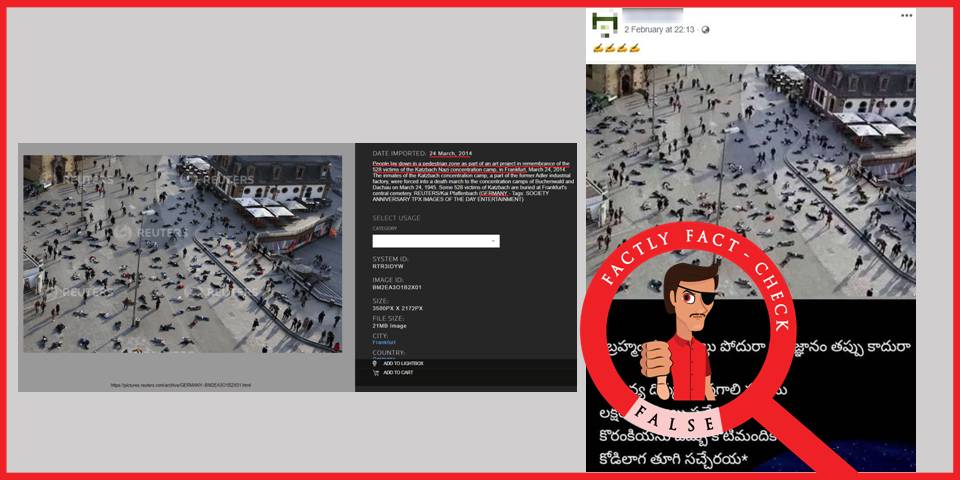
Newtral examined a shared image that users presented as showing people in China who had supposedly been infected with the coronavirus and fallen to the ground. The review states that the image is not related to the 2019-nCoV. Its account identifies the photograph instead as a scene from an art project in Frankfurt, Germany. To check the image’s origin, the review says it used a reverse image search on Google. That search led to an original photograph by Kai Pfaffenbach for Reuters, dated March 24, 2014. Reuters’ description identifies the people lying in a pedestrian area as participants in an artistic project commemorating the 528 victims of the Katzbach concentration camp in Frankfurt. The review also gives the historical context recorded in Reuters’ description: prisoners from Katzbach, part of the former Adler industrial factory, were forced on a death march to Buchenwald and Dachau on March 24, 1945; some victims are buried in Frankfurt’s central cemetery. Newtral says Google Maps also shows the Frankfurt location where the photograph was taken. This provenance and setting contradict the presentation of the image as a scene of coronavirus victims in China.

Photograph show Japanese doctors arriving in Wuhan, China
Publisher’s rating: FALSE

錯誤】網傳「從武漢撤回來的日︉本人,迎接他們的是每︃個人一台救護車,206人=2︃06台救護車,進︇行隔︇離」?
Publisher’s rating: 錯誤
The claim said that each of the 206 Japanese passengers evacuated from Wuhan was met by an ambulance, implying 206 ambulances were used and that the passengers were taken for isolation. The review identifies the footage as a Japanese television news report about the first evacuation flight, which arrived at Tokyo’s Haneda Airport on January 29, 2020. Its on-screen captions referred to 206 passengers, and Japan’s foreign ministry had announced that the flight was due to arrive at Haneda that morning. To identify the footage, the Taiwan FactCheck Center says it sought assistance from Japan’s FactCheck Initiative Japan. That group recognized Fuji TV’s morning program from a clock graphic in the video. The review also says it checked the Japanese foreign ministry’s announcement and compared reporting by Japanese media, including NHK, ANN and Kyodo News. Those reports described a very different transport arrangement from the one alleged: seven large buses and about 20 ambulances were waiting at the airport. NHK’s account, as relayed in the review, said five passengers who felt unwell went to hospital by ambulance, two went home accompanied by quarantine officials, and the remaining 199 travelled by government-arranged buses to a medical center in Shinjuku for testing. The reported vehicle counts and passenger dispositions therefore do not support the claim that every passenger had an ambulance.

Vídeo que muestra “médicos” que “caen” mientras operan a un paciente con coronavirus
Publisher’s rating: Falso

【錯誤】傳言引述文獻指稱「紅茶與普洱茶,抗冠狀病毒...紅茶跟普洱茶所含的茶黃素(TF3)...能夠阻止冠狀病毒的複製...」?
Publisher’s rating: 錯誤
Enjuagarse la garganta con agua salada previene la neumonía de Wuhan
Publisher’s rating: Falso
కొరోనా వైరస్ కారణంగా చైనాలో పందులను బ్రతికుండగానే పూడ్చిపెడుతున్న వీడియోలు.
Publisher’s rating: FALSE
La dieta alcalina cura y refuerza el tratamiento contra el cáncer
Publisher’s rating: Falso
Newtral addresses the specific claim that an alkaline diet or an “alkaline environment” can prevent or treat cancer. Its review says circulating claims that these diets reduce cancer risk are false, and that such diets cannot replace conventional treatment, including radiotherapy, chemotherapy or surgery. The article also directly rejects the claim that the diet cures or strengthens cancer treatment. The review discusses the scientific studies commonly cited in support of alkaline diets. It says that although those studies may be valid, they do not establish that a diet or alkaline environment can kill cancer. The excerpt then begins to identify an expert—a specialist in preventive medicine and public health associated with the Spanish Association Against Cancer—but the intervening text is omitted. It therefore does not provide that expert’s full explanation or enough information to describe any further checking or review of individual studies. The evidence presented supports rejecting the claim that an alkaline diet cures cancer or reinforces cancer treatment: the review says the cited studies do not establish that an alkaline diet can kill cancer, and warns that these diets cannot substitute for conventional cancer care. The excerpt does not support broader conclusions about specific diets, patient outcomes, or the effect of particular foods.
El hospital Johns Hopkins de Baltimore ha dicho que “la quimioterapia es la gran equivocación médica”
Publisher’s rating: Falso