PeakMetrics / Fact Checks
Health & medicine fact checks
Explore claims publishers have checked about health & medicine. Read their original ratings and follow the evidence.
Search fact checks
Search by text or image13,677 published reviews in this topic

【錯誤】網傳「印度權威科學家證實:類似愛滋病病毒植入新型冠狀病毒,懷疑是中國人工合成的生化武器」?
Publisher’s rating: 錯誤
The claim arose from an Indian research preprint about four short sequences in the new coronavirus’s spike protein that its authors said resembled sequences in HIV-1. The review identified the paper as “Uncanny similarity of unique inserts in the 2019-nCoV spike protein to HIV-1 gp120 and Gag,” posted on bioRxiv on January 31, 2020, by researchers affiliated with institutions in India. The fact-check distinguished the paper’s claims from the viral allegation that the virus had been deliberately engineered as a Chinese biological weapon. The preprint was withdrawn by its authors after they received comments about their technical approach and interpretation. bioRxiv cautioned that coronavirus papers on its site were preliminary, had not been peer-reviewed, and should not be treated as established conclusions. Taiwanese experts consulted by the fact-check also considered the evidence weak: they said the short sequences were not unique to the new coronavirus, and that the comparisons did not establish a connection with HIV. One expert noted that the study compared only a small number of coronavirus sequences; another said similar short sequences could also be found in proteins from other organisms. The review found that the research did not establish the stronger claim circulating online. According to the review’s account, the paper suggested the virus might not have arisen through natural variation, but did not say it was an artificially produced biological weapon. The review further reported that the study’s evidence was insufficient to show the virus was made in China. It therefore found no support for presenting the preprint as proof of the viral allegation.

Sanidad ha enviado un comunicado para recomendar que «no se suministren productos» provenientes de China
Publisher’s rating: Falso
The claim concerns a purported Ministry of Health communiqué advising against supplying products from China and listing businesses that worked with the country. Newtral reports that it checked the document’s authenticity with the ministry, which denied issuing the letter or document. The ministry also pointed out that the name used for it was incorrect: “Ministerio de Sanidad y Política Social” was the name of the department during the 2008–2011 IX Legislature, while the purported document added “e igualdad.” The document’s dates and contents also raised inconsistencies. It bore a purported registry stamp dated 9 January 2020, yet referred to people infected in France and Germany. Newtral compares that with the World Health Organization chronology, which placed China’s identification of a possible original infection focus in a Wuhan seafood market on 11 and 12 January. The review concludes that the document was falsified, rather than an authentic ministry recommendation.

Cocaine kill Corona virus.
Publisher’s rating: FALSE
The review addresses claims circulating on social media that cocaine, or cannabis, could kill or cure coronavirus. It says the cocaine claim appeared alongside an image resembling a television news screenshot, while other posts claimed that weed killed the virus. The review reports that researchers were still in the early stages of developing treatments and that the World Health Organization said no specific treatment was available at that time; it also notes that clinical trials were underway, not that a cure had been established. To investigate the apparent broadcast image, the review describes a reverse image search that led to Dopl3r, a meme-generator site. It says the image came from a template that lets users add their own message, which could then be photographed on a screen to make it look like a TV broadcast. The review concludes that the claimed cure lacked scientific basis and labels the claim false. Its described image check supports the conclusion that the supposed broadcast image was not evidence of an actual news report; the excerpt does not describe a clinical test of cocaine as a treatment.

Imagen de personas cayendo en China por el coronavirus
Publisher’s rating: Falso
Salah satu produk pembersih Dettol diklaim bisa membunuh virus Corona Wuhan
Publisher’s rating: Sesat

Notícia urgente: Cocaína mata o coronavírus. Cientistas estão chocados ao descobrir o que essa droga pode combater o vírus.
Publisher’s rating: Falso

Morcegos, serpentes e cachorros são vendidos em feira a céu aberto na China, por isso o coronavírus existe
Publisher’s rating: Falso

China trying to kill 20,000 people affected with Corona virus
Publisher’s rating: FALSE

Bats found under the tiles of many roofs in China were the source of Coronavirus.
Publisher’s rating: FALSE
The claim concerned a video said to show bats found beneath roof tiles in Hubei, China, and asserted that those bats were the source of the coronavirus outbreak. FACTLY’s review investigated the provenance of that specific video, rather than establishing the virus’s origin. It reports that reverse-image searches of video keyframes led to an earlier YouTube upload by Istueta Roofing, a Miami roofing company. The uploader’s description, as recounted in the review, said the bats were found while workers removed tiles from a customer’s old roof in Miami, Florida. The review identifies the upload date as 5 July 2011—years before the coronavirus outbreak—and concludes that the footage was not from China. That provenance directly contradicts the post’s claim about where the video was filmed and what the footage shows. The review distinguishes that false video attribution from the separate question of the virus’s origin. It notes that some studies suspected a possible bat connection, but says WHO had not officially declared the virus’s origin at the time. Thus, the evidence presented disproves the claim that this particular video documents bats in China as the source; it does not, by itself, settle the virus’s origin.


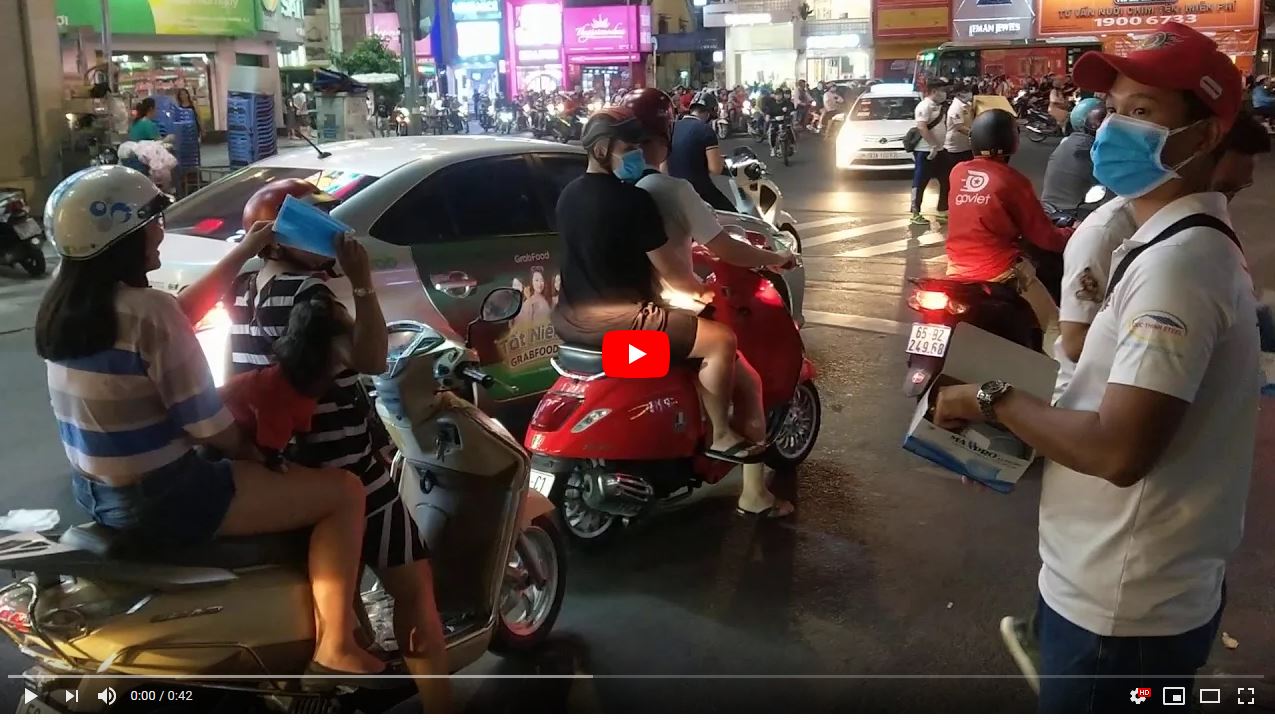
【部分錯誤】網傳「菲律賓政府免費送口罩...商家在街頭免費發口罩」照片?
Publisher’s rating: 部分錯誤
The review examined a social-media claim that a photo showed the Philippine government giving away masks, alongside an assertion that businesses were handing them out on the street. It found that the scene in the photo was in Manila, but that the government was not distributing masks to the public in the street. It distinguished that claim from documented mask donations to particular institutions and from free distribution by Chinese-Filipino groups. To check the photo’s location, the review compared signs visible in it with Google Street View and identified the location as Ongpin Street in Manila. For the government-distribution claim, it sought information from Philippine fact-checking organization Vera Files and a Central News Agency correspondent based in the Philippines, and checked Manila city government announcements. The review reported that the city had donated masks to hospitals and schools on January 30 and 31, 2020, but that the announcements’ photos did not match the circulated image. The review also found evidence of mask donations and street distribution by Chinese-Filipino groups, while noting that it could not determine who was pictured or what activity the particular photo showed. Its conclusion was therefore that the photo’s location was correctly associated with the Philippines, but the accompanying claim that the Philippine government was giving away masks in the street was misleading. The review did not establish that the people in the image were the government or identify the specific event shown.
Es gebe international keine Studie, die den Nutzen von Impfungen belegen könnte, wird in einigen Posts in sozialen Netzwerken behauptet
Publisher’s rating: Mehrere Studien belegen die Wirkung von Impfstoffen, auch auf internationaler Ebene.
The claim examined by dpa was that no international study could demonstrate the benefit of vaccination. The article responds by describing evidence from German regulatory and public-health institutions, international health agencies, and studies of particular vaccines and disease outcomes. It reports that the Robert Koch Institute and Paul-Ehrlich-Institut addressed the assertion that vaccine effectiveness had never been demonstrated. According to dpa, the institutes said a vaccine is approved only after effectiveness and tolerability have been shown, with manufacturers required to provide evidence from preclinical work and clinical trials; results are reviewed at EU level under the European Medicines Agency and in Germany by the Paul-Ehrlich-Institut. The article also points to evidence beyond the approval process. It says the institutes described ongoing evaluation of vaccine effectiveness and safety, including evidence accumulated through millions of people receiving long-used vaccines such as the measles vaccine. For polio, it contrasts nearly 4,700 cases among children in West Germany in 1961 with fewer than 50 in 1965, after oral vaccination was introduced in the early 1960s. It further reports WHO figures associating measles vaccination with a 73% worldwide decline in measles deaths between 2000 and 2018, and the polio-eradication initiative with a reduction of more than 99% in polio cases. Finally, dpa cites specific research: a US double-blind study in which the tested vaccine reduced shingles cases by more than 50%, and a study of the introduction of vaccines against Hib and meningococci in Bahrain from 1990 to 2013. Taken together, the examples directly contradict the categorical claim that no studies internationally demonstrate vaccine benefit. The excerpt does not provide full study methods or results for every cited item, so the explanation here is limited to the evidence and figures reported in the article.
A Facebook post from February 1, 2020 claims the current 2019 novel coronavirus is more deadly than HIV or Ebola.
Publisher’s rating: False - The primary claims of the content are factually inaccurate.
【錯誤】網傳「振興主任告知這次的武漢病毒並不耐熱在溫度26-27度的環境下就會被殺死。所以要多飲用熱水。可以轉告親朋好友們多喝熱水預防」?
Publisher’s rating: 錯誤
The claim attributes advice to a director at 振興醫院 (Cheng Hsin General Hospital): that the virus behind the Wuhan outbreak would be killed at 26–27°C, and that people should drink hot water to prevent infection. The Taiwan FactCheck Center says it checked both whether the hospital had issued the message and whether the temperature and prevention claims were medically sound.
Foto kontainer biohazard yang diklaim ditemukan terkubur di Konsulat Jenderal Amerika Serikat di Wuhan, Cina
Publisher’s rating: Keliru

【錯誤】網傳「我同學的嫡親外甥...在深圳醫院工作...剛剛來電讓我轉告訴朋友們:感冒時,如出現流鼻涕和咳痰者,就不可能是新型冠狀病毒肺炎...」?
Publisher’s rating: 錯誤
The review examined a circulating message that claimed a person working at a Shenzhen hospital had said COVID-19 could be ruled out when someone with a cold had a runny nose or phlegm, because the illness supposedly caused only a dry cough. The central issue was whether those symptoms could reliably distinguish COVID-19 from other respiratory illnesses. The Taiwan FactCheck Center reported interviewing Yang Chia-jui, director of infectious diseases at Far Eastern Memorial Hospital, and Huang Shih-tse, an epidemic-prevention physician with the Ministry of Health and Welfare’s Centers for Disease Control. Yang said the message’s claim was not correct: although fever and cough were common, some patients also had runny-nose symptoms. He said confirmation required molecular testing of a nasal or oral sample for the virus’s nucleic acid. Huang likewise said a patient needed medical evaluation and testing; symptoms alone could not distinguish COVID-19 from a cold, because respiratory illnesses share symptoms. The review also checked Taiwan CDC press releases for examples among confirmed cases. It reported that a locally confirmed case announced on January 30 had developed cough and a runny nose after returning to Taiwan on January 12. A February 6 CDC release described a woman in her twenties who had developed a cough with phlegm and chest tightness on February 1. These examples contradict the message’s absolute claim that such symptoms meant COVID-19 was impossible. The review’s conclusion was that symptoms could not rule out infection and that testing and clinical evaluation were needed.

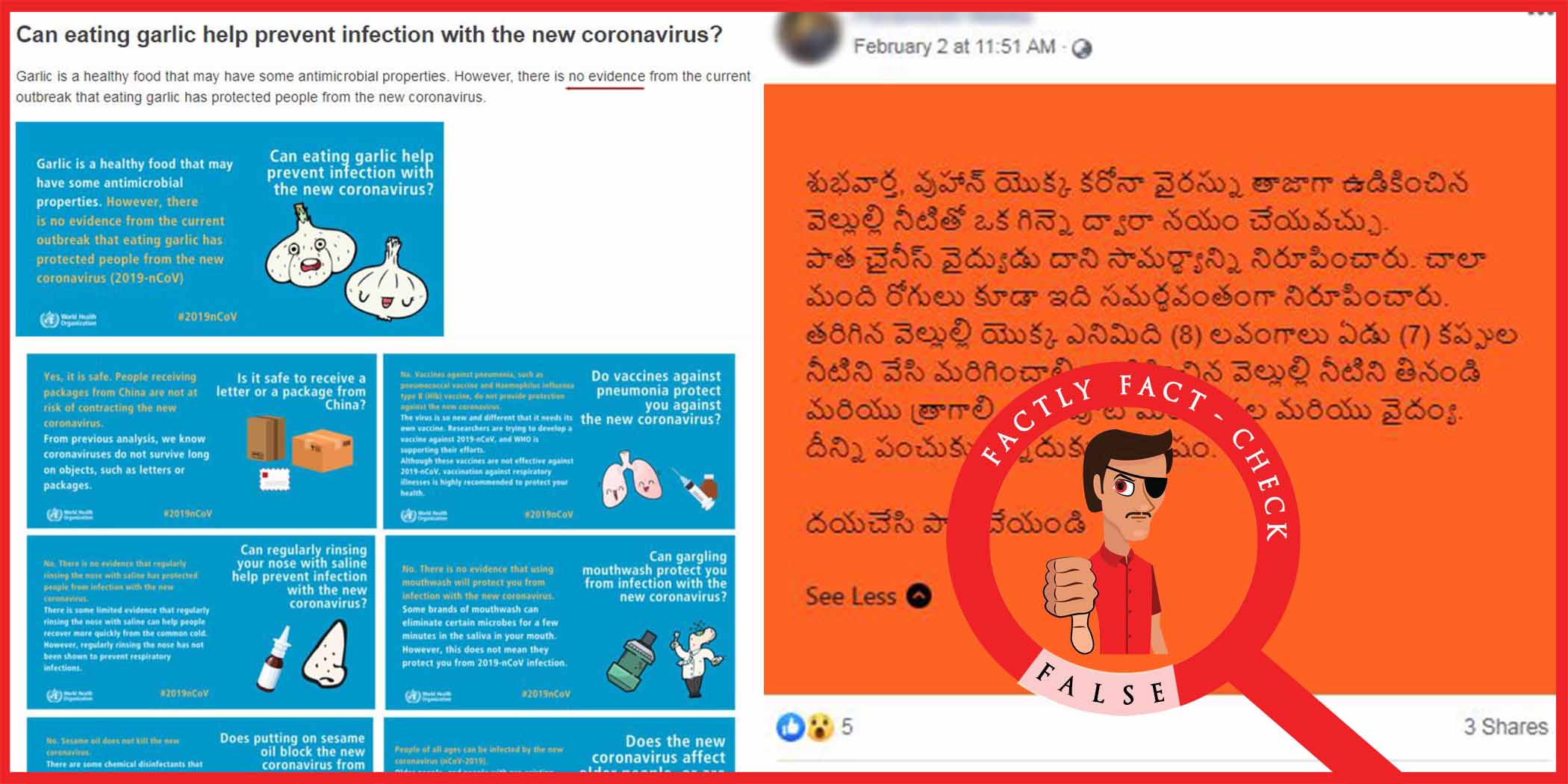
ఉడికించిన వెల్లుల్లి నీటి తో కొరోనా వైరస్ వ్యాధిని నయం చేయవచ్చు.
Publisher’s rating: FALSE