PeakMetrics / Fact Checks
Health & medicine fact checks
Explore claims publishers have checked about health & medicine. Read their original ratings and follow the evidence.
Search fact checks
Search by text or image13,677 published reviews in this topic
Ortega Smith hoy por la calle con coronavirus y sin mascarilla con su madre
Publisher’s rating: Falso
El País ha publicado que Juan Carlos I ha dado positivo en la prueba de coronavirus
Publisher’s rating: Falso

Buscan a voluntarios para que se dejen infectar con el SARS-CoV-2 en laboratorios británicos por 4.000 euros
Publisher’s rating: Engañoso
The claim concerns headlines saying that British laboratories would infect volunteers with the coronavirus behind COVID-19 in exchange for roughly €4,000. The review says the reported compensation was £3,500, approximately €4,000, but that volunteers would be exposed to two different coronaviruses, OC43 and 229E, described in the article as less severe than SARS-CoV-2. It reports that the headlines caused confusion even though many articles specified that the study involved viruses other than the one then driving the pandemic. [S1: “Los artículos por los que nos habéis preguntado señalan que los participantes recibirán una compensación económica de 3.500 libras, aproximadamente 4.000 euros al dejarse inyectar por las variedades del coronavirus 0C43 y 229E, menos severas que el SARS-CoV-2.”] To check the claim, Newtral says it contacted communications offices for Hvivo and Queen Mary University of London, and was referred to information from Open Orphan, the pharmaceutical-services company working with Hvivo. Hvivo confirmed to the outlet that volunteers would be infected with coronaviruses other than the one circulating in the pandemic, adding that using the current coronavirus would be too dangerous. The university center also said that Hvivo conducted respiratory-disease testing there, but that neither Hvivo nor other companies housed at the center were working with COVID-19 or testing vaccines against it at that time. [S1: “Desde Newtral.es, hemos contactado con su gabinete de comunicación y nos confirman que los voluntarios serán «infectados» con coronavirus distintos del que está circulando en la pandemia. «Sería demasiado peligroso hacerlo con el coronavirus actual», recalcan.”] [S1: “Sin embargo, subrayan que ni la empresa Hvivo ni «otras alojadas en el centro» trabajan con el COVID-19. Tampoco están probando vacunas contra el virus por el momento.”] The study, called a “Controlled Human Infection Model” (CHIM), was to take place at a 24-room quarantine clinic in the Queen Mary BioEnterprises innovation center in London. The review describes its purpose as establishing a model that could help companies assess vaccines and antivirals, so candidates could later be selected for field testing against COVID-19. That prospective research use does not mean the volunteers in this study would be infected with SARS-CoV-2. The distinction between the study’s actual challenge viruses and its potential future relevance to COVID-19 is the key context missing from the headline claim. [S1: “Es ahí donde se desarrollarán las pruebas para el estudio denominado «Modelo de infección humana controlada (CHIM)».”] [S1: “Puede utilizarse para probar la eficacia de las nuevas vacunas y antivirales, tanto nuevas como ya existentes. Esto permitirá la selección efectiva de los mejores candidatos y los productos efectivos para ser acelerados para las pruebas de campo subsiguientes contra el Covid-19”]

【部分錯誤】多家媒體報導「鍾南山:蓮蓬頭可能是播毒途徑 致鑽石公主號及香港國宅個案增加」、「鍾南山:蓮蓬頭與排氣管可能傳播新冠病毒」?
Publisher’s rating: 部分錯誤
Coronavirus issues were because "we were given rules, regulations, and specifications from a different time."
Publisher’s rating: False
China ha anunciado el éxito del suero egipcio contra el coronavirus.
Publisher’s rating: Falso

Boire de l'eau froide, des boissons chaudes ou de l'alcool protège contre le coronavirus
Publisher’s rating: Faux
"If you go back to the swine flu, it was nothing like this. They didn’t do testing like this."
Publisher’s rating: False.
Tweet de El Mundo que dice que el diputado de Unidas Podemos, Pablo Echenique, se encuentra ingresado de urgencia en la UCI
Publisher’s rating: Falso
The claim concerned a message presented as an El Mundo tweet saying that Unidas Podemos deputy Pablo Echenique had tested positive for coronavirus and was admitted “urgently” to intensive care. It added that this was supposedly the second confirmed case at the party’s headquarters. Newtral’s review says the message came from a fake account, not the newspaper: the account used El Mundo’s logo as its profile picture, but its Twitter username showed it was not the outlet. The review also reports that Echenique continued posting on Twitter and, on the Thursday night described in the article, said he had no symptoms, felt well, and had chosen to work from home after contact with people diagnosed with coronavirus. That account of his circumstances contradicts the tweet’s claim that he was in intensive care. The review further gives an example of a separate joke about him being “admitted” to Norauto, a vehicle-repair company, which he said was circulating as humor—not evidence of hospitalization.

“And taking early intense action, we have seen dramatically fewer cases of the virus in the United States than are now present in Europe.”
Publisher’s rating: Not the whole story
“I met with the leaders of health insurance industry, who have agreed to waive all co-payments for coronavirus treatments.”
Publisher’s rating: Wrong

برای همه دنیا روشن است ویروس کرونا یک سلاح بیولوژیک است که در آزمایشگاه ساخته شده است.
Publisher’s rating: شاخدار


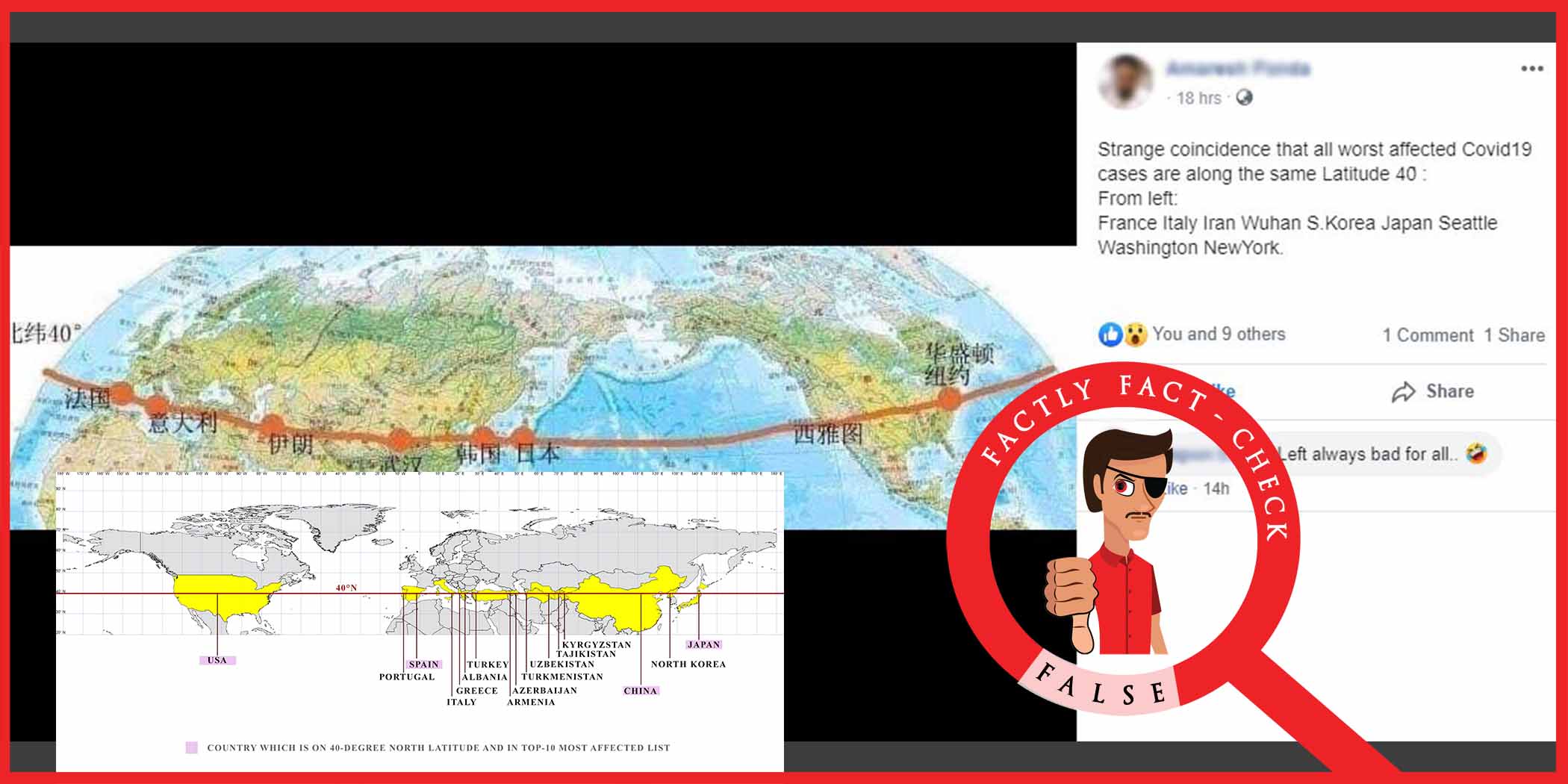
Most affected countries by COVID-19 are along the same 40-degree North latitude
Publisher’s rating: FALSE
FACTLY examined the claim that the countries most affected by COVID-19 were situated along 40° north latitude. Its comparison found that the latitude passes through only four countries in the review’s top ten list: the United States, Spain, China and Japan. The top ten was based on the WHO list as of 12 March 2020; the article does not describe a broader or later comparison. The review also checked whether the latitude crossed the hardest-hit regions within two of those four countries. It says it did not pass through Washington State, identified as the most affected region in the United States, or Hubei Province, identified as the most affected region in China. Wuhan, in Hubei, was described as being around 30° north, rather than 40° north. Together, those findings contradict the broad claim: most countries in the cited top ten were not crossed by 40° north, and even in two of the four countries that were, the review says the most affected regions lay elsewhere. FACTLY concluded that not all the countries most affected by COVID-19 were on that latitude.

Das Coronavirus ist bereits im Jahr 1981 in einem Comic-Heft der „Asterix”-Reihe erwähnt worden.
Publisher’s rating: Das ist nur teilweise wahr. In der französischen Version von „Asterix in Italien” wurde eine Figur Coronavirus benannt. Das Heft wurde allerdings im Jahr 2017 publiziert.

Une vidéo YouTube prétend montrer des exécutions massives d’animaux qui seraient liées à l’épidémie de coronavirus
Publisher’s rating: Faux

Cuba anuncia que já fabricou a vacina contra o coronavírus HAVANA.
Publisher’s rating: Falso
Boatos.org examined a circulated Spanish-language post whose headline said Cuba had manufactured a coronavirus vaccine. The post’s body, however, described Cuban President Miguel Díaz-Canel praising the use of Interferon alfa 2B in China. It said the medicine was made at the ChangHeber plant in Changchun, Jilin, and described it as a treatment—not as a newly developed vaccine. The review also noted that Brazilian headlines had presented the story as an announcement of a vaccine that had already cured patients. The review’s central check was to compare the headline with the text beneath it: it says the circulating article “não fala nada sobre a tal ‘invenção’” despite its vaccine headline. It explains that Interferon alfa 2B already existed and was used to treat viral infections, and that the medicine was used for more severe coronavirus infections in China. Thus the evidence in the post concerns use of an existing medicine, not Cuba announcing that it had manufactured a vaccine. For additional support, the review quotes the World Health Organization’s then-current statement that there was no vaccine or specific antiviral medicine to prevent or treat COVID-2019, while possible vaccines and treatments were being investigated. It also reports that other Brazilian fact-checkers cited a Cuban government researcher saying Cuba had no coronavirus vaccine developed. These points reinforce the distinction between treatment with an existing drug and a vaccine announcement; the review does not present Interferon alfa 2B as a vaccine.