PeakMetrics / Fact Checks
Health & medicine fact checks
Explore claims publishers have checked about health & medicine. Read their original ratings and follow the evidence.
Search fact checks
Search by text or image13,677 published reviews in this topic


La Policía tiene entrada libre en casas y edificios en Málaga para identificar posibles infectados de coronavirus
Publisher’s rating: Falso
The claim concerned a notice bearing the emblems of the Policía Nacional, Málaga City Council and the Diputación de Málaga. The notice said that coronavirus outbreaks had been detected in the municipality and that officers would have “free entry” to homes and buildings to identify possible infections. Newtral reported that the notice was false: it says the Policía Nacional denied it and the Diputación also rejected the message.
El número 915038030 es para renovar las recetas médicas en la comunidad de Madrid.
Publisher’s rating: Falso

La Comunidad de Madrid habilita el 915038030 para pedir recetas de medicamentos
Publisher’s rating: Falso
The claim concerned a WhatsApp message saying that the Community of Madrid had enabled the phone number 915038030 so people taking medication could call for a renewed prescription to be loaded onto their health card. The message presented this as a way to ease pressure on health centres during the coronavirus emergency. The review’s decisive evidence is the regional government’s response: it said the circulating message was false. The article reports that response, but the supplied text does not describe an independent test of the phone number or provide further details about how the government reached its conclusion. The article therefore rejects the specific claim that Madrid enabled this number for prescription requests, based on the government’s direct denial. Its account supports that conclusion, while leaving the underlying verification beyond the denial itself unspecified.
El número 915038030 es para renovar las recetas médicas en la comunidad de Madrid
Publisher’s rating: Falso
El hospital Niño Jesús se ha quedado limpio sin COVID-19 para atender niños y jóvenes de Madrid
Publisher’s rating: Falso
The claim concerned a message saying that Madrid’s Hospital Niño Jesús would be reserved for children and young people up to 18 or 20 years old and kept free of COVID-19. Newtral reports that both the hospital and the Community of Madrid’s Health Ministry denied that non-coronavirus patients under 20 were being directed there. The hospital also rejected the message’s age claim: it described itself as a children’s hospital and said it does not treat people over 18. The review therefore found the message’s central assertion false: the authorities and hospital denied the proposed arrangement, and the hospital’s stated age limit did not match the message’s claim that it would serve patients up to 20. The excerpt identifies the hospital and the regional ministry as its sources; it does not provide further detail about their responses or describe additional checks.

La COVID-19 serait causée par la 5G
Publisher’s rating: Faux

Die Einnahme des Medikaments Ibuprofen hat negative Auswirkungen bei einer Infektion mit dem neuartigen Coronavirus Covid-19.
Publisher’s rating: Es gibt derzeit keine wissenschaftliche Evidenz für negative Auswirkungen von nichtsteroidalen Antirheumatika (NSAR) wie Ibuprofen bei einer Covid-19-Erkrankung. Die MedUni Wien dementierte die in den Nachrichten enthaltenen angeblichen Forschungsergebnisse. Die WHO riet kurzzeitig von einer Einnahme von Ibuprofen bei Covid-19-Verdacht ohne ärztliche Anweisung ab, nahm dies aber einige Tage darauf wieder zurück.

"Boas notícias! O Wuhan CORONA VIRUS pode ser curado * com uma tigela de água de alho recém-fervida. Um velho médico chinês provou sua eficácia.
Publisher’s rating: Falso
The claim concerns a social-media message saying that a Chinese doctor had proved a bowl of freshly boiled garlic water could cure the Wuhan coronavirus. It gave a recipe—eight chopped garlic cloves boiled in seven cups of water—and promised recovery “overnight.” The review identifies this as the same claim and says it is not supported. The message named no doctor and offered no study or other evidence showing that the mixture worked. The review compares the claim with statements it attributes to Brazil’s Ministry of Health and the World Health Organization (WHO). It reports that neither identified a medicine, substance, vitamin, food, or vaccine that could prevent or cure the infection at that time. The Ministry’s advice, as quoted in the article, focused on preventive measures and care for symptoms, with hospitalization for more severe cases. The WHO material quoted by the review distinguishes possible comfort or symptom relief from actually preventing or curing the disease, and says there was no evidence for the latter. The article also addresses two possible rationales for the remedy. It says the WHO described garlic as a healthy food with antimicrobial properties, but not as a treatment for COVID-19. It reports that QZ India explained hot water would not raise body temperature enough to kill the virus, and that other fact-checking services had also found no scientific evidence supporting garlic as a cure. The review therefore concludes that the recipe’s promised cure was not established by the evidence it presents; it does not report a clinical test showing that garlic water treats the disease.

Video of Police in China taking into control suspected COVID-19 patients in the country
Publisher’s rating: FALSE
The claim concerns a video said to show police in China taking suspected COVID-19 patients into custody. The review identifies the people in the footage instead as demonstrators in Hong Kong who were protesting a proposed bill that would have allowed extraditions to mainland China. It says the video shows police arresting demonstrators who were vandalizing the Prince Edward Mass Transit Railway station in August 2019. This changes both the location and the event represented by the post: the footage depicts a protest-policing incident, not the containment of suspected COVID-19 patients in China. [S1] The review describes how it investigated the video: it ran keyframes through reverse-image search, which returned results about clashes between Hong Kong police and protesters. It then cites reporting by The Guardian and the BBC as identifying the footage with those clashes and the arrests at Prince Edward station. The excerpt does not provide links to particular images, search results, or detailed quotations from those reports, so those specifics cannot be independently assessed from the supplied text. [S1] The review also uses chronology to challenge the post’s description. It states that the coronavirus was first reported in the last week of December 2019, while the depicted arrests took place in August 2019—about four months earlier. The footage’s stated date and setting therefore do not fit the claim that it shows police taking suspected COVID-19 patients into custody in China. [S1]



భర్తకి కొరోనా వైరస్ వచ్చిందని తెలిసి భార్య తన పుట్టింటికి పారిపోయింది
Publisher’s rating: FALSE
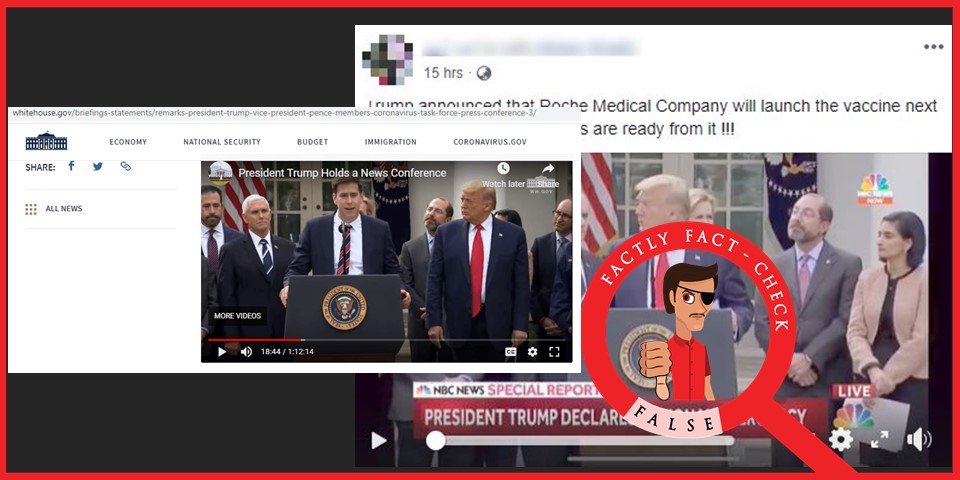
Video of American President Donald Trump announcing that Roche Medical Company will launch the vaccine for COVID-19 next Sunday
Publisher’s rating: FALSE
The review examined a video shared with the claim that Donald Trump had announced Roche would launch a COVID-19 vaccine the following Sunday. It distinguishes what the clip actually shows from the claim: Trump was discussing FDA approval of a Roche coronavirus test, not a vaccine. The review reports that it located the full version of the clip on the White House website and used that longer recording to check the surrounding remarks. In the posted excerpt, Trump hands the podium to Matt Sause, Roche Diagnostics’ chief executive for North America. Sause thanks the FDA for rapidly approving Roche’s coronavirus test and says it would be made available to help patients; after Sause speaks, Trump praises the company. The review says the full recording shows Trump discussing increased testing capacity and anticipating half a million additional tests early the following week. He also said test locations would be announced on Sunday. Those references to tests and Sunday provide a plausible source for the misleading vaccine-and-launch claim, but do not support it. The review further cites Roche’s website as saying the company had begun shipping COVID-19 tests to laboratories across the United States. It also cites NIH information that no approved coronavirus vaccines existed at the time, while a Phase 1 trial of an investigational vaccine had begun on March 16, 2020. That vaccine was developed by NIAID scientists and collaborators at Moderna, not Roche. Taken together, the video’s actual subject and the separate vaccine-trial information contradict the claim that Trump announced a Roche vaccine launch.