PeakMetrics / Fact Checks
Health & medicine fact checks
Explore claims publishers have checked about health & medicine. Read their original ratings and follow the evidence.
Search fact checks
Search by text or image13,677 published reviews in this topic

Nostradamus a prédit l’épidémie de coronavirus dans ses Prophéties en 1555
Publisher’s rating: Faux

Places most affected by coronavirus are situated along Latitude 40 degree
Publisher’s rating: FALSE

Corporation of Chennai has closed all fruit and vegetable markets because of coronavirus
Publisher’s rating: FALSE

נגיף הקורונה יכול לרפא את עצמו על ידי קערה עם מי שום טריים מבושלים
Publisher’s rating: לא נכון
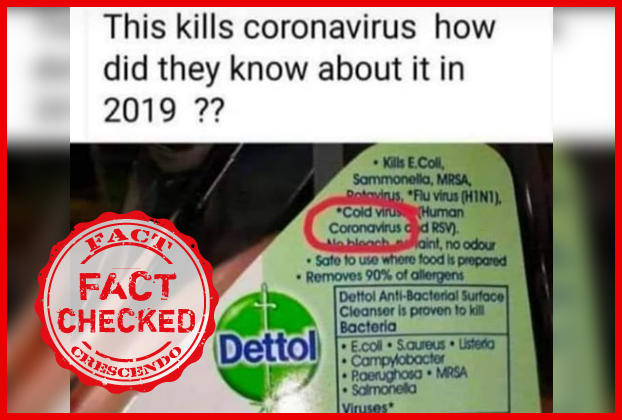
Claim: Coronavirus mentioned on Dettol bottle in 2019
Publisher’s rating: Partly False
The review examines a social-media claim that a Dettol bottle made in 2019 named coronavirus, and that this supposedly showed the disease spreading in 2020 had been planned in advance. It says the post contains both true and false elements, rather than establishing that the bottle predicted the COVID-19 outbreak. The excerpt does not describe an independent inspection of the bottle or provide its production records, so it does not establish those details itself. The review’s central distinction is between coronaviruses as a broader group and the new virus associated with COVID-19. It says coronaviruses were already known to medical experts, while the virus then spreading was a newly identified type. The review explains that the bottle’s coronavirus reference concerned an earlier coronavirus, not the novel coronavirus identified as nCoV 2019 or COVID-19. Thus, a reference to a coronavirus on a bottle does not, according to the review, show advance knowledge of the later outbreak. The article places the new virus’s emergence in China at the end of 2019 and says it then spread more widely. It also states that Dettol could not kill the COVID-19 virus and that the manufacturer had issued a denial, but the excerpt does not include the denial’s wording or details of the evidence behind it. Its conclusion is that the post conflated related but distinct viruses and was misleading.

El Ejército esté requisando material de protección contra el coronavirus en Cataluña
Publisher’s rating: Falso
The claim concerned an allegation posted on Twitter on March 17 by Joan Canadel, president of the Barcelona Chamber of Commerce: that the Army was requisitioning coronavirus protective equipment in Catalonia. The review reports that the Ministry of Defence told Newtral the allegation was “rotundamente falsa” (“categorically false”). The review also checked the stated origin of the allegation. The Chamber said the post was personal, not an institutional message, and based on information Canadel had received personally; it said it had no further information. The excerpt provides no independently identified source or documented example of a requisition to substantiate the claim. The review notes a relevant legal distinction: Article 14 of the state-of-alarm decree authorized the Ministry of Health to intervene in or temporarily occupy certain facilities to help ensure supplies needed to protect public health. That provision describes a power and its purpose; the excerpt does not say it proves that the Army requisitioned protective equipment in Catalonia. The account therefore contrasts the allegation with the Defence Ministry’s denial and the absence of supporting details from the post’s source.

Aguantar la respiración 10 segundos sin problemas es garantía de no tener coronavirus
Publisher’s rating: Falso
Novel "The Eye of Darkness" telah memprediksi kemunculan virus Corona sebagai senjata biologis dari Wuhan, Cina
Publisher’s rating: Keliru
Mujer salta desde el segundo piso por el aislamiento por el coronavirus: "madre mía como está el personal"
Publisher’s rating: Falso

Chinese Military Intelligence officer writes about how coronavirus was developed in a lab
Publisher’s rating: FALSE

ఒమాన్ దేశం అంతటా మిలిటరీ హెలికాప్టర్లతో కొరోనా వైరస్ నిర్మూలనకై ప్రత్యేక రసాయనాన్ని ఆకాశంలో విడుస్తున్నారు
Publisher’s rating: FALSE

PM Modi giving free masks under Swachh Bharat mission
Publisher’s rating: FALSE
Anuncia Cuba que fabricó vacuna contra el coronavirus
Publisher’s rating: Falso
Video yang diklaim sebagai video warga Jakarta yang berjatuhan karena terinfeksi virus Corona Covid-19
Publisher’s rating: Sesat

Coronavirus was found in mutton
Publisher’s rating: FALSE
FACTLY investigated a Facebook post showing goat meat with dark spots and claiming coronavirus had been found in mutton. The review’s central finding was that the image had been altered and did not establish that the meat was infected. It reported that the picture originated years before the coronavirus outbreak was first reported in December: “The photo in the post was edited. Also, the photo was taken five or six years ago.” To trace the picture, the review says it used a Google reverse-image search and found the same image on Justdial. Comparing the versions, FACTLY observed that the Facebook image had more spots than the Justdial image. The review also says FACTLY contacted the mutton shop that had posted the original picture, and was told it had been uploaded around five or six years earlier. Together, the comparison and the reported upload history support the finding that the spots in the circulating image were not evidence of coronavirus in the meat. The review separately addressed whether eating meat could transmit coronavirus. It reported that the FSSAI CEO said there was no scientific data showing that consumption of chicken, mutton, or other non-vegetarian foods spread the virus, and said FSSAI and WHO guidance considered properly cooked meat safe to eat. These points concern consumption and transmission; the image’s provenance and alteration are the evidence the review gives for rejecting the specific claim that coronavirus was found in the pictured mutton.
בצל הינו "תרופת הפלא לקורונה", שכן "בצלים סופגים בקטריות וזו הסיבה שהם כל כך יעילים במניעת הצטננות ושפעת"
Publisher’s rating: לא נכון