PeakMetrics / Fact Checks
Health & medicine fact checks
Explore claims publishers have checked about health & medicine. Read their original ratings and follow the evidence.
Search fact checks
Search by text or image13,677 published reviews in this topic

【部分錯誤】網傳影片宣稱「大家趕快提醒身邊的朋友ˊ很多外國人開始在台灣做這件事ˊ想害台灣人也淪陷疫情ˊ所以他們現在都故意把口水吐在捷運手把上喔」?
Publisher’s rating: 部分錯誤
The claim paired a video of a man putting saliva on a metro handrail with a warning that foreign people were deliberately doing this in Taiwan to spread the outbreak. The review found that the video did not show an incident in Taiwan: it identified the train as Hong Kong’s MTR, not the Taipei Metro. Its conclusion is limited to the location and framing of the videos; it does not establish that the act shown never occurred elsewhere. To identify the train, the review compared details visible in the footage with Hong Kong metro features. It noted the route map above the door, the red handrails and silver seats, the yellow-and-black warning strip at the doorway, and a Cantonese carriage announcement. The review also observed the Traditional Chinese warning about minding the platform gap. Taken together, those details led it to identify the setting as Hong Kong rather than Taiwan. The review also addressed a second video circulated with the same text. It said that its earlier report had traced that footage to an event on March 10 in the Brussels Metro, not the Taipei Metro. Thus, neither of the two videos described in the review supports presenting the depicted incidents as events on Taiwan’s metro system.

Audio clip of a conversation claiming that Government of India will announce shutdown of the country in the coming days from 15 April to 15 June in the wake of Coronavirus outbreak
Publisher’s rating: FALSE
The claim concerned a viral phone-audio clip in which a speaker said the Government of India would announce a nationwide shutdown from 15 April to 15 June amid the coronavirus outbreak. The speaker also presented the shutdown as linked to instructions from the World Health Organization (WHO). The review identifies the recording as a purported conversation between two people and describes the speaker’s claimed connection to the WHO India director. The review’s finding is that the audio was not authentic.

【部分錯誤】網傳圖片「任何人,在巴士,地鐵見到手上帶著這样的手環,要小心遠離,那是要隔離14天的新型肺炎人仕。私自外出。小心」?
Publisher’s rating: 部分錯誤
The review examined a specific image circulating in Taiwan with a warning that anyone who saw a person wearing the pictured wristband on a bus or train should keep away because the person was supposed to be isolating for 14 days and had gone out. It found that the image was taken in Hong Kong, not Taiwan, so using it to suggest the pictured event happened in Taiwan gave readers a misleading impression. The review’s conclusion therefore concerns the image’s location and its use in Taiwan, rather than establishing that the man was not subject to quarantine or had not left home.


Gargling warm water with either salt or vinegar can eliminate Coronavirus
Publisher’s rating: FALSE
FACTLY examined a social-media post claiming that gargling warm water with salt or vinegar can eliminate coronavirus from the throat. The review says it searched for credible information from the World Health Organization (WHO) and the Indian government and found none supporting the remedy. It also reports that India’s Press Information Bureau (PIB) had called the circulating message fake. The excerpt does not describe laboratory testing or a clinical study; its assessment rests on the absence of support from the named public-health sources and the government fact-check response. [S1]

Pengemudi Gojek yang positif terinfeksi virus Corona Covid-19 kabur dari rumah sakit
Publisher’s rating: Keliru

Dr Devi Shetty released audio note on coronavirus
Publisher’s rating: FALSE
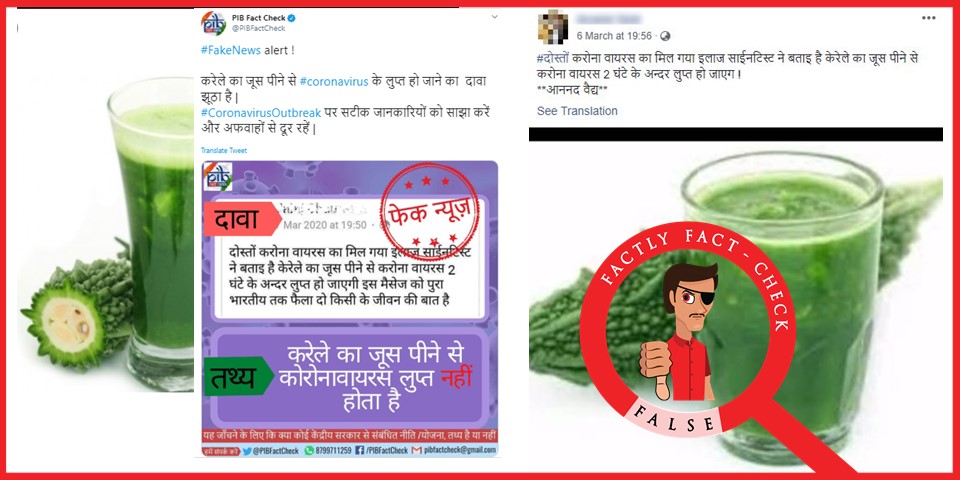
Scientists have found that drinking bitter gourd juice can cure Coronavirus
Publisher’s rating: FALSE

Gargling with warm salt water prevent Coronavirus.
Publisher’s rating: FALSE
The review examined a viral social-media image claiming that coronavirus stayed in the throat for four days and that drinking water or gargling with warm saltwater or vinegar could eliminate it before it reached the lungs. It says the image was circulating online during the coronavirus outbreak and identifies the advice as a claim about preventing infection, not just soothing a sore throat. The review’s investigation specifically addresses that proposed preventive effect. [S1]


Claim: novel corona patients being hunted like dog in China
Publisher’s rating: False
The claim concerns a video said to show Chinese police chasing and arresting coronavirus patients. Fact Crescendo reports that the footage shows masked people and uniformed officers at a railway station, but says the officers’ uniforms raised doubts about the claim that the scene was in China. The review’s investigation identified the location as Prince Edward Station in Hong Kong, not China. [S1]

איבופרופן (אדוויל, נורופן ושות') עלול להחמיר תסמיני קורונה
Publisher’s rating: לא מוכח

Fumigan los parques en Adra con venenos muy fuertes contra el coronavirus
Publisher’s rating: Falso
The claim concerned a message warning people not to walk their dogs in Adra’s parks because they were allegedly being sprayed with powerful poisons against coronavirus. The message linked the warning to a dog that reportedly became unwell after visiting a garden area called Parque de la Curva. The article reports that Newtral asked the National Police and Adra Local Police about the allegation; the National Police said parks were not being fumigated with poison, while the local police said the parks were sealed off. [S1]

Le coronavirus ne survit pas dans les climats chauds
Publisher’s rating: Faux

【錯誤】網傳「新冠肺炎預防配方 教化師姐說...㈠茶葉加苦瓜熬湯:有傳染到者需飲2500cc ㈡檸檬原汁加點塩,或加仙草,每日3200cc」?
Publisher’s rating: 錯誤
The claim concerns a message circulated on social media and messaging platforms that presents tea boiled with bitter melon and lemon juice, optionally with salt or grass jelly, as COVID-19 prevention advice. It also says that people who have been infected should drink 2,500 cc of the first mixture and gives a daily amount of 3,200 cc for the lemon mixture. The review notes that versions of the message used different attributions, including “教化師姐,” “教化菩薩,” and “文王聖帝.” To assess whether the recipes could prevent COVID-19, the Taiwan FactCheck Center says it interviewed Huang Shize, a chronic infectious-disease prevention physician at Taiwan’s Centers for Disease Control, and Shi Xinru, director of Chang Gung University’s Emerging Viral Infections Research Center. Huang said the advice had no basis and was unrelated to preventing the new coronavirus; Shi said neither remedy had a scientific or theoretical basis as a preventive method. The review therefore concludes that the circulated prevention advice is unsupported.
Durch die sozialen Medien geistern weiterhin viele Falschmeldungen zur Coronakrise. In einigen Posts wird etwa behauptet, Supermärkte wie Lidl, Kaufland oder Netto würden ab dem 16. März an einigen Werktagen geschlossen bleiben. Als Beleg dient ein vermeintlicher Screenshot eines "Focus Online"-Artikels.
Publisher’s rating: Der Screenshot ist gefälscht, es gibt keinen derartigen Artikel auf "Focus Online". Die Supermärkte der genannten Ketten Lidl, Netto, Aldi (Nord und Süd), Kaufland, Edeka, Penny und Real haben weiterhin regulär geöffnet.
The claim concerned a purported Focus Online article, shown in a social-media screenshot, saying that Lidl, Kaufland and Netto would be closed on some weekdays from 16 March. The dpa review examined that specific screenshot and the alleged article, rather than a separate claim about supermarket opening hours. It reports that the text shown in the image could not be found on Focus Online. The review gives two checks supporting that finding. Focus Online had itself stated that the article was fake and had never appeared on its site. The screenshot also contained conspicuous spelling and wording errors, including “weitern maßnahmen” and “Ladenzeiten” where opening hours would be expected. These details support the conclusion that the image was not a genuine capture of a Focus Online article. On the opening-hours question, the review says the named supermarket chains remained open as usual. It reports that all the chains mentioned in the post had addressed the rumor on Facebook, and quotes Kaufland warning that false claims about its store hours were circulating. The evidence therefore addresses both parts of the post: the supposed article was not authentic, and the chains’ own communications contradicted the alleged closures.