PeakMetrics / Fact Checks
Health & medicine fact checks
Explore claims publishers have checked about health & medicine. Read their original ratings and follow the evidence.
Search fact checks
Search by text or image13,677 published reviews in this topic
Japanese drug Avigan is effective medicine against COVID-19
Publisher’s rating: Needs Context
Kontaktsperren und Ausgangsbeschränkungen wegen des neuartigen Coronavirus halten manche für überzogen. Der 2012 emeritierte Mikrobiologie-Professor Sucharit Bhakdi etwa nennt sie sinnlos. Er sagt in seinem Video vom 19. März 2020, Sars-CoV-2 sei "nicht grundsätzlich" gefährlicher als andere Erreger der Virus-Familie. Von 10 000 Infizierten seien "lediglich 50 bis 60" erkrankt. "99 Prozent der Menschen haben keine oder nur leichte Symptome." Mit Blick auf staatliche Maßnahmen zur Eindämmung des Virus sagt Bhakdi: "Ich finde sie grotesk, überbordend und direkt gefährlich"
Publisher’s rating: Der Mikrobiologe setzt den Anteil der schwer Covid-19-Erkrankten deutlich zu niedrig an. Zudem missachtet er das exponentielle Wachstum bei den Neuinfektionen.
The claim concerns statements made by microbiologist Sucharit Bhakdi in a video published on March 19, 2020. He argued that the virus was not fundamentally more dangerous than other viruses in its family, that only 50 to 60 out of 10,000 infected people were ill, and that 99 percent had no or only mild symptoms. He also called the government’s containment measures excessive and dangerous. The review examined those statements against information about disease severity and the course of the outbreak in Germany. It reports that Bhakdi offered no sources for his assertion about mild or absent symptoms, and contrasts it with the WHO’s findings and RKI-cited analysis of cases in Hubei: among people who became ill, about 80 percent had mild to moderate symptoms, while the remainder experienced more severe or life-threatening courses. Thus, the review distinguishes the proportion of infected people who show symptoms from the severity of illness among those who do. (S1: “Damit widerspricht er ohne Angabe von Quellen weltweit übereinstimmenden Forschungsergebnissen - etwa der Weltgesundheitsorganisation WHO”; “Bei denjenigen, die erkranken, zeigen sich demnach bei 80 Prozent milde bis moderate Symptome.”; “Bei den restlichen 20 Prozent kommt es zu schwereren oder gar lebensbedrohlichen Krankheitsverläufen”) The review also checks Bhakdi’s use of German case and death figures. It says that about 10,000 infections and 28 deaths were registered nationwide as of March 18, but notes that the first two deaths in Germany had been reported on March 9, not 30 days earlier as his calculation assumed. It then points to subsequent reported deaths: 16 more on March 19 and over 115 deaths known four days later. The article’s counterpoint is that a low early death count did not establish that the outbreak would remain small. (S1: “zum damaligen Stand (Mittwoch, 18. März) tatsächlich bundesweit etwa 10 000 Coronavirus-Infizierte registriert wurden, 28 Menschen waren gestorben.”; “obwohl doch die beiden ersten Todesfälle in Deutschland am 9. März bekannt wurden”; “Schon am 19. März waren es 16 Tote mehr. Weitere vier Tage später waren mehr als 115 Todesfälle in Deutschland bekannt”) On projected spread, the review says Bhakdi acknowledged exponential growth but compared his scenario of one million infections with the RKI warning that, without compliance with government measures, infections could reach ten million in the coming months. It also describes the measures’ stated purpose as slowing spread so fewer people would be ill simultaneously. The evidence presented therefore challenges both his severity estimate and the reassurance drawn from early case and death totals; it does not establish that every individual measure was effective or assess each measure separately. (S1: “Zwar geht auch Bhakdi von einem exponentiellen Anstieg der Corona-Ausbreitung aus”; “Das Institut warnte jüngst vor bundesweit zehn Millionen Coronavirus-Infektionen in den kommenden Monaten, wenn die von der Bundesregierung angeordneten Maßnahmen nicht eingehalten würden”; “Die Hoffnung ist, dass sich die Ausbreitung der Krankheit aufgrund der drastischen Maßnahmen möglichst langsam vollzieht”)
โควิด-19 อาการไม่เหมือนกันทุกคน กลั้นหายใจเช็กไม่ได้
Publisher’s rating: ข่าวปลอม
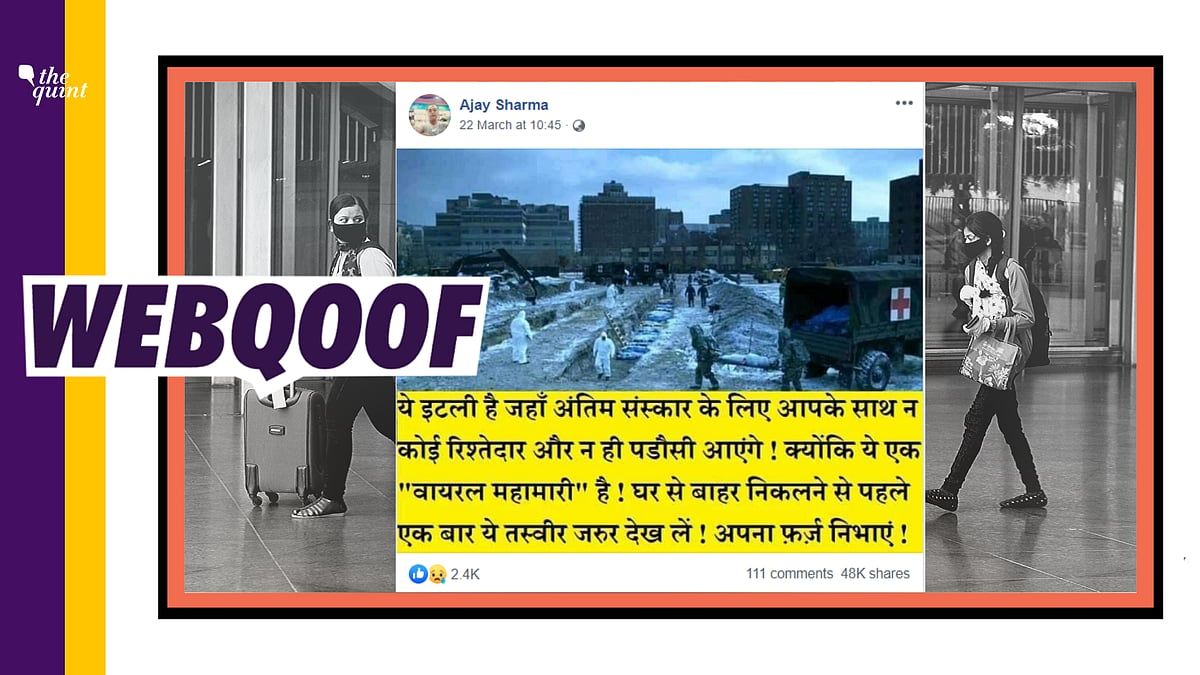
Image shows mass graves of coronavirus patients in Italy
Publisher’s rating: FALSE
The claim concerns an image circulated during the coronavirus outbreak as showing mass graves in Italy, where people were supposedly being buried en masse. The Quint’s investigation concluded that the image was not from Italy: it was a scene from the 2011 film *Contagion*. The review described the claim as false, consistent with the printed rating “False.”

Photo claming to show Covid-19 victims lying at an Italian street
Publisher’s rating: False.

Les chaussures seraient un vecteur de transmission important du coronavirus
Publisher’s rating: Faux

“Homem faz tratamento com o próprio sangue (auto-hemoterapia) e se cura do coronavírus”.
Publisher’s rating: Falso
«تصویر قطاری که مواد بیولوژیکی را برای بکارگیری ویروس کرونا با خود حمل میکند»
Publisher’s rating: شاخدار

Kenya confirms 23 more coronavirus cases from Mombasa.
Publisher’s rating: False.


Imágenes supuestamente grabadas en Italia de menores infectadas
Publisher’s rating: Engañoso
The claim concerns a video presented as showing children infected with coronavirus in Italy. The review describes two minors lying on what appear to be hospital beds and says the accompanying Portuguese caption reads “Niños infectados en Italia.” The video’s imagery and caption establish what the post asserted, but do not by themselves establish where it was filmed or whether the minors were infected. Newtral says it searched for the images using Google Images and Yandex. The results it found were Arabic-language posts placing the images at Ali Asghar Hospital in Shiraz, Iran; the oldest posts it found were from February. It reports that none of its search results connected the video to Italy. This evidence weighs against the Italian location claim, though the excerpt does not describe a definitive identification of the footage’s origin. The review explicitly limits what can be concluded about the children’s health: it says the available information does not establish whether they had coronavirus or whether their situation was connected to the health emergency. Thus the evidence challenges the video’s Italian attribution without proving that the minors were infected—or that they were not.

Indian Army set up a 1000 bed quarantine facility in Rajasthan's Barmer.
Publisher’s rating: FALSE

উষ্ণ গরম জলে নুন দিয়ে গার্গেল করলে করোনা ভাইরাস ফুসফুস পর্যন্ত পৌঁছাতে পারেনা
Publisher’s rating: Misleading


Photos of Italian man committing suicide after he lost his entire family to COVID-19
Publisher’s rating: FALSE
The post claimed that photos showed an Italian man committing suicide after losing his entire family to COVID-19. FACTLY says it checked the images using Yandex reverse image search, which returned a video with similar visuals. The review identifies that video as showing a hotel in Valencia, Spain, rather than establishing that the scene was in Italy.
El 22 de marzo la velocidad del ritmo de contagio de coronavirus se reduce durante dos días consecutivos
Publisher’s rating: Falso
The claim concerned an audio attributed to Ricardo Cubedo, an oncologist at Puerta de Hierro University Hospital. It said that on Sunday, March 22, the rate of coronavirus contagion had slowed for a second consecutive day, citing increases of more than 50% on Friday, March 20, 20% on Saturday, and 14% on Sunday. Newtral compared those figures with Spain’s daily case data published by the Ministry of Health, which the review says were updated at 11:30. Those figures do not show a two-day consecutive slowdown. The reported daily increases were 16.52% on Friday, 24.75% on Saturday, and 14.6% on Sunday: the rate rose between Friday and Saturday, then fell on Sunday. The review also says that the increase in cases had not exceeded 50% on any day of the previous week. On that evidence, the audio’s claimed sequence and its Friday figure were inaccurate. Newtral contacted Cubedo, who said he had taken the figures from a television news broadcast. The excerpt says the fragment he shared mentioned increases of 24% on Saturday and 14% on Sunday, but did not refer to the previous day’s figure or establish a two-day consecutive decline.