PeakMetrics / Fact Checks
Health & medicine fact checks
Explore claims publishers have checked about health & medicine. Read their original ratings and follow the evidence.
Search fact checks
Search by text or image13,676 published reviews in this topic

La COVID-19 n'est pas une pneumonie mais une thrombose. Et cela est l'unique cause de décès des victimes
Publisher’s rating: Faux
The claim circulated in a widely shared Facebook post that attributed its message to French professor Jacques Theron. It said Italian autopsies had shown thrombosis to be the sole cause of death among people who died of COVID-19, and used that claim to argue that ventilators and intensive care were unnecessary. The review distinguishes the possibility of blood clots from the post’s much stronger claim that they explained every COVID-19 death. The review reports that no Italian research supported the assertion that thrombosis was the sole cause of death, or that the claimed numbers of autopsies had been analyzed in Bergamo and Milan. It describes a study of 38 intensive-care patients in those cities, posted on medRxiv as a preprint that had not been checked by other scientists. The study called COVID-19 a respiratory disease and said all 38 patients had tested positive and showed clinical and radiological signs of pneumonia when hospitalized. It found clots in 33 patients, evidence of a complication in that group—not evidence that thrombosis was the sole cause of death. Other figures in the review also do not support treating thrombosis as universal: it reports that 31% of 184 patients in a Dutch study developed thrombosis. The review further notes that doctors differed over anticoagulant use and that the Italian physician promoting heparin acknowledged his protocol did not stop pneumonia. A Quebec intensive-care specialist said some severely ill patients developed both a major inflammatory response and extensive coagulation, and that intubation remained necessary for some patients. Together, these details contradict the post’s claim that COVID-19 was not a respiratory illness and that clots alone accounted for deaths.

"Doutor João Vaz" indica hidroxicloroquina e que as pessoas saiam para trabalhar
Publisher’s rating: Enganoso: Homem que aparece em vídeo faz afirmações sobre como lidar com a pandemia de coronavírus que não têm comprovação científica e são questionadas por diversas autoridades de saúde.
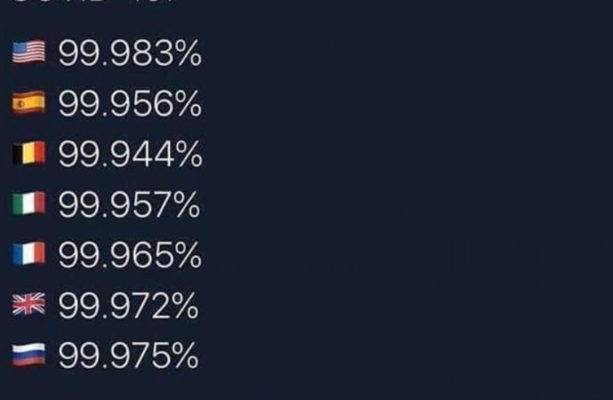
The 'survival rate' for Covid-19 is above 99.9%
Publisher’s rating: False
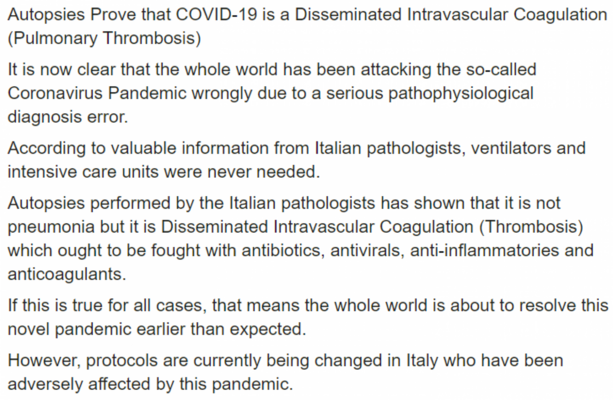
The world has been trying to treat Covid-19 incorrectly and patients are being misdiagnosed with pneumonia.
Publisher’s rating: False


【部分錯誤】網傳「跑廁所比中風好...所需的水份補充 ⋯體重1公斤30cc ⋯體重60公斤~ 60×30=1800cc ⋯水份補充得夠-想中風也難」?
Publisher’s rating: 錯誤
Unter dem Hinweis "Offiziell auf der RKI Seite" wird bei Facebook aktuell eine Grafik mit den angeblich täglich gemeldeten Covid-19-Neuerkrankungen verbreitet, die zum Ende hin stark abfällt. In dem Post vom 22. Mai 2020 heißt es: "Die Scala ist seid Ende April auf 0" [sic!]
Publisher’s rating: Dem Robert Koch-Institut (RKI) werden täglich neue Fälle von Covid-19-Erkrankungen gemeldet (Stand: 21. Mai 2020). Das war auch Ende April so. Die Grafik ist nicht aktuell, sie zeigt den Stand vom 7. Mai. Das RKI warnt vor Fehlinterpretationen, vor allem bei jüngeren Daten.
The post described a Facebook graphic as official RKI data and asserted that its scale had been at zero since the end of April. The investigation identifies the graphic as a time series showing data as of 7 May, rather than a current display. It says the RKI had published figures as recently as 21 May, so the graph’s apparent decline should not be read as evidence that new cases had stopped being reported. The review explains that the graph itself warned that falling case counts in recent days could result from reporting and transmission delays. The RKI’s daily situation report also noted delays in reporting and subsequent additions to case and death data, which were updated continually. That qualification matters because the graph’s latest dates had less complete information than earlier ones. For April specifically, the review says the RKI situation report for 7 May showed that figures for neither symptom-onset date nor reporting date had fallen to zero on any day in April. The exceptionally low figures for the first week of May reflected the limited data then available: by 21 May, the reported figures for that period were substantially higher. Thus, the shared graph was an outdated snapshot, and its steep end-of-series drop did not establish that daily cases had reached zero.

La COVID-19 n'est pas une cause de décès importante.
Publisher’s rating: Attention

El coronavirus se contagia por radiación electromagnética 5G
Publisher’s rating: Falso
The review examines viral messages claiming that COVID-19 was not caused by a virus but was a bacterial illness amplified by 5G electromagnetic radiation. It groups this claim with related assertions in the same messages: that Italy had found a cure after autopsies and that the illness was thrombosis treatable with aspirin. The review reports that these messages are false and identifies COVID-19 as an infectious disease caused by SARS-CoV-2.

Les masques peuvent causer de l'hypoxie cérébrale.
Publisher’s rating: Faux
The review examines social-media claims that wearing masks can cause hypoxia, including cerebral hypoxia. It describes a widely shared Facebook post alleging that prolonged mask use could lead to cerebral hypoxia and impaired conscious thought, and says experts consulted by the outlet regarded these concerns as generally unfounded. Its focus is therefore the physiological risk attributed to masks, not whether masks can feel uncomfortable or whether every mask is suitable for every person. The article reports that pneumologist and intensivist Mathieu Simon rejected cerebral hypoxia as a plausible outcome of ordinary mask use. It explains that hypoxia involves dangerously low oxygen supply and falling blood-oxygen levels, and says the masks discussed are designed to allow air circulation: cloth and procedure masks block larger droplets while letting oxygen and carbon dioxide molecules pass. The article also quotes pediatric infectious-disease specialist Caroline Quach saying that discomfort or a sensation of breathing poorly can occur, but does not mean gas exchange is prevented. The review does not present an exception-free conclusion. It says people with severely limited lung function—including some with pulmonary fibrosis, severe emphysema, or substantial breathing resistance—may find mask use more difficult. It separately reports Quach’s warning that prolonged N95 use can potentially cause some hypoxia, and notes that the article described N95 masks as intended for health-care workers rather than the general population. These qualifications narrow the conclusion: the article disputes the broad claim that masks generally cause cerebral hypoxia while acknowledging particular medical limitations and a potential issue with prolonged N95 use.

【錯誤】網傳「舉手不是投降,是救命...噎到東西之處理方式,只要把雙手舉起來就對了...這個急救方法同時可以運用在腳抽筋...對心肌梗塞更管用」?
Publisher’s rating: 錯誤
The Taiwan FactCheck Center examined a circulating message that claimed raising both hands could clear a choking person’s airway, relieve leg cramps by raising the opposite hand, and help with heart-attack symptoms, chest tightness, or angina. The review reports interviews with two physicians: Lee Binzhou, an emergency-department director at Taipei City Hospital’s Zhongxiao Branch, and Yeh Rui-ru, a family-medicine physician at Shuang Ho Hospital. They said that simply raising the hands does not treat these conditions. For choking, Lee explained that the response depends on whether the person can make sounds. If they can, the obstruction is partial, and they should be encouraged to cough while being observed. If they cannot, the obstruction is complete and another person should use the Heimlich maneuver. The review says raising hands cannot clear food from the airway; for a fish bone, Yeh cautioned that raising the hands could press it deeper, and recommended having an ear, nose, and throat doctor remove it. For cramps, the physicians said hand-raising has no scientific basis; stretching the affected area is the advised approach described in the report. The claim also presented raised hands as a remedy for heart attacks and chest symptoms. Lee explained that a heart attack involves a blocked coronary artery and requires medical care, potentially including a procedure to reopen the vessel; raising hands does not help. He and Yeh advised seeking medical care for heart-attack symptoms, chest tightness, or chest pain rather than relying on the claimed maneuver.
El coronavirus en realidad es una trombosis que se trata con aspirina 100mg
Publisher’s rating: Falso

Una mujer con coronavirus da a luz y para evitar el contagio sacan al bebé dentro de la bolsa de la placenta
Publisher’s rating: Falso
The claim attached to the viral video was that a woman with coronavirus gave birth and medical staff kept the baby inside the placental sac to avoid infection. Newtral’s investigation found that the footage was real, but that its date and context had been changed: the birth took place before the COVID-19 health emergency, not as a protective response to the virus. The investigation says AFP Factual traced the footage through Facebook to the mother, who confirmed that she had given birth to twin girls at San Vicente de Paúl hospital in Costa Rica on January 8, 2020. The mother said hospital workers recorded the delivery because they were struck by the baby being born in an intact amniotic sac. Newtral identifies this as an “en caul” birth and reports that the mother had not publicly shared the complete video. The footage therefore documents an unusual birth, but the source’s account of its provenance contradicts the claim that it showed a COVID-19 patient or a delivery arranged to prevent coronavirus transmission. Newtral also compared the viral footage with published infection-control guidance. It reports that at least two healthcare workers visible in the video lacked the eye protection recommended in Costa Rica’s guidance for staff attending a COVID-19 birth. The article discusses the limited evidence then available about transmission during pregnancy and childbirth, but that medical discussion is not what establishes the video’s date: the decisive evidence is the mother’s identification of the birth and its January 2020 timing, before the health emergency.

చార్మినార్ (హైదరాబాద్), మదీనా ప్రాంతం దగ్గర భౌతిక దూరం పాటించకుండా జనాలు గుంపులుగా షాపింగ్ చేస్తున్న వీడియో
Publisher’s rating: FALSE

Philippines is in 'second wave' of COVID-19 transmissions
Publisher’s rating: FALSE. Duque qualifies PH still in first wave of 'sustained' transmissions


【錯誤】網傳影片宣稱「這是14日印度記者拍攝的實況,貧民區疫情超乎想像的嚴重,根本沒有核酸檢測,也沒有真實的統計數字,印度社會亂得一塌糊塗」?
Publisher’s rating: 錯誤
The claim concerns a circulating video said to show an Indian reporter filming, on the 14th, severe COVID-19 conditions in a slum where testing and reliable statistics were allegedly absent. The review identifies that caption as the one attached to the video that circulated in May 2020, and says the footage was instead taken from reports of a chemical-gas leak. It concludes that the video was unrelated to the pandemic and that presenting it as pandemic footage was misleading. [S1]

Consumir alimentos más alcalinos previene la COVID-19
Publisher’s rating: Falso

People flouting social distancing norms in Hyderabad
Publisher’s rating: FALSE