PeakMetrics / Fact Checks
Health & medicine fact checks
Explore claims publishers have checked about health & medicine. Read their original ratings and follow the evidence.
Search fact checks
Search by text or image13,676 published reviews in this topic

Claim: Covid 19 patients lungi dance video
Publisher’s rating: Partly False
The claim concerned a viral video of people dancing to a Hindi song in a large hall with beds. Social-media posts identified the location as the quarantine centre at Chennai’s Nandambakkam Trade Centre, and one post described the dancers as patients. Fact Crescendo investigated where the footage was filmed; it did not dispute that the dancing shown in the video was real. The review says its researchers used reverse-image search on a frame from the video. That search led them to reporting that described a “lungi dance” at a quarantine centre in Agartala, Tripura. The review also cites a comment by Sandeep Choudhury on a post by Gopi Nath: Choudhury said the hall was in Agartala, far from where he lived, and asked people not to falsely say the incident occurred in Chennai. The review notes that Gopi Nath had corrected his post after the location was questioned. On this evidence, the review concluded that the dance was genuine but the Chennai location was wrong: it placed the video at a quarantine centre in Tripura, not Chennai’s Trade Centre. It also cautioned against treating everyone in a quarantine centre as a confirmed Covid-19 patient: the review describes the centre’s occupants as people under observation, some of whom might or might not develop Covid-19. It did not assess whether the dancing was appropriate or what the centre’s administrators did.

[España tiene] la peor cifra de muertos por habitante del mundo
Publisher’s rating: Falso

කොරෝනා වෛරසය හේතුවෙන් සුප්රසිද්ධ නළුවෙකු හා සටන්කරුවෙකු වන චක් නොරිස් මියයයි | Chuck Norris died from Coronavirus at the age of 77
Publisher’s rating: FALSE

Coronavirus is actually a bacterium causing blood clots. Coronavirus can therefore be cured by antibiotics, aspirin and anticoagulants.
Publisher’s rating: The posts are misleading. It's true some Covid-19 patients have suffered blood clots. But the disease Covid-19 is caused by a virus not bacteria. There is no known cure and the WHO warns against self-medication to treat the virus, including with antibiotics.

Os remédios contra Covid-19 são Ivermectina e Azitromicina
Publisher’s rating: Enganoso: Médico defende uso do medicamento em pacientes com a covid-19 mas diz que é irresponsável post em grupo de Facebook que afirma que ele descobriu a cura para a doença
Asymptmatic COVID patients can't transmit the disease
Publisher’s rating: False.
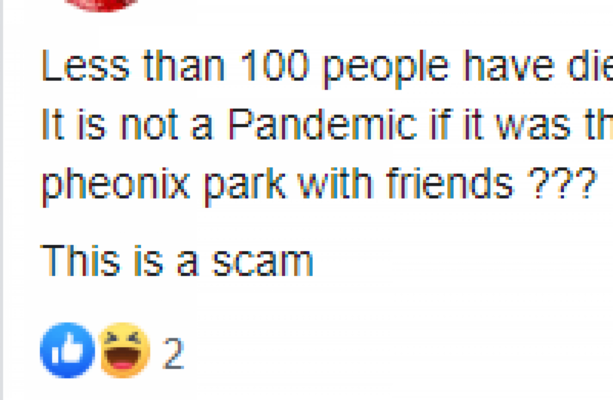
Fewer than 100 people have died directly from Covid-19 in Ireland
Publisher’s rating: False
The review examines a Facebook post shared at the end of May claiming that fewer than 100 people had died directly from Covid-19 in Ireland. The post offered no source for that figure. The review compared the claim with Department of Health figures announced by Chief Medical Officer Dr Tony Holohan and with the Health Protection Surveillance Centre’s breakdown of deaths through 9 June. The figures cited put the overall toll at 1,703. The HPSC breakdown recorded 1,700 deaths: 1,440 among confirmed cases, 95 among probable cases and 165 among possible cases. Even the confirmed-case figure alone is far above 100. The review therefore found the post’s claim unsupported by the official figures it examined. There is a qualification in what those figures establish: the review describes deaths among people with Covid-19 and separates them by case classification; it does not present a separate count proving that Covid-19 was the sole or direct cause in every death. It also notes that 1,555 of the recorded deaths were among people with underlying clinical conditions. That statistic does not reduce the reported total, but it matters when interpreting the post’s wording about deaths “directly” from the virus.
Op sociale media gaan al weken verschillende berichten rond over adviezen om het coronavirus te bestrijden. De adviezen zouden afkomstig zijn van onderzoekers, artsen en experts uit verschillende landen. Volgens de richtlijnen kan het virus niet overleven bij temperaturen van 26 à 27 graden, is het drinken van warm water effectief voor alle virussen en leeft het virus zo’n 12 uur op een metalen oppervlak. De berichten werden gedeeld in verschillende talen.
Publisher’s rating: De tekst die rondgaat staat vol met foute claims. Het virus wordt niet vernietigd bij temperaturen van 27 graden, je adem langer dan 10 seconden inhouden bewijst niet dat je niet besmet bent en regelmatig water drinken kan de besmetting niet voorkomen. Ook de meeste andere stellingen en richtlijnen zijn onwaar.
The review examined circulating social-media advice attributed to researchers, doctors and experts in different countries. The posts claimed, among other things, that coronavirus could not survive at 26–27°C, that warm water worked against all viruses, and that the virus survived for about 12 hours on metal. The review’s assessment was that the advice contained false claims. For the temperature claim, the article argues that a virus destroyed below 30°C could not persist in a human body, where body temperature is generally above 35°C. It also points to reported spread in warm, humid countries, including Malaysia, as evidence against the claim that heat or sun prevents transmission. The article separately says that sunlight does not destroy SARS-CoV-2. The review distinguishes the general health value of drinking water from the unsupported claim that it prevents infection: it says neither drinking regularly nor the water’s temperature or added salt or vinegar stops someone from catching the virus. It also addresses other advice in the circulating messages, including breath-holding as a supposed test, and says that being able to hold one’s breath for more than ten seconds does not establish that a person is uninfected.

Sir Ganga Ram Hospital's Doctor Has Recommended Home Isolation and Medication to COVID-19 Patients
Publisher’s rating: FALSE


Claim: This is not covid 19 ward in New Zealand
Publisher’s rating: Partly False
The claim concerns a video shared as showing health workers leaving a COVID-19 ward in New Zealand after its last patient recovered. The review says the post attributed the footage to that event, while the video itself included a “Visit Italy” logo. It reports that the footage showed medical staff coming out in pairs and removing their protective headgear as they passed the camera. The review states that New Zealand’s last COVID-19 patient had been discharged, but that circumstance did not establish where the video was filmed. (S1) To check the footage’s origin, the publisher says it converted a frame to an image and searched for it, without finding a matching post. It then searched for the “Visit Italy” logo and checked pages using that name. The review reports finding the video on a Visit Italy page dated June 8, where it was described as showing the closure of the COVID-19 ward at Matera hospital. (S1) The review further identifies Matera as a city in Italy’s Basilicata region and concludes that the video was not filmed in New Zealand. It says the footage showed medical staff leaving after Matera’s COVID-19 ward closed. Thus, the video’s location was misrepresented in the social-media claim, even though the footage did depict a COVID-19 ward and its staff. (S1)

Video of Coronavirus ward being closed in New Zealand after the treatment of the last patient in the country
Publisher’s rating: FALSE
The claim was that a video showed a coronavirus ward in New Zealand being closed after the country’s final COVID-19 patient had been treated. The review says the footage shows medical staff leaving a ward, removing their caps, and applauding as its doors are shut. Its conclusion is that the scene was not in New Zealand: “The video shows a Coronavirus ward being closed at a hospital in Matera, Italy.” To investigate the video’s provenance, the review reports that it subjected screenshots to reverse-image searches. Those searches found the same video on a Facebook page called Matera News, whose description identified the location as the Madonna delle Grazie hospital in Matera. The review also says searches for that hospital name returned similar videos. Matera is identified in the review as a city in Italy’s Basilicata region. The review adds that a nurse from the hospital shared the same video and a screenshot of a news article, and that Italian newspaper Il Riformista had reported the same information about the footage. It acknowledges that New Zealand had recently announced zero active COVID-19 cases, but distinguishes that fact from the video’s origin. The footage therefore does not establish that a ward was closed in New Zealand after its last patient was treated.

కేరళ లోని కోవిడ్ హాస్పిటల్ లో క్రికెట్ ఆడుతున్న వీడియో
Publisher’s rating: FALSE

Claim: Covid 19 not controlled in Bengaluru
Publisher’s rating: Partly False
The review examined a Facebook post comparing Bengaluru with New Zealand. The post credited Karnataka Chief Minister B. S. Yediyurappa with controlling the disease in Bengaluru and suggested that media coverage overlooked this because the state was governed by the BJP. The review distinguishes that claim from the post’s separate statement about New Zealand: it says reporting that New Zealand’s last Covid-19 patient had recovered was true, but found the assertion that the disease had been controlled in Bengaluru was not supported. To check the Bengaluru claim, the publisher says it searched for reports that the outbreak there had been stopped and consulted Karnataka health-department figures. It found reports of continued spread, including containment zones increasing from 36 to 113 in recent days. The review also reports that the department’s June 11 bulletin recorded 17 new cases in Bengaluru city, and that 23 people in the city had died. These figures contradict the post’s implication that the outbreak had been brought under control. The review adds a qualification to the comparison: Yediyurappa governed all of Karnataka, not Bengaluru alone, and other districts were reporting substantial case numbers. It cites 969 cases in Udupi and 735 in Yadgir, with 22 and 66 new cases respectively on June 11. The review’s conclusion is therefore specific: the New Zealand statement was accurate, but the claim that Covid-19 had been controlled in Bengaluru was false.

Video shows the last COVID-19 patient exiting from the hospital in New Zealand
Publisher’s rating: FALSE
The claim concerned a video shared as showing New Zealand’s last COVID-19 patient leaving a hospital, after which the hospital’s COVID ward was supposedly closed. Fact Crescendo reports that it examined the video and noticed the words “VisitItaly Community” on it. The review then searched that name and checked the VisitItaly website and its Facebook page. The page described VisitItaly as a tourism site about Italy, and the review says its Facebook page had posted videos showing conditions in Italy.

कोरोना वायरस के दौरान मुंबई में सोशल डिस्टेंसिंग भूल बस में चढ़ते लोग
Publisher’s rating: FALSE

OMS pede desculpa por seu posicionamento controverso em relação à hidroxicloroquina
Publisher’s rating: Enganoso: Texto distorce declarações de representantes da OMS para dar a entender que a entidade se arrependeu de ter interrompido as pesquisas com o medicamento

‘Sir Ganga Ram hospital' letter prescribing preventive medication for everyone to tackle COVID-19
Publisher’s rating: FALSE
Kan je door te gorgelen met warm water met azijn of zout het coronavirus uitschakelen? Volgens een bericht dat in verschillende talen wordt gedeeld op sociale media lijkt het daar wel op. Verder wordt er beweerd dat het virus na infectie eerst vier dagen in de keel blijft hangen voor het de longen bereikt. Maar wat is daar precies van aan?
Publisher’s rating: Het bericht klopt niet. Gorgelen beschermt je niet tegen het coronavirus en is zelfs af te raden. Door druppelverspreiding bestaat de kans dat je mensen in je omgeving besmet. Bovendien is het niet bewezen dat het virus eerst 4 dagen in de keel blijft hangen voor het de longen bereikt.
The review examined a social-media message claiming that gargling with warm water, vinegar, or salt could eliminate coronavirus, alongside a claim that the virus remains in the throat for four days before reaching the lungs. It says the message had circulated in several languages and that its wording closely matched a French version previously fact-checked by DPA. The review concludes that gargling does not protect against infection and could pose a risk to people nearby through droplets. (S1) To assess the proposed remedy, the review cites the World Health Organization’s position that no remedy was then known for the new coronavirus and that there was no evidence that drinking water protects against infection. It also cites Harvard’s public-health school as saying that gargling with salt water does not protect against SARS-CoV-2. Belgian virologist Steven Van Gucht explained that gargling cannot reach the virus inside cells and said that gargling could spread droplets to others. These points address the claim directly: the review presents no evidence that any of the suggested gargles can prevent or eliminate infection. (S1) The review treats the four-day throat claim separately, stating that it was not established. It reports that a Johns Hopkins University study found an average incubation period of 5.1 days, with symptoms beginning as early as two days after infection. The review cautions that this does not establish how long the virus remains in the throat—or that it follows the claimed route from throat to lungs—and says gargling would not remove it. (S1)