PeakMetrics / Fact Checks
Health & medicine fact checks
Explore claims publishers have checked about health & medicine. Read their original ratings and follow the evidence.
Search fact checks
Search by text or image13,676 published reviews in this topic

Face masks cause hypoxia - when you body is deprived of oxygen
Publisher’s rating: No evidence of this. The World Health Organization says: "The prolonged use of medical masks when properly worn, does not cause CO2 intoxication nor oxygen deficiency."
Face masks cause hypercapnia - when there's too much carbon dioxide in the blood
Publisher’s rating: No evidence of this. The World Health Organization says: "The prolonged use of medical masks when properly worn, does not cause CO2 intoxication nor oxygen deficiency."
AstraZeneca sets aside 400 million doses of Covid-19 cure for distribution worldwide
Publisher’s rating: PARTLY FALSE
Op sociale media gaan de voorbije dagen berichten rond waarin wordt beweerd dat je ziek kan worden door een mondmasker te dragen. De berichten verwijzen regelmatig naar een artikel van de nieuwssite Ninefornews.nl. Zij citeren een gepensioneerde Amerikaanse neurochirurg Russel Blaylock, die zou beweren dat de kleine filteropeningen van de maskers te weinig zuurstof zouden geven. Dat lager zuurstofgehalte zou bijgevolg de immuniteit aantasten, wat de kans op besmetting vergroot. Maar wat klopt daar precies van?
Publisher’s rating: De uitspraken in het artikel zijn grotendeels fout. Er is geen enkel bewijs dat het dragen van een mondmasker het zuurstofgehalte in het bloed doet dalen. Ook andere uitspraken, zoals het gevaar voor het opnieuw inademen van je eigen bacteriën en virussen, zijn fout.

Kann man sich durch Fleisch oder Wurst von "Corona-infizierten" Schlachthöfen anstecken?
Publisher’s rating: Theoretisch ja. Bisher gibt es aber keine nachgewiesenen Fälle, so das bayerische Landesamt für Gesundheit und Lebensmittelsicherheit, in denen sich Menschen über den Verzehr kontaminierter Lebensmittel oder durch den Kontakt zu kontaminierten Gegenständen infiziert haben. Dazu müsste ein Kunde diese Ware anfassen und sich anschließend mit der Hand ins Gesicht fassen. Auf diese Weise könnte das Coronavirus in die Schleimhäute gelangen. Das geringe Infektionsrisiko lässt sich weiter reduzieren, wenn Verbraucher die Hygieneregeln konsequent beachten.
Dans un article publié le 13 juin 2020, notamment sur sa page Facebook, le « site web de sciences » Trust My Science affirme que, dans le cadre de la crise du coronavirus, « les gouvernements commencent déjà à stocker des millions de doses de différents vaccins afin d'être prêts à vacciner dès que possible ».
Publisher’s rating: C’est faux. Aucun vaccin n’existe, à l’heure actuelle. Impossible, donc, d’en stocker un. Tout au plus certains pays européens ont-ils signé un accord avec un laboratoire pharmaceutique afin que puisse débuter, « d’ici à la fin de 2020 », la livraison dans l’Union européenne d’un vaccin actuellement à l’essai au Royaume-Uni.
Une publication diffusée sur Facebook prétend que les habitants de Masisi (un territoire du Nord-Kivu en République démocratique du Congo) ont chassé une « délégation de l’Eunion Europeenne (sic!) qui soit disant est venue avec des vaccins anti CORONAVIRUS. » Une vidéo montrant le courroux des habitants du territoire Masisi envers des personnes dans des véhicules accompagne le post.
Publisher’s rating: Aucune délégation européenne n’a été en territoire Masisi en vue de vacciner la population. Ce sont les équipes du Programme alimentaire mondial (PAM) qui ont été refoulées par des jeunes en colère.
The claim attached a video of angry residents confronting people in vehicles in Masisi, in the Democratic Republic of the Congo, to an allegation that a European Union delegation had arrived with coronavirus vaccines. The review identifies the people in the vehicles as a World Food Programme (WFP/PAM) delegation, not a European delegation. It reports that the video’s narrator says those who were “chased” and were “returning to Goma” under police escort were members of “la délégation PAM.” The review also reports that DPA contacted the WFP’s country office in Congo by email. According to the office, the WFP mission took place on June 5 and 6 and was intended to identify people eligible for food assistance. A group of young people confronted the team because they believed the organisation was not hiring enough local surveyors. The WFP said it explained that it did hire locally, but could not train a new team in every locality; some youths continued to protest, so the organisation ended the identification mission. The review further notes that a local journalist also reported the events. It says there was no reason to believe the teams intended to vaccinate people, and that no coronavirus vaccine existed at the time: WHO chief scientist Soumya Swaminathan had described more than 200 vaccine candidates in development, with three nearing the final stage of human trials. The evidence therefore identifies the people and purpose of the mission as WFP food-assistance work, rather than an EU vaccination visit.
Une publication postée sur Facebook affirme qu’il y a de « l’ADN humain dans les vaccins et autres produits de santé » . Ce post est le partage d’un courriel posté sur un blog. Un courrier de l’Agence fédérale pour les médicaments et produits de santé (AFMPS) y est photographié. La mention « don de matériel corporel humain pour fabrication de médicaments » y est discutée par les utilisateurs de Facebook.
Publisher’s rating: Non, il n'y a pas d'ADN dans les vaccins prophylactiques actuels.
The review investigates a Facebook post sharing a blog email that cited a photographed letter from Belgium’s medicines agency, the AFMPS. It says the post discussed the phrase about donating human bodily material to manufacture medicines. The agency told dpa that the letter concerned advanced therapy medicinal products (ATMPs), not vaccines, and that the post contained incorrect information about what the letter meant. The agency explained that some ATMP batches may have controlled residual traces of DNA from human cells, while such DNA is not the active substance. It distinguished cell-therapy products, where traces could result from cell death during preparation, from gene-therapy products, which use recombinant DNA. The review also reports that Professor Pierre Coulie of UCLouvain said he knew of no human DNA in currently used prophylactic vaccines, while noting that DNA vaccines were a possible future approach, not then-current practice. The review adds a qualification to the broad claim about vaccines: the AFMPS said MMR vaccines contain small quantities of fragmented residual human DNA from MRC-5 cells. Coulie said those vaccines contain live, weakened viruses grown in cell culture, so a very small amount of human DNA may be present. The AFMPS described the residual levels as low and non-toxic. Thus, the review distinguishes the letter’s discussion of ATMPs from vaccines and separately notes a limited exception to the general statement about vaccines.


Senegal usa cloroquina desde 1° caso e tem apenas 5 mortes
Publisher’s rating: Enganoso: Post verificado pelo Comprova selecionou e tirou de contexto trechos de entrevista em que um médico senegalês elogia a cloroquina e omite as partes em que ele fala que o sucesso no combate à pandemia no Senegal se devia a vários pontos, como distanciamento social, uso de máscara e fechamento das fronteiras, e não apenas ao uso da hidroxicloroquina

Matéria da revista Saúde de maio de 2003 já falava sobre o coronavírus
Publisher’s rating: Enganoso: Vídeo mostra reportagem da revista "Saúde É Vital" de 2003, que trata do vírus que causou o surto da Síndrome Respiratória Aguda Severa (Sars, na sigla em inglês) há 17 anos – e não do Sars-Cov-2, ou novo coronavírus, que causa a covid-19 Lula Zeppeliano

Op Facebook claimt een man dat het filtersysteem in vliegtuigen een mogelijke broeihaard vormt voor virussen en bacteriën. Volgens het bericht is de man een ervaringsdeskundige, aangezien hij nog als onderhoudsmonteur bij de Nederlandse fabrikant Fokker heeft gewerkt. Ook wordt er beweerd dat de filters in vliegtuigen niet veel sterker zijn dan in de airconditioning die aanwezig is in een huis of een auto.
Publisher’s rating: De claims zijn onjuist. Hoewel het niet is uitgesloten dat je besmet kan geraken via de ventilatie in een vliegtuig, is die kans bijzonder klein door het sterke filtersysteem. Ook de andere claims kloppen niet.

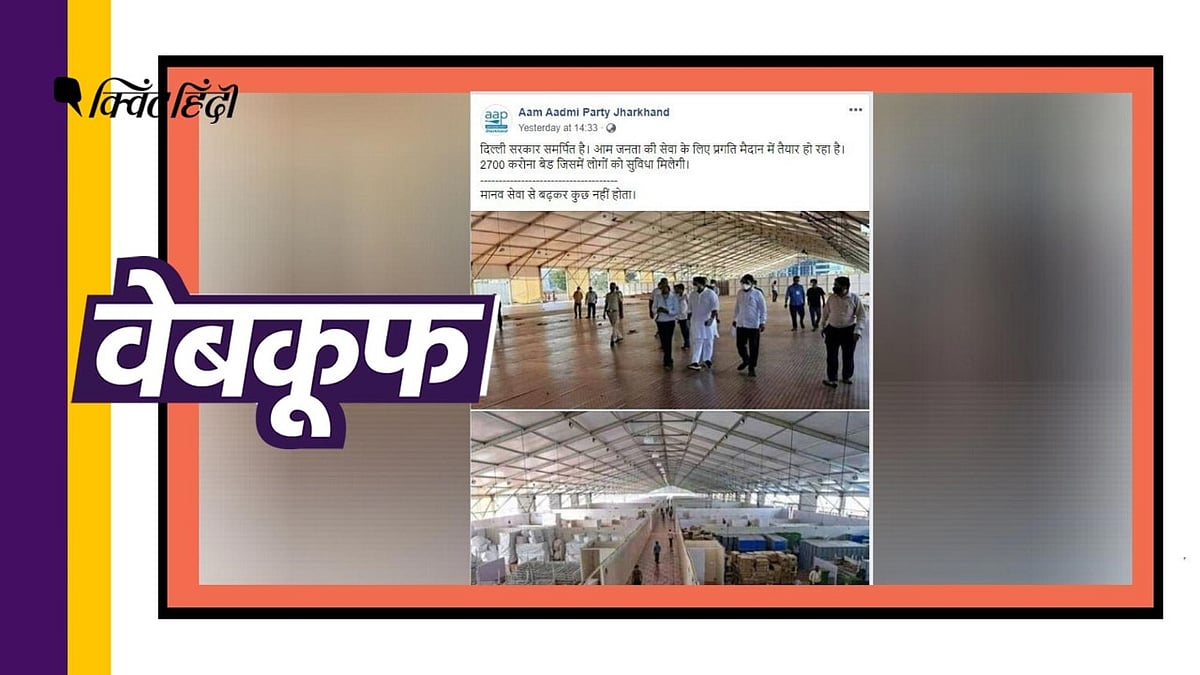
दिल्ली के प्रगति मैदान में कोरोना के मरीजों के लिए लगवाए गए जा रहे बेड की है ये फोटो
Publisher’s rating: FALSE

Añadir un salvaslip convierte una mascarilla en una FFP2
Publisher’s rating: Falso
Las personas sanas deben llevar la parte azul de la mascarilla hacia dentro para protegerse a sí misma de partículas en el ambiente
Publisher’s rating: Falso
Newtral examines an image circulated on social media claiming that mask orientation should depend on whether someone is infected: people who are healthy should wear the blue side inward to protect themselves from particles in the air, while infected people should wear it outward to protect others. The review reports that María Cruz Minguillón, a CSIC researcher, rejected this advice and points readers to the mask’s construction and the direction in which it is designed to work. [S1] The article describes surgical masks as having at least three layers. Gemma del Caño explains that the colored outer layer is water-repellent, the middle layer acts as a filter, and the inner layer absorbs moisture from exhaled breath. Sensar warns that reversing the mask can reduce protection: placing the water-repellent side inward may make breathing harder and cause moisture to accumulate against the face, while exposing the moisture-absorbing side can contaminate the mask from outside. Minguillón therefore says to wear the blue side outward and to follow the manufacturer’s instructions if the correct orientation is uncertain. [S1] The evidence presented is about mask design and the consequences of reversing the layers, not a test comparing infection outcomes for healthy and infected wearers. The review also notes that both surgical and hygienic masks protect other people more than the wearer, but it distinguishes the two types: surgical masks are designed to filter exhaled air and protect against fluid splashes, while hygienic masks are non-medical products that may be reusable. These points do not support the image’s proposed inside-out orientation for healthy people. [S1]
Para aumentar la capacidad protección de la mascarilla hay que superponer dos a la vez
Publisher’s rating: Falso

ঘৰুৱা মেডিকেল কিটত থাকিবলগীয়া সামগ্ৰী আৰু 'ক'ভিড-১৯'ৰ তিনিটা ষ্টেজৰ বিষয়ে এই বার্তাটো টাটা হেলথৰ পৰা প্ৰচাৰ কৰা হৈছে
Publisher’s rating: মিছা