PeakMetrics / Fact Checks
Health & medicine fact checks
Explore claims publishers have checked about health & medicine. Read their original ratings and follow the evidence.
Search fact checks
Search by text or image13,674 published reviews in this topic
Nach einer Corona-Impfung ist die Einstichstelle magnetisch.
Publisher’s rating: In den Corona-Impfstoffen ist nichts enthalten, was dazu führen könnte, dass Magnete an der Haut haften. Oberflächenhaftung hat nichts mit Magnetismus zu tun.
The review examines social-media posts showing people whose arms were said to be magnetic where they had received a COVID-19 vaccination. It describes the apparent demonstration as an attempt to suggest that the injection contained metal, then considers whether the vaccines or the observed effect support that interpretation. The review names the mRNA vaccines from Moderna and BioNTech/Pfizer and the vector vaccines from AstraZeneca and Janssen. As evidence about vaccine contents, the review says it checked the ingredient lists for those vaccines and found no magnetic materials such as metals. It also distinguishes adhesion from magnetism: the German health ministry attributed magnets sticking briefly to skin to surface adhesion, which can be increased by sweat, skin oils, or other residue. The review gives examples including sweat, adhesive residue from a bandage, and body cream. The review also cites magnet researcher Eric Palm, who explained that even an extremely magnetic particle injected through a very small needle would be too small to exert enough force to hold a magnet on the skin. It adds that some other vaccines contain aluminium compounds as adjuvants, but says no vaccine contains pure aluminium and that aluminium is not a magnetic metal. These points address both the proposed ingredient explanation and the skin-sticking effect shown in the posts.

30 personas se desmayaron tras recibir dosis de la vacuna Cansino en Las Condes
Publisher’s rating: Impreciso

Black Fungus came from Chicken and so avoid eating chicken to save yourself from Black Fungus
Publisher’s rating: No, there is no scientific evidence that mucormycosis can spread from chicken to humans

O fungo negro que causa medo à Índia é causado pelo uso de máscara
Publisher’s rating: Falso
Coronaprikken zijn geen vaccinaties, maar gentherapie.
Publisher’s rating: De claim dat de COVID-19 vaccins gentherapie zijn en daarmee dus geen vaccinatie, is sowieso fout. Een vaccin stimuleert een immuunrespons om te beschermen tegen een specifieke ziekte. Dat is wat de coronavaccins ook doen. Bepalen of de COVID-vaccins onder gentherapie vallen is ingewikkeld, omdat er geen wettelijke definitie is. Wat vast staat is dat de vaccins niet het menselijk DNA veranderen.
Coronavaccins beschermen helemaal niet goed.
Publisher’s rating: De cijfers zijn correct, maar bewijzen niet dat de vaccins niet zouden beschermen. Dit is de absolute risicoreductie. De hoge werkingspercentages die bekend zijn van de coronavaccins zijn de zogenaamde relatieve risicoreductie. Het absolute en het relatieve getal sluiten elkaar niet uit, maar vullen elkaar aan. De vaccins bieden wel degelijk bescherming.
The claim concerns social-media posts that cited absolute risk-reduction figures for several COVID-19 vaccines to argue that there was “virtually no protection.” The review identifies the figures as 1.3% for AstraZeneca, 1.2% for Moderna, 0.93% for Janssen and 0.84% for Pfizer, and says the cited Lancet article was a commentary, not a peer-reviewed study reporting new findings. The review explains that absolute and relative risk reduction describe the same trial outcomes in different ways. Its illustrative example compares 10 illnesses among 100 unvaccinated people with one among 100 vaccinated people: the absolute reduction is 9 percentage points, while the relative reduction is 90%. A small absolute figure therefore does not, by itself, establish that vaccination has little effect relative to the unvaccinated group. The review reports relative effectiveness figures of 95% for Pfizer, 94% for Moderna, and 67% each for Janssen and AstraZeneca. It says these figures can coexist with the lower absolute risk-reduction numbers, which depend in part on the underlying risk in the population studied. The cited commentary criticized the emphasis on relative figures without comparable attention to absolute figures; according to the review, its authors did not conclude that the vaccines offered no protection.

Polio vaccine was introduced in India in 1995. Nehru, Indira and Rajiv Gandhi could not start the vaccination during their prime ministership
Publisher’s rating: MISLEADING
The claim combines two propositions: that polio vaccine was first introduced in India in 1995, and that Nehru, Indira Gandhi, and Rajiv Gandhi did not start vaccination while they were prime ministers. The review distinguishes the introduction of routine polio vaccination from the later launch of a nationwide campaign. It reports that polio vaccine was included in India’s Expanded Programme on Immunization in 1978 and Universal Immunization Programme in 1985, whereas the National Immunization Days, also called the Pulse Polio Immunization programme, began in 1995. To check the timeline, the review cites an Indian Health Ministry document stating that the vaccine was introduced under the 1978 and 1985 programmes, with special polio campaigns beginning in 1995. It also cites a journal article describing Oral Polio Vaccine as available in India in 1967 and reporting that an indigenous trivalent vaccine was developed and produced in 1970. These details distinguish earlier vaccine availability and routine immunization from the later special campaigns. The review says vaccination was implemented during Indira Gandhi’s 1980–84 and Rajiv Gandhi’s 1984–89 tenures. Its evidence therefore contradicts the claim that vaccination began only in 1995 and supports earlier vaccination during those two administrations. The excerpts do not provide specific evidence about vaccination during Nehru’s tenure, so they do not independently establish that part of the claim.

Claim: Patanjali chairman Balakrishna not admitted in hospital for covid 19
Publisher’s rating: False
The claim concerned a video circulating in June 2021 that purported to show Patanjali chairman Acharya Balakrishna being hospitalized for COVID-19. The post’s accompanying text alleged that he had contracted the disease and was unable to breathe. Fact Crescendo examined whether the video actually documented that event; its review says the footage was shared on Facebook on June 2, 2021, by the Krishnagiri District News page.

Pasien Covid-19 yang juga terinfeksi jamur hitam yang diklaim dari di Sri Lanka
Publisher’s rating: Keliru
COVID-19 vaccines are creating SARS-CoV-2 variants
Publisher’s rating: False
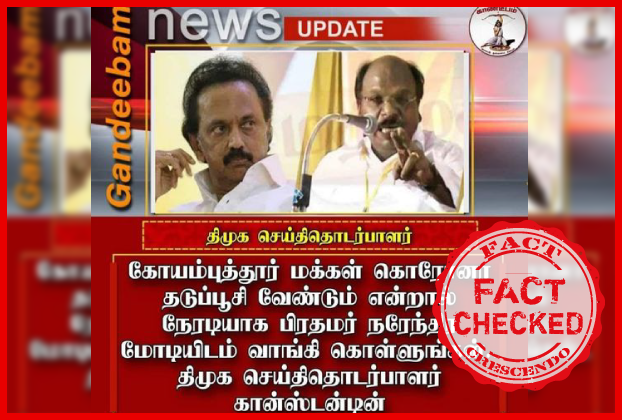
Claim: DMK spokesperson Constantine Ravindran not said Coimbatore people to ask covid vaccine from Modi
Publisher’s rating: Missing Context
واکسنهای کرونا در بدن خاصیت آهنربایی ایجاد میکند.
Publisher’s rating: شاخدار

Antibodies from COVID-19 vaccines cause stronger infection among patients.
Publisher’s rating: False