PeakMetrics / Fact Checks
Health & medicine fact checks
Explore claims publishers have checked about health & medicine. Read their original ratings and follow the evidence.
Search fact checks
Search by text or image13,673 published reviews in this topic


80% kinderen Malawi ingeënt, terwijl slechts 40% bevolking toegang heeft tot schoon water
Publisher’s rating: De tekst op de afbeelding klopt niet. Zo’n 33% van de bevolking in Malawi heeft geen toegang tot schoon water. Dat is veel, maar ruimschoots minder dan de 60% die wordt beweerd. Wel is het zo dat meer dan 80% van de kinderen tegen veel voorkomende kinderziektes is gevaccineerd. Tegen COVID-19 echter nog niet; er heerst een grote schaarste aan coronavaccins in het land.
The Facebook image combined two claims about Malawi: that 80% of children were vaccinated and that only 40% of the population had access to clean water. The review distinguishes routine childhood immunisation from COVID-19 vaccination, and checks the water figure against information it attributes to WaterAid and a WHO–UNICEF report. The image’s vaccination claim is therefore misleading if read as referring to COVID-19: the high coverage figure concerns common childhood diseases, not coronavirus. [S1: “Op Facebook wordt een foto gedeeld (hier gearchiveerd) met daarin claims over kinderen en de gehele bevolking van Malawi. Zo valt er te lezen dat 80% van de kinderen in het land gevaccineerd is, maar slechts 40% van de totale populatie toegang heeft tot schoon water.”] [S1: “De oorspronkelijke auteur, @authorkatewilliam op Instagram, lijkt aan de begeleidende tekst af te lezen niet te doelen op de coronavaccins.”] For routine childhood vaccines, the review says WHO and UNICEF’s 2019 report showed that the share of children vaccinated against each of the common childhood diseases was above 80%. It contrasts this with COVID-19: Reuters data cited in the review put the fully vaccinated share of Malawi’s population at about 1.1%, and the review says children had not yet been reached under the vaccination effort. [S1: “De Wereldgezondheidsorganisatie (WHO) en UNICEF publiceerden in 2019 gezamenlijk een rapport over de vaccinatiegraad tegen veel voorkomende kinderziektes in het land. Te zien is dat bij alle ziektes het aantal gevaccineerde kinderen inderdaad boven de 80% ligt.”] [S1: “Volgens de gegevens van onafhankelijk persbureau Reuters is tot dusverre zo’n 1,1% van de bevolking in Malawi volledig gevaccineerd tegen COVID-19.”] [S1: “Nu bekend is dat pas 1,1% een vaccin heeft gehad, moge duidelijk zijn dat kinderen nog niet aan de beurt zijn geweest.”] The water comparison also reverses the meaning of the 40% figure. The review traces that number to an article about water provision in Africa, where it referred to people in sub-Saharan countries without clean water—not to the share with access in Malawi. For Malawi specifically, it cites WaterAid’s estimate that about one in three people lacked access, meaning the image’s 40%-with-access figure substantially understates access. [S1: “Die wordt toegeschreven aan landen die ten zuiden van de Sahara liggen, maar het cijfer is hier wel precies andersom: 40% heeft geen toegang tot schoon water (en dus 60% wel).”] [S1: “Volgens hulporganisatie WaterAid heeft in het land één op de drie mensen, zo’n 33% dus, geen toegang tot schoon water.”]

Eine „Studie von fünf Universitäten” hat festgestellt, dass die Nutzen-Risiko-Bewertung bei Corona-Impfungen bisher überschätzt wurde.
Publisher’s rating: Die Publikation existiert wirklich. Methodisch weist sie allerdings erhebliche Mängel auf. Wissenschafter kritisieren die AutorInnen.
The claim refers to a real publication that argued COVID-19 vaccine risks had been underestimated, including a widely repeated estimate that two vaccine-caused deaths were incurred for every three deaths prevented. The APA review reports that the article was published by MDPI, but says the description of it as a study from five universities overstated its institutional backing: the authors were three individuals, with only two universities represented among the affiliations, one through a visiting professorship. The review also notes that none of the authors was a virologist, epidemiologist or vaccinologist. (S1) The review’s central methodological criticism concerns the death counts used in the paper. Its authors relied on the European Medicines Agency’s adverse-event database, where reported deaths occurred after vaccination but were not thereby shown to have been caused by it. The APA says the study nevertheless used such reports to estimate vaccine-caused deaths. It also describes how the authors focused on Dutch reports, which they called the most thorough dataset, and derived a figure of four deaths per 100,000 people. Applying that rate to Austria would imply about 300 deaths, while the review says the Austrian regulator had received reports of 132 deaths temporally following vaccination by mid-June. (S1) The review further challenges the study’s estimate of deaths prevented: it says the Israeli effectiveness research used for that calculation supplied mortality data only for people who had received one dose and covered about 40 days, so it could not establish the full protection from a second dose. The review therefore describes the study’s recommendation to reconsider vaccination policy as questionable. It also reports that MDPI issued an Expression of Concern over data interpretation and, in an update dated July 6, 2021, that the study had been withdrawn after the authors acknowledged errors, including treating suspected adverse events as causally linked to vaccination. (S1)

“5 commercial pilots in India just died after being vaxxed in May.”
Publisher’s rating: Unsupported
"Four British Airways Pilots have DIED of the COVID-19 Vaccine n past 7-days"
Publisher’s rating: Unsupported

Dilma: “Se a segunda dose da vacina é a que garante a imunização, então deveriam dar a segunda dose primeiro”.
Publisher’s rating: Falso

Pés gelados podem causar infarto e, por isso, devem ficar protegidos
Publisher’s rating: Falso
Video yang diklaim sebagai video penyiraman virus di wilayah Madura lewat pesawat
Publisher’s rating: Keliru
WHO bevestigt dat coronavaccins niet werken, maar juist voor slachtoffers gaan zorgen in de herfst van 2021.
Publisher’s rating: De bewering is fout. De Wereldgezondheidsorganisatie waarschuwt inderdaad voor een nieuwe golf in de herfst van 2021. Dit doen ze alleen niet omdat de vaccins slachtoffers zouden maken, maar vanwege de grote versoepelingen in verschillende Europese landen. Dit in combinatie met het feit dat nog lang niet iedereen is gevaccineerd, leidde tot de oproep van de WHO om goed op te passen. Zeggen dat de WHO met dit bericht bevestigt dat de coronavaccins niet werken, is onjuist.

FACT CHECK: වෛරස් ආරක්ෂක කාඩ්පත් පැළඳීමෙන් කොරෝනා වෛරසයෙන් ආරක්ෂා වෙනවාද?
Publisher’s rating: Misleading
The review examined a Sri Lankan advertisement for a card worn around the neck and promoted as protection against coronavirus. It said the promotion claimed the card could provide long-lasting protection and work in places such as shopping centres, classrooms and public transport. The investigation also checked the advertisement’s claim that the product had been approved by Sri Lanka’s National Medicines Regulatory Authority (NMRA). The seller told the reviewer that the imported product contained chlorine dioxide and supposedly disinfected germs in the air within about one metre. These were the seller’s claims, not findings established by the review. To check the claims, the reviewer contacted the seller using a phone number in the advertisement, then asked the Health Promotion Bureau and NMRA about approval. The review reports that both authorities said such products had not been approved for sale or for COVID-19 protection. It also explains that chlorine dioxide is a manufactured gas used to disinfect drinking water, and reports that inhalation can cause irritation affecting the nose, throat and lungs. The review cites an Indian medical specialist’s warning that chlorine dioxide used as bleach can harm the eyes, skin and respiratory system. The evidence therefore does not support treating the wearable card as established COVID-19 protection: the asserted local regulatory approval was contradicted by the authorities consulted, and the product’s claimed protective effect was not substantiated in the review. The article warns that relying on the card could create false confidence and discourage precautions such as masks and distancing. Its conclusion recommends following health guidance, including vaccination, masks and distancing, rather than relying on the card.
Leng Youbin verwacht daling in de verkoop van melkpoeder omdat vrouwen niet zwanger kunnen worden in de zes maanden na hun vaccinatie.
Publisher’s rating: De Facebookpost is fout. Het bericht is gebaseerd op een foute vertaling of interpretatie van een toespraak van Leng Youbin. De directeur van Feihe heeft het in zijn speech wel over een aarzeling bij toekomstige ouders om aan kinderen te beginnen. Mogelijk zouden ze uit angst voor bijwerkingen van het coronavaccin langer wachten om zwanger te worden. Youbin spreekt niet over een oorzakelijk verband tussen het coronavaccin en onvruchtbaarheid. Ook vanuit de medische wetenschap is daar geen enkel bewijs voor.
President Duterte said the government has to stick to the status quo of mandatory use of face shield indoors and outdoors.
Publisher’s rating: Flip-flop
Landsadvocaat geeft toe dat vaccins medisch experiment zijn.
Publisher’s rating: De video wordt iets te vroeg afgeknipt. De landsadvocaat gaat door en legt uit waarom er volgens haar geen sprake is van een experimentele fase. Alle studies omtrent veiligheid van het vaccin zijn afgerond; er wordt enkel nog gekeken naar zaken als de duur van de bescherming die het vaccin biedt.
.Brief zegt: 'maximaal 4 ongevaccineerden in deze ruimte', medische apartheid in ziekenhuis Leeuwarden
Publisher’s rating: Het briefje is echt, maar hing niet in een publieke ruimte van het ziekenhuis. Het ziekenhuis geeft zelf in een persbericht aan dat het ook absoluut niet in lijn is met het beleid. Volgens een medewerker hing de tekst in een personeelsruimte en was deze bedoeld als grap.
The claim concerned a Facebook photo of a sign reading “Maximaal 4 ongevaccineerden in deze ruimte,” said to be displayed at the “Leeuwarder Ziekenhuis”—which the review identifies as most likely the Medisch Centrum Leeuwarden (MCL). The accompanying allegation was that the hospital was creating medical segregation. The review distinguishes the sign’s existence from where and why it was displayed: it reports that the sign was real, but not in a public area for hospital visitors. The review says MCL’s own statement rejected the message as inconsistent with hospital policy. It quotes the hospital as saying that it treats everyone regardless of vaccination status and asks people to follow basic measures, including distancing and wearing a mask when needed. The review also says its check of the hospital’s COVID-19 information page found no indication that the hospital separated vaccinated and unvaccinated people. For the sign’s setting, the review cites an anonymous hospital employee active in the department where it was posted. According to that employee, colleagues had put it up in a staff changing room as a joke. On the evidence described, the photo showed a staff-room joke, not a hospital rule to divide visitors by vaccination status; that distinction is central to whether the image supports the allegation.
Dennennaaldthee bechermt je tegen spike-eiwit transmissie van gevaccineerden naar niet-gevaccineerden.
Publisher’s rating: De beweringen zijn fout. Noch dennenthee, noch suramine beschermen je tegen de transmissie van spike-eiwitten. Het houdt trouwens geen steek dat gevaccineerde mensen überhaupt spike-eiwitten overdragen aan niet-gevaccineerden. Het is een populaire antivaxtheorie die niet wetenschappelijk onderbouwd is. Bovendien kan je dennennaaldenthee zonder probleem op het internet kopen.
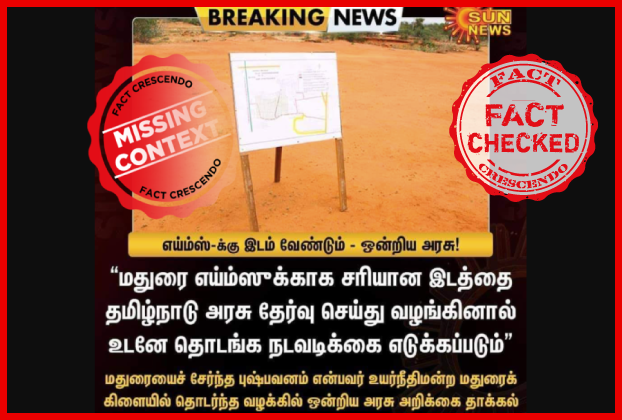
Claim: Sun News posted a misleading on Madurai AIIMS issue
Publisher’s rating: Missing Context
The review examined a Sun News card that suggested the Union government wanted Tamil Nadu to select and provide a proper location for Madurai AIIMS. It distinguished that claim from what the government reportedly sought in court: temporary facilities for an outpatient department and an MBBS medical college while construction at the already selected site remained pending. The review says 224.24 acres had been selected at Thoppur, near Madurai, and that the foundation stone was laid before construction stalled after boundary-wall work. To check the card’s provenance, the publisher says it consulted Sun News’s Facebook posts and confirmed that the channel had published the card on June 30, 2021. It then reviewed news reports about the court proceedings and contacted Madurai MP Su. Venkatesan. According to the review’s account of the government’s court statement, it was ready to start work if Tamil Nadu provided a temporary site for the outpatient service and student admissions; the government had not asked for a new permanent location for AIIMS. Venkatesan also told the publisher that the Thoppur land had been handed over and that the dispute was about temporary facilities, not relocating the project. The review therefore concluded that the card omitted the temporary-facilities qualification and made the government’s request appear to concern a new location for the hospital.
Selon les CDC américaines, il n'y a pas de pandémie de Covid.
Publisher’s rating: Le message est trompeur. Il s’inspire librement d’un extrait d’un sermon du pasteur américain John MacArthur, prononcé le 30 août 2020, qui a mal interprété un rapport des Centres de contrôle et de préventions des maladies (CDC) américaines sur les décès liés au coronavirus. Les CDC n’ont jamais affirmé qu’il n’y a pas de pandémie.

Gelekt document van Imperial College London toont dat het VK binnenkort in permanente lockdown gaat.
Publisher’s rating: De memo is nep, zo bevestigde het Imperial College London. De berichten zijn dan ook fout.
The claim concerned screenshots of an email said to be a leaked Imperial College London memo predicting that the United Kingdom would enter a “permanent lockdown” from mid-July. The screenshots carried an Imperial College heading and the subject “Next steps - permanent lockdown of the UK (Private & Confidential)”; the review says they circulated on Dutch websites and Facebook. The purported author was Professor Neil Ferguson, and the document was said to have been sent to British doctors and medical professionals. Imperial College London told the review that the memo was fabricated. The university said it was not written by Ferguson and had no connection with the college, the UK government or its scientific advisers. This directly addresses the document’s claimed authorship and institutional provenance, rather than merely disputing its prediction. The review also points to features within the document that it describes as conspicuous details and false claims, including conspiracy theories about the Delta variant, a financial crisis and global water scarcity. Taken together with the university’s denial, these details undermine the screenshots’ presentation as an authentic Imperial College memo. The supplied text does not establish who created the document.