PeakMetrics / Fact Checks
Health & medicine fact checks
Explore claims publishers have checked about health & medicine. Read their original ratings and follow the evidence.
Search fact checks
Search by text or image13,673 published reviews in this topic
COVID-19 vaccines are being to reduce the Filipino population.
Publisher’s rating: False
"These vaccines are failing & do not reduce the spread of the virus."
Publisher’s rating: The COVID-19 vaccines work
"Most of the masks you get over the counter don’t work. They don’t prevent infection."
Publisher’s rating: Masks limit virus spread

FACT CHECK: ලෝකයේ වැඩිම දෛනික කොරෝනා මරණ අනුපාතය ලංකාවෙන්?
Publisher’s rating: False

A study shows the Covid vaccine accumulating in the ovaries.
Publisher’s rating: This is false and misreads a study submitted to the Japanese regulator.
Covid caccines could attack the placenta.
Publisher’s rating: There is no evidence to support this claim and now studies are emerging to help disprove it.
টিকার দুই ডোজ নিয়ে করোনায় আক্রান্ত ৪০ হাজার
Publisher’s rating: Misleading
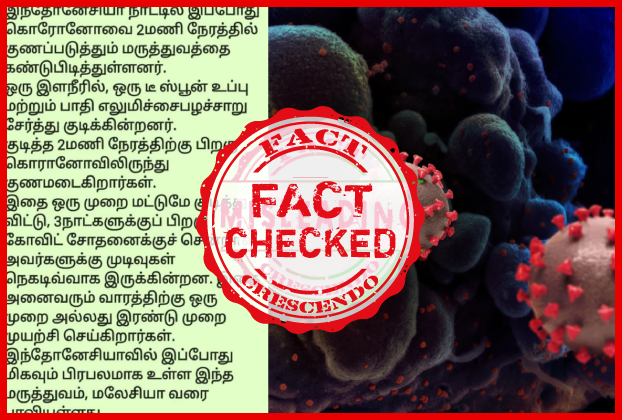
Claim: கொரோனாவை 2 மணி நேரத்தில் குணப்படுத்தும் மருந்து இந்தோனேஷியாவில் கண்டுபிடிக்கப்பட்டதா? I fake news that tender coconut lemon and honey mixture can cure covid 19
Publisher’s rating: Misleading
The claim under review was that Indonesia had discovered a coconut-based treatment that cures COVID-19 in two hours. The viral post described drinking coconut water with salt and lemon juice; the review also notes versions adding honey. It says the post was shared as a screenshot and that its author, Senthil, posted it on August 5, 2021, while acknowledging he did not know whether it was true. The review says it found no evidence that Indonesian authorities or doctors recommended the mixture as a COVID-19 cure. To check the claim’s Indonesian connection, the review traced reports circulating since September 2020. Those reports described one person who had COVID-19, self-isolated at home and drank a mixture of coconut water, honey, salt and lemon juice. The person later improved and recovered, then encouraged others to try the mixture. But, according to the review, those reports did not say that one drink eliminated COVID-19 within two hours, and the review found no reports showing patients recovered because of this mixture. The review also reports that AFP asked Indonesian university researchers about the claim, who said it was untrue. A Tamil Nadu government Siddha hospital doctor told the fact-checkers that a two-hour cure was an exaggeration and that confirming a cure would require research. The review further says the WHO’s Sri Lanka office had not endorsed the mixture as a way to destroy the virus or treat COVID-19. Taken together, the evidence described in the review does not support the specific two-hour cure claim; an individual’s reported recovery after drinking the mixture does not establish that the mixture caused recovery or cures COVID-19.
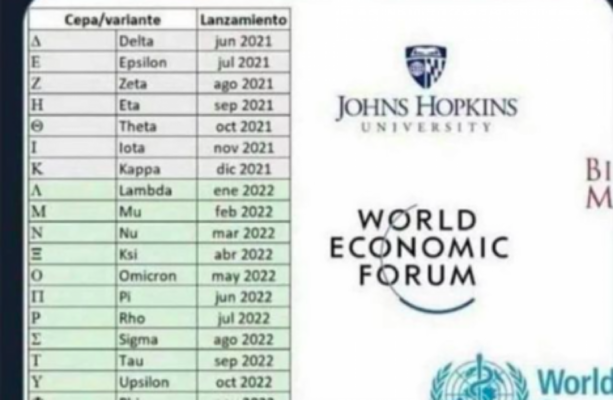
The media has been told when future Covid-19 variants will be 'released'
Publisher’s rating: False. There is no evidence to back up this claim.
Playing games on mobile cause worms in eyes, loa loa disease
Publisher’s rating: False
L'OMS admet que le Covid-19 est comme la grippe ordinaire, 500 000 Américains morts à cause des vaccins.
Publisher’s rating: C’est faux. Bien qu’il existe certaines similitudes entre le Covid-19 et la grippe, l’OMS établit toujours une distinction très nette entre les deux. En ce qui concerne les États-Unis, les autorités sanitaires américaines font état de 6 490 rapports de décès signalés après une vaccination, sans que le vaccin soit avéré comme la cause.
A vaccine monitoring site shows Covid vaccines cause miscarriages.
Publisher’s rating: False claim. There were indeed miscarriages reported in these databases - they are unfortunately common events - but this does not mean the jab caused them.

FACT CHECK: කොවිඩ් ආසදිතව මියගිය පිරිසකගේ මෘතදේහයන් අඩංගු පොලිතීන් බෑග් (Body Bags) ඡායාරුපයක් ද?
Publisher’s rating: False
Bij McDonald's in Italië krijgt iedere ongevaccineerde klant een rode sticker.
Publisher’s rating: Het bericht is onjuist. Volgens nieuwe Italiaanse regelgeving mogen enkel mensen met een coronapaspoort binnen in restaurants eten. Filialen gaan hier op verschillende manieren mee om: de één geeft stickers aan mensen mét coronapaspoort, de ander aan mensen zónder paspoort, en weer andere filialen plakken helemaal geen stickers. Daarbij gaat het niet om het verschil tussen gevaccineerd en ongevaccineerd: een coronapaspoort kan ook worden verkregen met een herstelbewijs of negatief testbewijs.
Ex-medewerker Pfizer bewijst dat er grafeenoxide in coronavaccins zit
Publisher’s rating: Dit klopt niet. Er is geen enkele reden om aan te nemen dat grafeenoxide voorkomt in de coronavaccins die in Europa en de Verenigde Staten zijn goedgekeurd. De ex-Pfizermedewerker levert ook geen bewijs waaruit dit blijkt.
The claim came from Karen Kingston, a former Pfizer employee who said documents showed that graphene oxide was in COVID-19 vaccines but that this had not been disclosed. Although she did not specify a vaccine, the review says her arguments concerned the Pfizer and Moderna mRNA vaccines. It found that the documents she cited did not establish the claim. Kingston reasoned that because the vaccines contain lipids, and Sinopeg makes a PEG lipid, Sinopeg’s website article about graphene supported her allegation. The review identifies the flaw: the lipid is not made only by Sinopeg. It names other producers of Pfizer’s ALC-0315 and ALC-0159 and says Croda supplied Pfizer’s lipids, while CordenPharma handled supply for Moderna. The Sinopeg article was listed as industry news and concerned a study unrelated to COVID-19 vaccines. The review also distinguishes a Shanghai research-centre patent for a vaccine candidate described as containing graphene oxide from the vaccines authorized for use: it found no link between that candidate and the approved vaccines. It reports that graphene-containing liquids shown in the cited study were dark brown to black, whereas available images of approved vaccines showed clear or slightly yellow liquid. It further notes that graphene oxide was absent from the public ingredient lists for the four EU-approved vaccines. These points do not turn Kingston’s cited documents into evidence that the authorized vaccines contained graphene oxide.
অধ্যাপক ডা. মীরজাদী সেব্রীনা ফ্লোরার লিখা লকডাউন পরবর্তী সময়ের স্বাস্থ্য বিধি
Publisher’s rating: False

¿Los senos aumentan de tamaño luego de ponerte la vacuna contra el covid-19?
Publisher’s rating: No hay evidencias
Kanadisches Gerichtsdokument belegt: Es gibt keinen Beweis dafür, dass Covid existiert.
Publisher’s rating: Die vermeintliche Belegstelle wurde aus dem Zusammenhang gerissen und unvollständig wiedergegeben. In dem zitierten Gerichtsdokument geht es nicht um Sars-CoV-2.
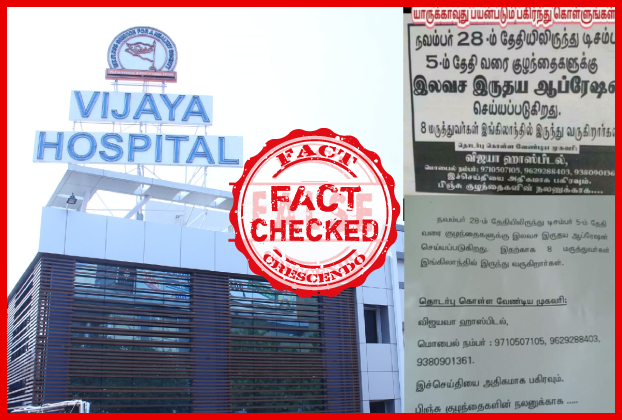
Claim: விஜயா மருத்துவமனையில் குழந்தைகளுக்கு இலவச இதய அறுவைசிகிச்சை நடக்கிறதா? I Misinformation spreading that free pediatric heart surgery camp at Vijaya hospital
Publisher’s rating: FALSE
The review examined social-media posts claiming that Vijaya Hospital would provide free heart operations for children from November 28 to December 5, with eight doctors arriving from England. The posts listed contact numbers and urged people to share the information. One version was posted by the Facebook page Kanyakumari District on August 2, 2021; a similar poster had been posted by Kanakalingam Bakkiyaraja on November 24, 2020. The article says the posts did not identify the hospital’s town and used both “Vijaya” and “Vijayava” spellings. To check the claim, Fact Crescendo says it called the listed numbers, which were no longer in service, and searched for a hospital called Vijayava but found none. It then contacted Chennai Vijaya Hospital. The hospital’s chief public relations officer, Ujwala, told the review that no free pediatric heart-surgery camp was taking place there. She also said the hospital did not have a pediatric cardiac surgery department and did not perform children’s heart surgeries. The review reports that the hospital received repeated calls about the rumour each year, beginning in October, and had assigned an operator to explain that the claim was false. The review’s conclusion therefore rests on the hospital representative’s direct response and the stated absence of the relevant pediatric surgical service, alongside checks of the contact numbers and the hospital name. It does not provide independent records of the advertised camp or identify another hospital at which the surgery might have been offered. Its evidence addresses the specific claim about Vijaya Hospital, rather than establishing that free pediatric heart surgery was unavailable elsewhere.