PeakMetrics / Fact Checks
Health & medicine fact checks
Explore claims publishers have checked about health & medicine. Read their original ratings and follow the evidence.
Search fact checks
Search by text or image13,673 published reviews in this topic
Japan heeft de vaccins van Moderna en Pfizer verboden.
Publisher’s rating: Het klopt dat Japan myo- en pericarditis heeft opgenomen in de lijst met bijwerkingen van de vaccins van Pfizer en Moderna. Het is echter niet waar dat het land deze vaccins dan ook verboden heeft. Vaccinatie met Moderna en Pfizer gaat gewoon door in Japan.
The claim concerned a screenshot shared on Facebook that appeared to show a Japanese news report describing myocarditis and pericarditis as serious side effects of the Pfizer and Moderna vaccines. Posts used that report to assert that Japan had consequently banned both vaccines. The review identifies the screenshot as coming from an ANN (All-Nippon News Network) broadcast about an expert panel considering vaccine side effects; the broadcast was posted on YouTube on 3 December 2021. [S1: “De screenshot in de posts komt uit het nieuws van ANN (All-Nippon News Network), op Youtube geplaatst op 3 december 2021. De nieuwsuitzending gaat over een panel van experts dat zich buigt over de bijwerkingen van de vaccins.”] The review reports that Japan’s Ministry of Health did add myocarditis and pericarditis to the possible-side-effects information for both vaccines. But it found no announcement of a ban in the broadcast or in articles about the issue. It also checked the vaccine-status information on the ministry’s website and covid19.trackvaccines.org, which, according to the review, still listed both vaccines as approved in Japan. [S1: “Het Japanse ministerie van Gezondheid heeft ten gevolge hiervan inderdaad myo- en pericarditis opgenomen op de lijst van mogelijke bijwerkingen van de vaccins van Pfizer en Moderna (onder 'side effects').”] [S1: “In de nieuwsuitzending en in artikelen over het thema wordt dat nergens vermeld. Op de website covid19.trackvaccines.org (laatste update: 8 december) en op de website van het ministerie van Gezondheid staan beide vaccins nog aangegeven als goedgekeurd in Japan .”] The review further says that Japan’s ministry explained the possible link in a Q&A and described these heart conditions as extremely rare and mainly mild after vaccination. It reports that the ministry considered vaccination’s benefits to outweigh the potential risks. The evidence therefore distinguishes adding a possible side effect to safety information from withdrawing approval or stopping vaccination. [S1: “Het artikel vermeldt dat, hoewel een mogelijke bijwerking, deze hartaandoeningen uiterst zelden en voornamelijk in lichte vorm voorkomen na vaccinatie. Het artikel stelt dan ook dat de voordelen van vaccinatie nog steeds groter zijn dan de mogelijke risico's van bijwerkingen.”]
Die Tabelle beweist: Die Omikron-Variante war eigentlich erst für Mai 2022 geplant.
Publisher’s rating: Die Tabelle stammt nicht von den angegebenen Organisationen. Die Daten stimmen nicht mit dem Auftreten der Varianten von Sars-CoV-2 überein.
The claim concerns a Facebook table headed “Lanzamiento” (“launch” or “introduction”), which lists “may 2022” beside Omicron and displays logos for several organizations. The review checked whether the table was authentic and whether its dates matched the variants’ documented appearances. It reports that none of the websites of the organizations whose logos appear on the table—Johns Hopkins University, the World Economic Forum and the WHO—contained such a table, and that the review found no other evidence of its authenticity. The dates also conflict with the chronology described in the review. The WHO’s page listed variants alongside their first appearances, and the review says none of those dates matched the table’s purported release dates. In particular, the table placed Delta in June 2021, while the review says Delta had appeared in October 2020. It further reports that Omicron had been circulating since November 2021, rather than first being due in May 2022. The review explains that the WHO tracks changes in the virus and classifies variants according to their spread and available evidence; it also describes new mutations as a natural process that cannot be predicted or planned. The table’s sequence of one new variant each month is inconsistent with the review’s account of the dates for other listed variants as well. Taken together, the source checks and timeline comparisons undermine the table’s implication that Omicron had been scheduled for May 2022.

Face shields helped control Delta spread in PHL
Publisher’s rating: No basis

Die Covid-Impfstoffe wurden zu schnell entwickelt und haben nur eine Notzulassung. / Claim 2: Die Langzeitwirkungen der Impfung sind nicht erforscht. / Claim 3: Die Impfung verhindert weder Infektion noch Übertragung. / Claim 4: Testen ist sicherer als Impfen.
Publisher’s rating: Stimmt nicht: Die Impfstoffe haben nicht nur eine Notzulassung. Die schnelle Entwicklung macht die Impfstoffe nicht weniger sicher oder wirksam als solche, deren Entwicklung länger gedauert hat. / Claim 2: Langzeitwirkungen sind bei Impfstoffen unwahrscheinlich. / Claim 3: Stimmt grundsätzlich - aber die Impfung schützt vor einem schweren Verlauf der Krankheit und Geimpfte spielen eine wesentlich geringere Rolle bei Infektionen. / Claim 4: Stimmt nicht. Schnelltests sind nicht immer zuverlässig und können deshalb nur eine zusätzliche Sicherheitsmaßnahme sein.
Vaccinations are causing a rise on positive COVID-19 cases and hospitalizations.
Publisher’s rating: False
Le nombre d'hospitalisations liées au Covid-19 a diminué au Japon depuis la recommandation de l'Association médicale de Tokyo d'un traitement avec l'ivermectine.
Publisher’s rating: L'Association médicale de Tokyo n'est pas une organisation gouvernementale. Les autorités japonaises n'ont pour l'instant pas autorisé l'utilisation de l'ivermectine contre le Covid-19.
The claim originated in a Facebook post published on 28 November 2021. It presented a graph said to use figures from Japan’s health ministry and asserted that Covid-19 hospitalizations fell sharply after the Tokyo Medical Association recommended ivermectin. The review distinguishes that association’s position from a decision by Japan’s government: it describes the association as an independent body that lobbies and offers expert recommendations, not as a government organization. (S1)

Curd Rice is the only source of Tryptophan
Publisher’s rating: MISLEADING
The post claimed that curd rice is the only source of tryptophan. FACTLY’s review says that is not the case: it identifies curd, rather than rice, as the ingredient containing tryptophan, and lists cheese, chicken, egg whites, milk, nuts and seeds as other sources. It also explains that tryptophan is an essential amino acid that the body cannot synthesize and must obtain from food. The review distinguishes curd rice’s role as a combination from the claim that it is a unique source. It says curd supplies tryptophan while rice supplies carbohydrates, and describes how the combination may affect tryptophan’s uptake by the brain. That discussion helps explain why curd rice may be valued, but does not support the claim that it is the only source. The review concludes that curd rice is not the only source.
Dr. Anthony Fauci said COVID-19 hospitalizations are rising among those who are vaccinated.
Publisher’s rating: Misleading
The World Health Organization's VigiBase shows there are over 2.5 million adverse reactions to the COVID-19 vaccine
Publisher’s rating: Needs Context



Una película llamada "La variante ómicron" predijo o sabía de la existencia de la variante del coronavirus en 1963
Publisher’s rating: Falso/ Manipulado

רק 0.003% מהילדים שיחלו בקורונה ידרדרו למצב קשה
Publisher’s rating: דרוש הקשר
The review assessed Michal Shir’s claim about the risk of severe illness among children who contract COVID-19. Shir referred to healthy children and, the review says, appeared to mean children aged 5–11, whose vaccination campaign had recently begun. The investigation compared figures presented in a parliamentary committee with a position paper from the Israeli Association of Pediatrics and the Israeli Society for Pediatric Infectious Diseases. The committee’s figures for all children aged 0–18 showed a higher severe-illness rate, but the review cautioned that this was a broader age group than the one Shir apparently meant. [S1: “נתונים שונים שהוצגו בוועדה מלמדים כי מתוכם בין 0.03% ל-0.04% חלו במחלה קשה. זה קצת מבלבל, אבל אלה נתונים הגבוהים פי עשרה מהנתון שציינה שיר”] For ages 5–11, the position paper’s count of children hospitalized in critical or severe condition, or who died, corresponded to the 0.003% figure Shir cited. But the review identified an important omission: that calculation did not include PIMS, a serious condition that can appear weeks after infection and recovery. It reported that 0.03% of infected children in this age group developed PIMS, and that 60%–70% of children with the condition required intensive care. Adding those cases to the severe cases counted during the infection itself produced an estimated 0.034% facing severe harm. [S1: “בנייר עמדה שפרסם האיגוד לרפואת ילדים והחוג הישראלי למחלות זיהומיות בילדים לקראת אישור החיסון לגילאים 5-11, הוצג מספר הילדים שאושפזו במצב קשה, קריטי, או נפטרו מקורונה מתחילת המגפה ועד לסוף חודש אוקטובר. מספר זה אמנם עומד על 64.5 לכל שני מיליון ילדים, קרי 0.003%, כפי שציינה שיר. אלא שאליו יש להוסיף עוד מאות מקרים של ילדים שפיתחו תסמונת MIS-C (Pediatric Inflammatory Multisystem Syndrome) המוכרת כתסמונת PIMS.”] [S1: “הן בוועדה של שיר והן במסמך של האיגוד לרפואת ילדים צוין כי 0.03% מהילדים בני 5-11 שנדבקו בקורונה צפוים גם לפתח לאחר מכן את התסמונת המסוכנת הזו - פי עשרה מאחוז הילדים שיחלו במצב קשה בזמן המחלה מהנגיף עצמו.”] The review also noted that the severe-case figure did not capture every child who needed hospital care: 460 of 223,850 infected children aged 5–11 were hospitalized, or 0.2%. Its conclusion was therefore qualified: the 0.003% figure matched the count of severe, critical, or fatal COVID-19 cases in the stated age group, but left out PIMS and other hospitalizations. [S1: “מתוך 223,850 הילדים בני 5 עד 11 שחלו מתחילת המגפה, 460 אושפזו בבתי חולים (0.2%), 72 מהם במצב בינוני עד קריטי (0.03%), שני מספרים ששוב גבוהים בהרבה מזה שהזכירה שיר.”]

Es sterben mehr Geimpfte als Ungeimpfte.
Publisher’s rating: Irreführend. In der Tat starben in den letzten Wochen teilweise mehr vollständig Geimpfte an Covid-19 im Krankenhaus als Ungeimpfte. Das bedeutet aber nicht, dass die Impfstoffe wirkungslos sind. Sondern es hat damit zu tun, dass - insbesondere in den Jahrgängen über 60 - inzwischen 90 Prozent der Menschen geimpft sind. Die verbleibenden zehn Prozent Ungeimpfte haben ein viel höheres Risiko, schwer an Corona zu erkranken - es ist rund 5,5 Mal so hoch wie das der Geimpften.
Er zit 50 keer zo veel kankerverwekkende ethyleenoxide op teststaafjes dan toegestaan.
Publisher’s rating: De claim mist degelijke wetenschappelijke onderbouwing. Ethyleenoxide wordt gebruikt bij de sterilisatie van wattenstaafjes voor coronatests, maar dat proces is aan strikte regels onderworpen. De aanwezige ethyleenoxide wordt op het einde van het proces weer verwijderd en is in die situatie niet gevaarlijk.
The claim came from a screenshot of a Frontnieuws headline, based on an interview in the Austrian weekly Wochenblick with German engineer and former professor Werner Bergholz. It asserted that coronavirus-test swabs contained 50 times the permitted amount of ethylene oxide (EO). The review reports that Bergholz did not give a source for that figure in the interview. A separate document bearing his name cited a 2004 American study, but that study examined sterilization methods for various items, including office supplies and Q-tips, in the context of the 2001 U.S. anthrax attacks—not the claimed contamination level on coronavirus-test swabs. The cited study concluded that no sterilization method was perfect and said EO-treated items might need airing before use. It did not conclude that EO sterilization was dangerous or impermissible. The review therefore finds that the study does not establish Bergholz’s numerical claim. It also explains that EO is used to sterilize medical equipment, including test swabs, and that residual EO is removed through aeration under regulated procedures. The review cites a 2017 study finding that residual EO was too low to measure three weeks after sterilization, and says permitted residues depend on exposure method, frequency, and duration. On the evidence presented, the cited material does not demonstrate that swabs exceed the permitted limit by 50 times.


Aus Zahlen der EMA-Datenbank EFVV ergibt sich, dass bis zum 6. Dezember 79 Kinder im Alter von 0 bis 17 Jahren an Coronaimpfstoffen gestorben sind.
Publisher’s rating: Die Behauptung ist falsch. Eine Datenbank der Europäischen Arzneimittelagentur EMA über gemeldete Verdachtsfälle von Arzneimittelnebenwirkungen gibt weder Auskunft über nachgewiesene Nebenwirkungen noch über die Kausalität von Todesfällen.
The claim concerned a graphic circulated on Facebook in Luxembourg. It attributed to the European Forum for Vaccine Vigilance (EFVV) the assertion that, by 6 December 2021, 79 children aged up to 17 had died “as a result of” COVID-19 vaccination. The review challenges the inference that the count of reports in the European Medicines Agency’s database establishes that those deaths were caused by vaccines. [S1: “In einem in Luxemburg verbreiteten Facebook-Post wird eine Grafik mit dem Logo der EFVV geteilt, die sich auf die EMA-Datenbank beruft. Darin wird behauptet, dass bis zum 6. Dezember 2021 insgesamt 79 Kinder bis zum Alter von 17 Jahren «an den Folgen der Impfung» gegen Corona gestorben seien.”] The review explains that the database records suspected adverse-reaction reports, not confirmed side effects or established causes of death. It quotes the database’s own qualification that reported cases “are not necessarily related to or caused by” a medicine. The presence of a suspected adverse event in the database therefore does not, by itself, show that vaccination caused it. [S1: “Tatsächlich befasst sich die Datenbank der Europäischen Arzneimittelagentur über gemeldete Verdachtsfälle von Arzneimittelnebenwirkungen - wie der Name vermuten lässt - mit reinen Verdachtsmeldungen zu Arzneimittelnebenwirkungen. Auf der Webseite der Datenbank wird ausdrücklich darauf hingewiesen, dass diese Verdachtsfälle von Nebenwirkungen «nicht notwendigerweise mit dem Arzneimittel in Zusammenhang stehen oder von ihm verursacht wurden».”] The review further reports that the database cautions against interpreting reports as proof either that a medicine caused an observed effect or that it is unsafe. It says reliable conclusions about a medicine’s benefits and risks require detailed assessment and scientific review of all available data. It also notes that suspected effects can have other explanations, including an illness or interactions between medicines, and that the database’s entries cannot be used to estimate the likelihood of a side effect. Thus, the reported number does not establish the claim’s causal wording. [S1: “Zudem wird betont: «Angaben zu Verdachtsfällen von Nebenwirkungen dürfen nicht so verstanden werden, als hätte das Arzneimittel oder der Wirkstoff die beobachtete Wirkung verursacht oder als sei das Arzneimittel oder der Wirkstoff nicht sicher in der Anwendung.» Erst die detaillierte Auswertung und wissenschaftliche Überprüfung aller verfügbaren Daten erlaube es, belastbare Schlussfolgerungen über Nutzen und Risiken eines Arzneimittels zu ziehen.”] [S1: “Nebenwirkungen könnten auch von anderen Faktoren ausgelöst sein, beispielsweise durch die Erkrankung oder durch eine Wechselwirkung mehrerer Medikamente. Die Informationen der Datenbank könnten «nicht herangezogen werden um die Wahrscheinlichkeit abzuschätzen, mit der eine Nebenwirkung auftritt».”]
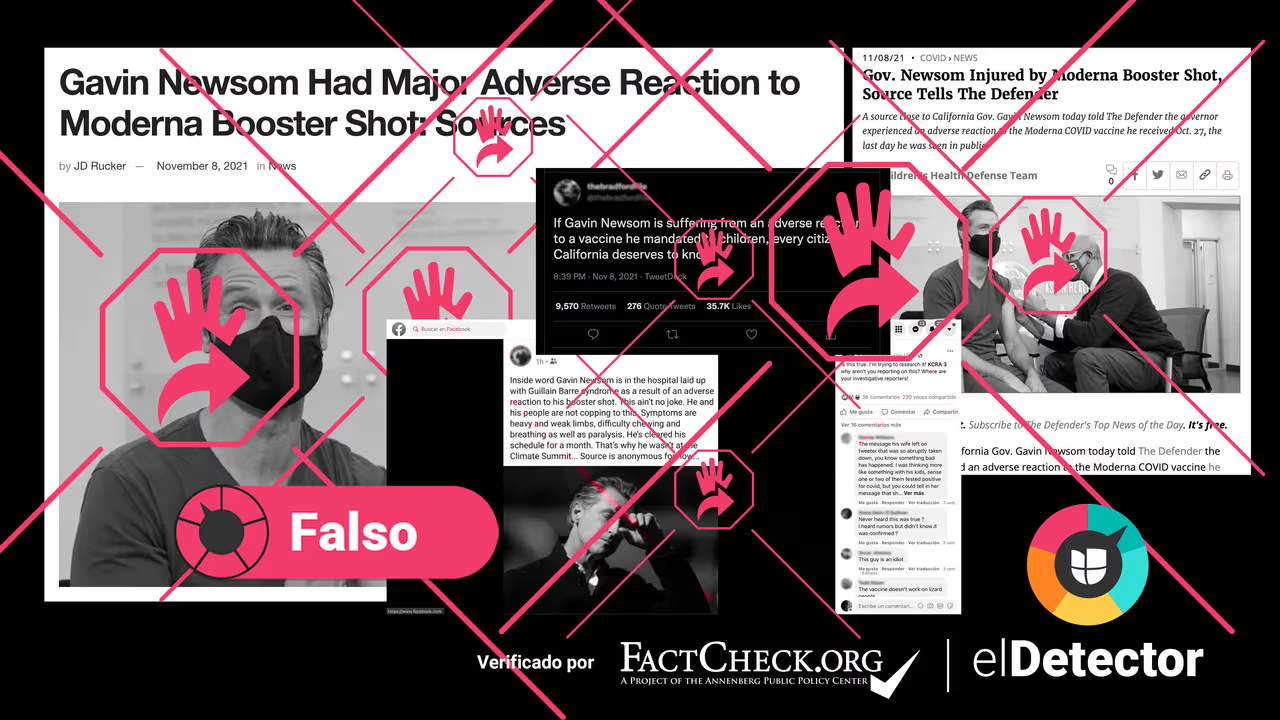
El gobernador de California, Gavin Newsom, sufrió una reacción grave por la dosis de refuerzo de la vacuna contra el covid-19
Publisher’s rating: Falso

OMS vai ser julgada em "Nuremberg 2021" por crimes contra a humanidade por promover vacinação
Publisher’s rating: Falso