PeakMetrics / Fact Checks
Health & medicine fact checks
Explore claims publishers have checked about health & medicine. Read their original ratings and follow the evidence.
Search fact checks
Search by text or image13,667 published reviews in this topic

Volgens het CDC zijn gevaccineerde mensen minder goed beschermd tegen de nieuwe BA.2.86 Covid-variant dan ongevaccineerde mensen.
Publisher’s rating: Nee, het CDC stelt dat de nieuwe coronavariant mogelijk besmettelijker is dan eerdere varianten. Dat geldt óók voor gevaccineerde mensen, maar daardoor niet minder voor ongevaccineerden. Er wordt een vergelijking getrokken tussen virusvarianten, niet tussen wel- en niet-gevaccineerde mensen.

Can oiling of the navel cure joint pain?
Publisher’s rating: False
The review addresses a social-media claim that applying oil to the navel can cure joint pain. It describes the broader post as attributing several benefits to navel oiling, including skin moisturising, treating infection and reducing menstrual pain. The review explains that the practice, also called the Pechoti technique, is traditionally based on beliefs about the navel’s connections to the body; those beliefs do not themselves establish that oil applied there treats joint pain. It reports that the investigators “couldn’t find enough scientific evidence to support the claim that oiling the navel can directly cure joint pain.” (S1: “A social media post on Pinterest claims that oiling the navel has several benefits: moisturising skin, curing infection, improving fertility, reducing pimples and acne, and decreasing menstrual pain.”; “Navel treatment, or the Pechoti technique, is a traditional Ayurveda technique that refers to applying oil to the navel to detoxify the body and fix different afflictions.”; “We couldn’t find enough scientific evidence to support the claim that oiling the navel can directly cure joint pain, as joint pain can have various causes, including inflammation, injury, arthritis, or underlying health conditions.”) The review also sought an orthopaedic surgeon’s assessment. Dr. Dhruv Rawal said scientific proof for the practice in treating joint pain is limited and described joint-pain management as requiring diagnosis and a broader treatment approach. He cautioned that oil treatment might provide temporary comfort but is not a stand-alone remedy. The article therefore distinguishes possible temporary comfort from evidence that navel oiling cures the underlying pain. (S1: “Putting oil on the navel is a traditional Ayurvedic technique, but there is limited scientific proof that it is useful in treating joint pain. Joint pain management necessitates a multifaceted strategy that includes accurate diagnosis, medical treatment, physiotherapy, and self-care. While oil treatment may provide temporary comfort, it is not a stand-alone remedy.”) The article includes a second orthopaedic surgeon’s general advice for managing joint pain: rest or immobilisation for acute pain or flare-ups, hot or ice packs, and appropriate medication, with medical attention for worsening or persistent pain or swelling. For chronic arthritic pain, the advice includes healthy activity and weight management. These recommendations provide context for the review’s conclusion, but the excerpt does not report a clinical trial specifically testing navel oiling. Its stated basis is the absence of sufficient scientific evidence and the expert’s assessment, rather than a described experimental comparison. (S1: “The most important aspect of managing acute pain or exacerbation of chronic pain is by Rest or joint Immobilization. Hot or ice packing will soothe joint pain. Topical NSAIDs or oral medications like paracetamol or ibuprofen are helpful.”; “Contact your doctor if the pain accumulates, is associated with joint swelling, or is not responding to conservative management.”; “Chronic pain, like arthritic pain, can be managed with weight reduction with a healthy, balanced diet and active lifestyle, including aerobic and resistance exercises.”)


Ab 01.06.2023 ist jede Impfung welche in Österreich verabreicht wird auf mRNA-Basis.
Publisher’s rating: Das ist falsch. Von den allgemein empfohlenen Impfungen sind nur die Covid-19-Impfungen der Hersteller Biontech/Pfizer und Moderna solche auf mRNA-Basis.
The claim concerns all vaccinations administered in Austria from June 2023, not just Covid-19 shots. The review compares it with Austria’s 2023–2024 national immunization plan, which lists the vaccinations generally recommended in the country. It reports that the list includes Covid-19 vaccines as well as vaccines for diseases including diphtheria, measles, mumps, rubella, tetanus and tick-borne encephalitis (FSME). The claim’s blanket wording therefore does not match the range of vaccines listed in that plan. The review says that, among the generally recommended vaccines, only the Covid-19 vaccines from BioNTech/Pfizer and Moderna use mRNA technology. It also points to a graphic on gesundheit.gv, an information platform operated by Austria’s health ministry: under the heading for mRNA vaccines, the graphic lists only those two Covid-19 vaccines. These details directly address the technology used by the recommended vaccines, rather than establishing that every vaccine administered in Austria is mRNA-based. The review further distinguishes other vaccine types. It says measles, mumps, rubella and chickenpox vaccines are live vaccines, while vaccines for a range of other diseases—including hepatitis A and B, typhoid, pertussis, meningococcal disease, rabies, influenza, FSME and tetanus—are in the inactivated-vaccine category. It identifies AstraZeneca and Janssen Covid-19 vaccines as vector vaccines, another example that the review says is not mRNA-based. The article’s evidence thus contradicts the claim’s assertion that all vaccinations administered in Austria from the specified date share the same mRNA basis.

Die Weltgesundheitsorganisation will mit dem Pandemievertrag die Grundrechte der Mitgliedstaaten beschneiden und deren Souveränität untergraben.
Publisher’s rating: Die Behauptungen in den geteilten Postings sind teilweise irreführend. Die Souveränität der Mitglieder wird nicht ausgehebelt. Kritik an dem Vertragsvorentwurf gab es allerdings schon, insbesondere bezüglich des schnellen Tempos und der massiven Erweiterung der Kompetenzen der WHO im Notfall.
The review examines claims that the WHO’s pandemic treaty would restrict member states’ fundamental rights and undermine their sovereignty. It distinguishes the treaty negotiations from a separate process to revise the International Health Regulations (IHR). The treaty was assigned to an intergovernmental negotiating body after WHO members agreed in November 2021 to develop it; the review says its intended adoption was May 2024. The IHR process, meanwhile, concerns rules under which the WHO can declare an international public health emergency. The review notes that the WHO’s existing emergency declarations were accompanied by recommendations, not orders, and that member states ultimately decided their pandemic-response measures. The review describes the treaty’s stated aims as strengthening member states’ capacity, clarifying pandemic procedures, coordinating international health work and improving equitable access to medical supplies. It does not present those aims as proof that sovereignty could never be affected. Rather, it weighs the sovereignty claim against the review’s account of the legal framework: binding WHO agreements allow states to apply them within their own constitutions, and the treaty was to be checked for compatibility with Article 19 of the WHO Constitution. The review says this provision safeguards members’ democratic order and parliaments from being overridden by international treaties. It also reports substantive criticism of the proposals. An analysis by Silvia Behrendt and Amrei Müller argued that both the treaty negotiations and IHR revision were unusually fast, and that proposed IHR changes could greatly expand WHO authority during emergencies. The review therefore presents the sovereignty claim as overstated, while acknowledging concerns about the pace of negotiations and the possible reach of emergency powers.
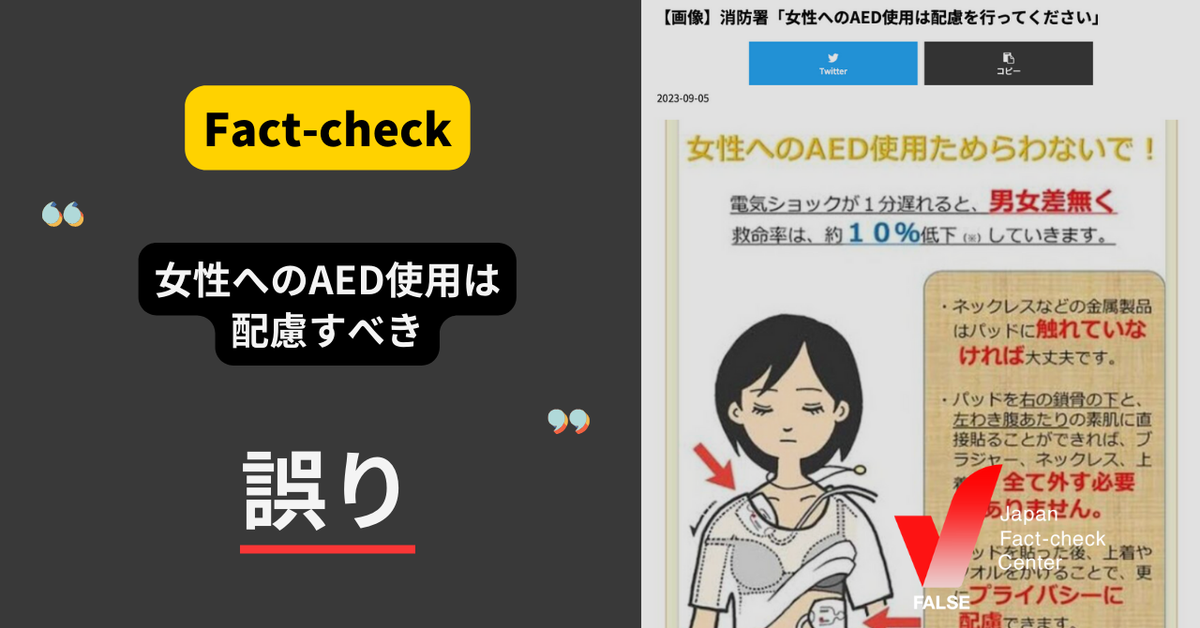
消防署が女性へのAED使用に配慮を呼びかけ
Publisher’s rating: 誤り
A viral post suggested that the Toyota City Fire Department urged people to take special care when using an AED on women. The review found that the department’s leaflet instead urged people not to hesitate, explaining that a prompt shock is needed while respecting privacy; it also said the pads can be placed on bare skin without removing a bra or outer clothing.

Deze video toont grafeenoxide in een petrischaaltje. Dat zit tegenwoordig in antibiotica en in coronavaccins.
Publisher’s rating: Nee, de video toont geen grafeenoxide, maar kleine metalen balletjes, die blootgesteld worden aan elektrische spanning in een wetenschappelijk experiment. Hoewel de toepassing van grafeenoxide in medicijnen wel wordt onderzocht, is er geen enkele aanwijzing dat het momenteel al in voor mensen toegestane medicijnen wordt verwerkt. Grafeenoxide zit ook niet in de geautoriseerde coronavaccins.
the CDC removed COVID-19 VAERS from its website?
Publisher’s rating: Mostly False

Llegó un cargamento de arroz que no pasó las normas de sanidad porque trae un virus
Publisher’s rating: Falso

Geimpfte sind laut CDC anfälliger gegenüber der neuen Corona-Variante als Ungeimpfte.
Publisher’s rating: Die Behauptung ist falsch. Die US-Gesundheitsbehörde hat den Schutz von Geimpften nicht mit dem Schutz von Ungeimpften verglichen. Sie vergleicht das Infektionsrisiko verschiedener Virusvarianten.
A blog claimed that the World Health Organization was calling for mass vaccinations in order to combat climate change.
Publisher’s rating: MISLEADING: WHO officials talked about how climate change was causing some diseases to spread to new places and said that vaccines could help mitigate the spread. They did not call for mandatory mass vaccinations.

అల్యూమినియం పాత్రలలో వంటలు చేయడం, అలాగే అల్యూమినియం ఫాయిల్స్ వాడడం ద్వారా అల్జీమర్స్, తల నొప్పి వంటి వ్యాధులు వస్తున్నాయి
Publisher’s rating: MISLEADING
pineapple increases blood circulation
Publisher’s rating: Missing context
Research from related reporting includes one article that says pineapple contains bromelain, which may promote menstrual flow, and that it can improve blood circulation. The article presents these as health claims in a discussion of foods that may help regulate irregular periods; the excerpt does not describe a study or other method used to test whether pineapple increases circulation. [S4] Accordingly, the supplied reporting shows that the claim is made, but does not provide evidence establishing that pineapple increases blood circulation. The excerpt also does not specify how much pineapple would be needed, what measure of circulation is meant, or whether the proposed effect applies beyond the menstrual context discussed.
The new BA.2.86 variant of covid-19 is more likely to infect people vaccinated against COVID-19.
Publisher’s rating: Misleading

Video depicting Zombie virus outbreak in China
Publisher’s rating: FALSE
The claim concerns a video shared on social media as showing a zombie-virus outbreak in China. FACTLY reports that the footage instead comes from “Train To Apocalypse,” a staged, zombie-themed event in Jakarta, Indonesia. In the event, performers dressed as zombies approached passengers and security guards at railway stations and on metro trains; the footage therefore shows a performance, not a real outbreak. To identify the video, the review says it used reverse image searches on screenshots and found social-media posts identifying similar footage as “Train To Apocalypse.” It also located videos on the Pandora Box Instagram page showing zombie encounters at stations and inside metro trains. FACTLY compared those visuals with the video in the post and concluded they matched the Indonesian event. The review describes “Train To Apocalypse” as an event organised by Jakarta Light Rail Transit and Pandora Box to promote public transportation. It says the event ran from 05 August 2022 to 11 September 2022 in Jakarta, and that actors attacked passengers and security guards as part of the paid experience. This provenance explains why the footage can look like an outbreak while not depicting one, and why the China attribution is misleading.

Ever wonder how diseases spread so fast? Bill Gates normally has his men drop the mosquitos from the helicopters at night when nobody can see it… but on this day there was a delay and they were forced to release in broad daylight! BILL GATES IS EVIL
Publisher’s rating: Misleading

Prezydent Ukrainy Wołodymyr Zełenski rzekomo jest uzależniony od narkotyków.
Publisher’s rating: Fałsz