PeakMetrics / Fact Checks
Economy & business fact checks
Explore claims publishers have checked about economy & business. Read their original ratings and follow the evidence.
Search fact checks
Search by text or image7,104 published reviews in this topic
The overall unemployment [rate] among the youth is at 55%.
Publisher’s rating: The overall unemployment [rate] among the youth is at 55%.
The United States and Britain are each other's "largest" trade partner.
Publisher’s rating: False.

All banks will remain closed on all Saturdays from 1 June onwards.
Publisher’s rating: FALSE
Kenya’s unemployment rate “currently staggers above 39.1%.
Publisher’s rating: Incorrect

German government has lowered the raised fuel prices, as its people abandoned their cars on road as a mark of protest.
Publisher’s rating: FALSE
The claim links an image of cars on a road to a protest in Germany against rising fuel prices, and says the government lowered prices in response. The review’s investigation focuses on whether the image shows that protest. It says the image instead depicts a traffic jam in Shenzhen, China, so the photo does not support the claimed German protest. The excerpt does not independently verify whether the German government lowered fuel prices.
First time applicants for Quickmart Supermarket must pay sh.200 to be considered for job openings
Publisher’s rating: False.

Diariamente salen de nuestra nación tres millones de dólares en combustible
Publisher’s rating: Engañoso
Di bawah pemerintahan Joko Widodo, tiket kereta Jakara-Surabaya saat mudik harganya mencapai Rp1.500.000.
Publisher’s rating: Sesat
My 2-cent wealth tax can pay for universal child care, free college tuition and reduce loan debt for 95 of students.
Publisher’s rating: Maybe.
Australian Chamber of Commerce and Industry chief executive James Pearson claims increasing the minimum wage is risky because it is already one of the highest in the world
Publisher’s rating: Mostly True - Mostly accurate, but there is a minor error or problem
"Nearly 1 in 4 people in poverty works full-time."
Publisher’s rating: Overblown
Adam Bandt made the claim while calling for a higher minimum wage, citing poverty reports that counted people living in households where the designated reference person worked full-time. The review found that the 2018 report’s figure—one in four—described a household reference person’s employment status, not necessarily the work status of every person in that household. The review notes that the method assigns that person’s characteristic to other household members, including children and people who are unemployed or work part-time. To test the claim about individuals, the review asked three experts to estimate the share of working-age people in poverty who themselves worked full-time. Their estimates were 12.6 per cent, 12.2 per cent and 15.6 per cent. These figures are well below one in four, though the review also reports that the estimates depend on choices made in poverty analysis, such as who to include and how to treat household size and extreme incomes. The central distinction is therefore between a household-level statistic and a claim about individual workers. The reports’ reference-person measure can support a statement about people living in households whose reference person works full-time; by itself, it cannot establish that one in four people in poverty personally works full-time. On the individual-status analysis described by the review, Bandt’s wording overstates the share.
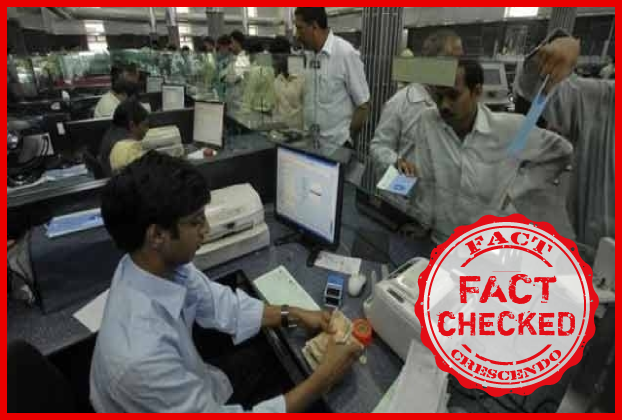
Claim RBI extends transaction hours in public sector banks
Publisher’s rating: Fact Crescendo Rating FALSE

Il nostro è un Paese nel quale il 20 per cento della popolazione detiene oltre il 66 per cento della ricchezza complessiva
Publisher’s rating: C'eri quasi
Nicola Fratoianni, a member of parliament and leader of Sinistra Italiana, made the statement during the television program Mezz’ora in più on April 28. Pagella Politica checked whether the 20% and 66% figures were supported and whether they were current. It traced the figures to Oxfam Italia’s report Disuguitalia, published on January 22, 2018, which gave a matching estimate for Italy at the end of the first half of 2017: the richest fifth held 66.4% of national wealth. That supports the claim’s approximate figure for that period.
Nessuno rispetta questo parametro [del deficit/Pil sotto il 3 per cento]. La Francia quest’anno farà il 3,5 per cento, il Portogallo, che tanti economisti celebrano come modello virtuoso, ha fatto il doppio del nostro deficit negli ultimi dieci anni
Publisher’s rating: Nì

Lo shock fiscale di Trump ha portato in 13 Stati della confederazione americana la disoccupazione sostanzialmente a tasso zero
Publisher’s rating: Nì
The review assesses a statement Matteo Salvini made on 27 May 2019: that unemployment had reached “substantially” zero in 13 U.S. states, and that Trump’s tax cuts were responsible. It compares that assertion with U.S. Department of Labor figures for April 2019 and considers the proposed causal link separately from the unemployment figures. The investigation notes that the U.S. unemployment rate was 3.6%, but explains why “zero” is not a useful literal benchmark: employment levels normally include some unemployment. It uses 4.6% as a reference point for the natural rate, citing a Congressional Budget Office estimate; it also reports that the Federal Reserve put the range at 4–5%. On the 4.6% benchmark, the review counts 44 of 51 jurisdictions—including the District of Columbia—as below it, not 13. It identifies Mississippi, West Virginia, Alaska, New Mexico, Arizona, the District of Columbia, and Washington as above that threshold. None had zero unemployment; Vermont was lowest, at 2.2%. For context on the trend, the review compares the same threshold in December 2016, when 24 of 51 jurisdictions were below it. But it says the figures do not establish that Trump’s late-2017 tax cuts caused the subsequent decline. The review reports that unemployment had already fallen during Obama’s presidency, reaching 4.7% in January 2017, and that the increase in employment began in 2010. It therefore distinguishes the observed improvement from Salvini’s claim about its cause.

El sorteo de una tarjeta regalo de 500 euros de Leroy Merlin
Publisher’s rating: Falso

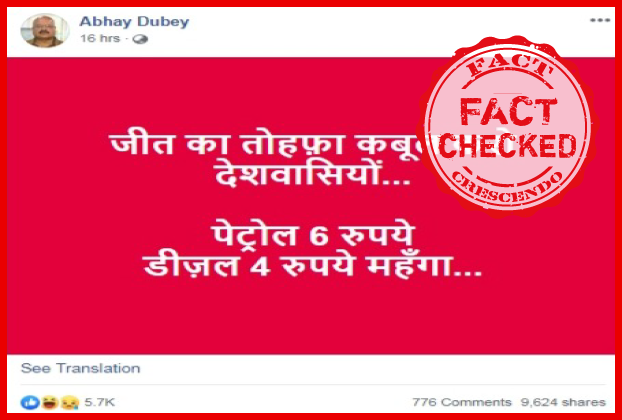
Claim petrol and diesel price increased by 6 and 4 rupees respectively after elections
Publisher’s rating: Fact Crescendo Rating FALSE