PeakMetrics / Fact Checks
Economy & business fact checks
Explore claims publishers have checked about economy & business. Read their original ratings and follow the evidence.
Search fact checks
Search by text or image7,093 published reviews in this topic


“Una economía que ha sido incapacitada por la mayor inflación que hemos visto en más de 60 años”.
Publisher’s rating: Falso
ایران با تولید ۴ میلیون تن سیب در سال رتبه چهارم جهانی تولید سیب را دارد.
Publisher’s rating: نیمهدرست

Die Rothschilds kontrollieren über 160 Zentralbanken der Welt - darunter auch die Deutsche Bundesbank.
Publisher’s rating: Die Rothschilds besitzen und kontrollieren weder die Deutsche Bundesbank noch andere Zentralbanken. Die verbreitete Liste ist ein reines Fantasieprodukt.
The claim concerns a social-media list alleging that more than 160 central banks are “owned and controlled” by the Rothschilds, including Germany’s Deutsche Bundesbank. The review identifies the list as a circulating claim and asks who owns or controls the Bundesbank and where the list came from. It reports that the Federal Ministry of Finance answered an ownership inquiry in 2014 by citing the Bundesbank Act: the Bundesbank is a federal public-law entity, and its capital belongs to the federal government. The ministry also said the Bundesbank has no private-law owners, shareholders, or stockholders. [S1: “Gemäß § 2 Bundesbankgesetz (BBankG) ist die Deutsche Bundesbank eine bundesunmittelbare juristische Person des öffentlichen Rechts. Ihr Grundkapital steht dem Bund zu.”; “Die Deutsche Bundesbank habe keine privatrechtlichen Eigentümer, Anteilseigner oder Aktionäre.”] The review also describes the Bundesbank’s oversight: its executive board produces an annual financial report, which is audited, published, and submitted to the Federal Court of Auditors; that court conducts its own examination and reports the result to the Bundestag. The review says the annual reports have been publicly available since the bank’s founding in 1957. These details describe documented public governance and reporting, rather than private ownership. [S1: “Der Vorstand der Bundesbank legt jährlich einen Abschlussbericht vor, der von Wirschaftsprüfern geprüft, veröffentlicht und dem Bundesrechungshof vorgelegt wird.”; “Alle Jahresberichte seit 1957, dem Gründungsjahr der Bank, sind öffentlich einsehbar.”] On the list’s provenance, the review traces it to a 2019 kla.tv video titled “Die Rothschild-Kontrolle,” which displays the same list. It says similar lists circulated as early as 2017 and refers to prior dpa checks concerning the U.S. Federal Reserve System and central banks generally; the supplied review excerpt does not provide the underlying records or detailed findings from those earlier checks. Its stated basis for rejecting the specific Bundesbank allegation is the government’s ownership information and the Bundesbank’s documented public oversight. [S1: “Dort findet man ein etwa 13 Minuten langes Video aus dem Jahr 2019 mit dem Titel «Die Rothschild-Kontrolle», in dem die gleiche Liste von Zentralbanken gezeigt wird.”; “Behauptungen mit fast identischen Listen wurden bereits 2017 geteilt”]

Walmart instaló cámaras para “poder identificarte” y limitar la venta de productos como carne, huevos y lácteos
Publisher’s rating: Falso

All UPI transactions more than ₹2000 to be charged 1.1%, starting from April 1
Publisher’s rating: MISLEADING
The claim concerned a blanket 1.1% charge on UPI payments above ₹2,000 from April 1. The review distinguishes ordinary bank-account UPI payments from merchant payments made using a prepaid payment instrument (PPI), such as a wallet. It reports that the NPCI circular issued on 24 March 2023 proposed an interchange fee for merchant transactions initiated through PPI on UPI, effective 1 April—not a charge on every UPI payment. The review says the fees apply to merchants and institutions, not the general public. [S1: “NPCI, on 24 March 2023, issued a circular proposing an interchange fee applicable to merchant transactions initiated through PPI on UPI, with effect from 01 April 2023.”; “NPCI circular only talks about charging only those transactions initiated through PPI. And moreover, these charges are only applicable to merchants, not the public.”] The review explains how the ₹2,000 threshold could have contributed to the misunderstanding: it says the circular also required PPI issuers to pay the remitter bank 15 basis points when loading a wallet with more than ₹2,000. Its example is a ₹3,000 wallet load, for which the issuer would pay ₹4.50 to the bank. That is a wallet-loading charge between institutions, not a 1.1% charge imposed on a consumer for an ordinary UPI transaction. [S1: “the PPI issuer shall pay 15 bps as wallet loading charges to the remitter bank (account holders bank) for loading transaction value greater than Rs. 2000 on the wallet.”; “Paytm shall have to pay 0.15% i.e., Rs. 4.5 to Access Bank.”] For its clarification, the review reports that NPCI addressed the rumours in a tweet on 29 March 2023, stating that users would not be charged on UPI transactions; it also says PIB clarified the claim. The excerpt does not reproduce the circular or the tweet in full, so the account of those materials is limited to what the review reports. Its conclusion is that the new interchange arrangement concerned PPI merchant transactions, not a universal consumer fee for UPI payments. [S1: “NPCI on 29 March 2023, through a tweet clarified that users will not be charged on UPI transactions.”; “The tweet categorically mentions that interchange charges are only applicable for PPI merchant transactions.”]

అదానీ గ్రూప్ సంస్థలు ప్రతీ సంవత్సరం భారత ప్రభుత్వానికి లక్ష కోట్లు టాక్స్ రూపంలో చెల్లిస్తున్నాయి
Publisher’s rating: FALSE


SAUDIA AIRLINES 78º Aniversário do Subsídio de Previdência do Governo Parabéns! Seu prêmio é: R$1.000,00
Publisher’s rating: Falso

01 ఏప్రిల్ 2023 నుంచి గూగుల్ పే, ఫోన్ పే, పేటీఎంల ద్వారా చెల్లింపులు జరిపితే ఛార్జీలు వర్తిస్తాయి
Publisher’s rating: MISLEADING

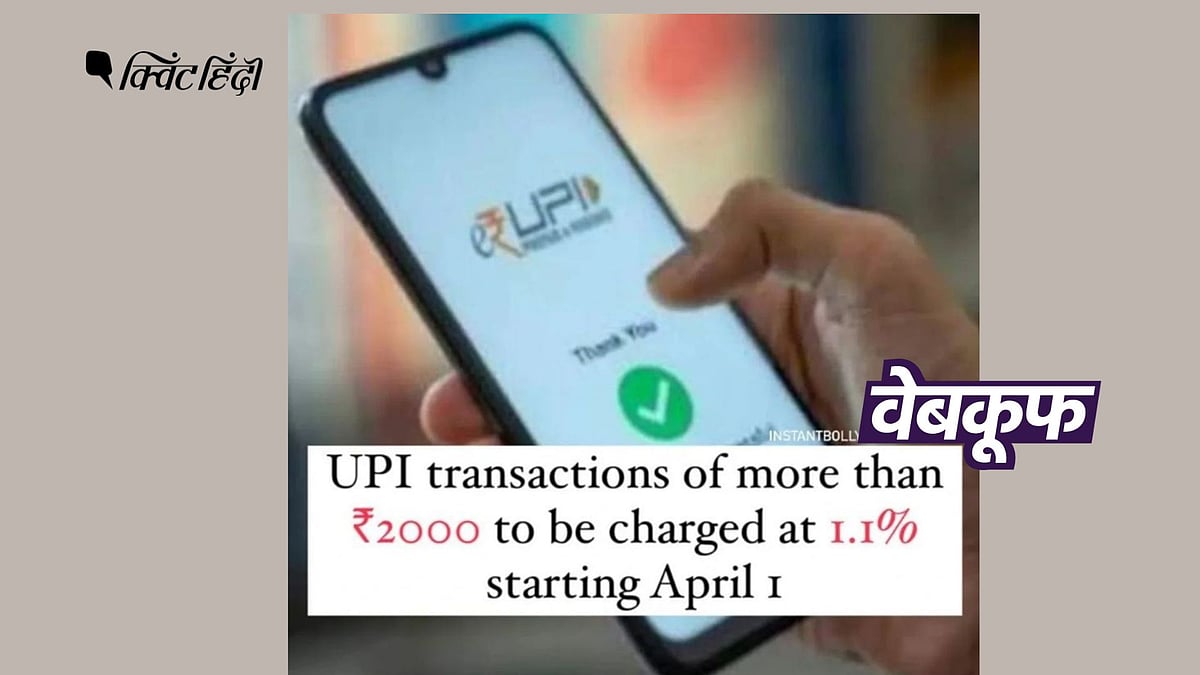
यूपीआई के जरिए भुगतान करने पर लगेगा 1.1 प्रतिशत शुल्क
Publisher’s rating: FALSE
Иран возместит Беларуси потерянные экономические связи с Западом
Publisher’s rating: Это фейк. Прямые потери от прекращения поставок в Европу министр экономики Беларуси в прошлом году оценил в 6 млрд, 5 из которых, по его словам, компенсировали Россия и Китай.

Silicon Valley Bank donated $73 Million to Black Lives Matter and Related Causes
Publisher’s rating: Missing context