PeakMetrics / Fact Checks
Disasters & emergencies fact checks
Explore claims publishers have checked about disasters & emergencies. Read their original ratings and follow the evidence.
Search fact checks
Search by text or image3,259 published reviews in this topic

विरेन्द्र सिंह बचला बना बारां,पाली जिले में । जिले के पावा गांव में आई बाढ़ में फंसे लोगों को वायु सेना ने रेस्क्यू किया।
Publisher’s rating: False
Picture shows wreckage of Titan submersible
Publisher’s rating: False
A woman lost her arm while trying to board a bus through the window to avail a free ride under Karnataka’s newly launched ‘Shakti’ scheme
Publisher’s rating: False
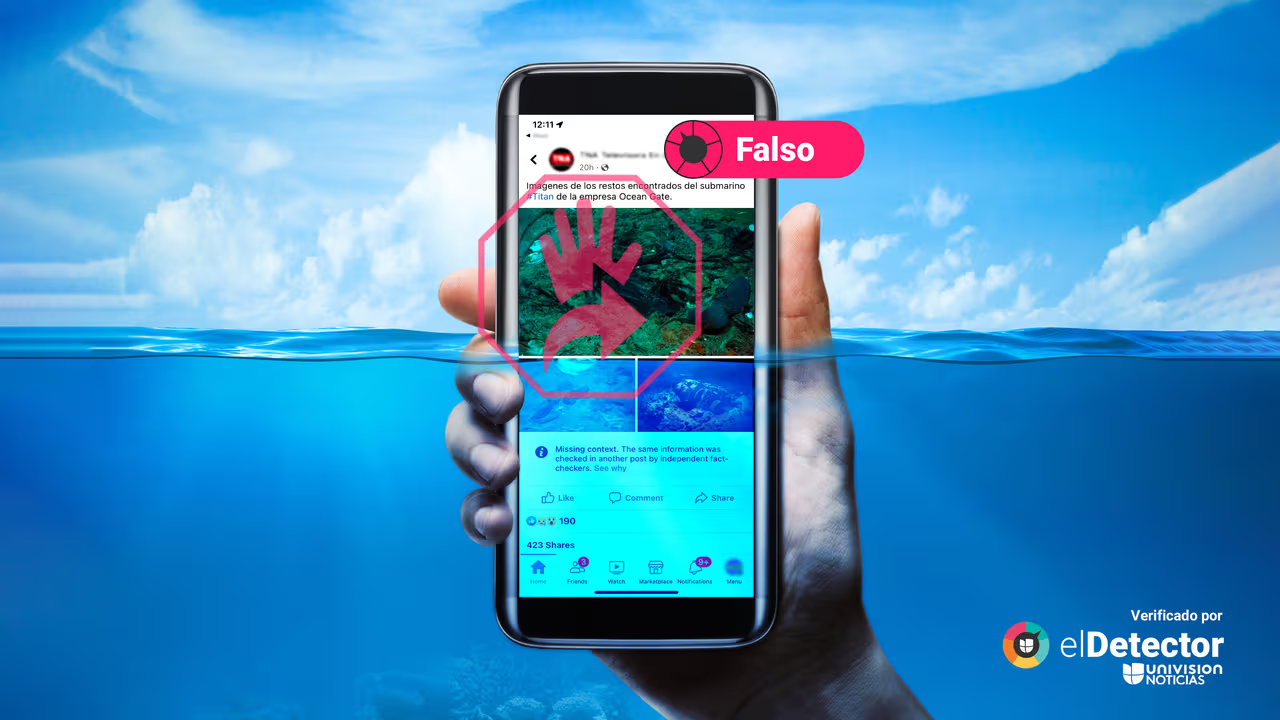
Fotos muestran “imágenes de los restos encontrados del submarino #Titan, de la empresa OceanGate”.
Publisher’s rating: Falso
The claim concerned a Facebook post published on June 22, 2023, which presented three images as showing wreckage from OceanGate’s Titan submersible. The investigation found that two images instead showed debris from the Titanic, which sank in 1912. It reported that the images had been taken during a 2004 Titanic expedition—19 years before the Titan’s implosion—and used reverse-image searches on Yandex, TinEye, Bing, and Google to trace them. For one image, the review describes an Alamy archive caption identifying a coat and boots on the seabed near the Titanic’s stern and crediting the 2004 expedition. For the other, it found the same image in a KSDK report and Alamy’s archive, both identifying it as a 2004 photograph. These earlier records establish that those two images were not new photographs of Titan wreckage. The review could not establish whether the third image had circulated before. It also reported that, as of the review, the U.S. Coast Guard had not released images or video of Titan’s wreckage. The evidence therefore supports rejecting the post’s attribution of the two traceable images; the excerpt does not independently identify the third image.

जालोर, राजस्थान, टीन शेड से आदमी के हुए दो टुकड़े।,आंधी तूफान आने पर बाहर ना निकले
Publisher’s rating: False
CNN reported that the OceanGate submarine was empty prior to its destruction
Publisher’s rating: False


Debris Of The ‘Titan’ Submersible!
Publisher’s rating: False
The review examined a collection of photos circulating online as newly discovered debris from the Titan submersible. The posts claimed that robots had found debris near the Titanic and that experts identified the pictured material as Titan wreckage. The investigation concluded that the collection was not what the posts claimed: some images were older Titanic-related material, while the others were likely AI-generated. To check the images, the team says it looked for them on US Coast Guard websites and social media, then used reverse-image searches and searched for reporting by international media. It found that some images dated to 2004 and appeared in Alamy stock photos: one showed shoes associated with a possible Titanic-disaster victim, and another showed a coat and boots on the seabed near the Titanic’s stern. The searches did not establish the provenance of the other images; the review says they had recently appeared on social media and that AI-identification tools indicated a high possibility that the remaining three were AI-created. The review also distinguishes the viral pictures from the actual Titan debris discovery. It cites reporting that an ROV found debris near the Titanic and quotes Coast Guard Rear Admiral John Mauger describing the debris as consistent with a catastrophic implosion. The review says the Coast Guard confirmed by email that the Unified Command had not released photos or videos of the debris. That supports its conclusion that the circulating collection was not verified imagery of Titan debris; the excerpt does not establish who created or first posted each image.
A viral post depicting photos of a coat and boots in the mud on the sea has been posted by social media users recently, along with a claim that they were the debris of Ocean Gate’s Titan submersible. This post has been reacted to with mixed comments and shared by many Facebook users. However, after running a Google Reverse Image search and getting clarification from the US Coast Guard Department, it proved that the claim made above is misleading.
Publisher’s rating: Misleading

Submarino Titan não explodiu porque foi tudo uma armação para um filme
Publisher’s rating: Falso
The claim was that the Titan disaster was fabricated as a publicity stunt for a new film. The review examined several TikTok videos making or implying that allegation, including one using a clipped remark by Luciano Huck and two featuring women. It reports that the review’s authors watched the videos and compared their content with the captions attached to them. The review distinguishes an implosion from an explosion: it says authorities described the Titan as having imploded during its expedition to the Titanic wreck site. That distinction does not support the staging theory. The review found that Huck was speaking about the submarine’s lack of suitable structure for the voyage, not claiming the disaster was staged. It also says one woman’s reference to a “setup” was an unsupported opinion, while she still believed deaths had occurred. The remaining video did allege a setup, but the review describes its remarks blaming Lula and claiming the occupants were swimming and fishing as plainly unserious. It further argues that the videos supplied no reliable evidence for the theory and concludes that the assertion of a staged disaster tied to a film was false.

The missing submersible Titan was found empty.
Publisher’s rating: False

El Titanic nunca se hundió porque antes de zarpar había sido cambiado por su nave hermana, el Olympic; y el accidente fue planificado por el dueño de la naviera propietaria de ambas embarcaciones, J.P. Morgan, para eliminar a algunos hombres de negocio que se oponían a la creación de la Reserva Federal.
Publisher’s rating: Falso
Video shows gas explosion in central Paris
Publisher’s rating: False

Mais um ciclone vindo pro Rio grande do Sul
Publisher’s rating: Falso
The claim concerned a video presented as satellite imagery, accompanied by an audio warning that a new cyclone was forming near Rio Grande do Sul and would bring heavy rain and strong winds to parts of Rio Grande do Sul, Santa Catarina, and Paraná. The message referred to conditions around June 22–23, shortly after a cyclone on June 15–16 had caused deaths, injuries, and damage in Rio Grande do Sul—circumstances that could make a new warning seem plausible. The article identifies the forecast as an online message, not as an official meteorological alert. The investigation reports that Porto Alegre’s Civil Defense said the video’s prediction of a new extratropical cyclone near the coast was false. It quoted the agency’s coordinator, Evaldo Rodrigues de Oliveira Júnior, saying that no climatological model indicated such a cyclone. The forecast described instead was isolated rain showers, with up to 30 mm accumulated through June 26; the agency said there was no indication of a cyclone. The article also explains that a Civil Defense alert issued June 20 concerned geological conditions: saturated soil in risk areas after the previous week’s excessive rain, not an approaching cyclone. The article reports a separate rebuttal from MetSul Meteorologia, which said a new extratropical cyclone would not hit Rio Grande do Sul that Friday and described the TikTok user’s report as baseless and false. It notes that the viral message lacked a reliable source and urged people to share it, while the cited meteorological and local-authority statements contradicted its central forecast. On that evidence, the article concludes that the alleged cyclone threat in the coming days was false.

Tripulantes de submarino Titan gravaram vídeo com mensagem de despedida
Publisher’s rating: Falso
Person claimed that CNN reported that the missing submarine had been located and that it was empty.
Publisher’s rating: FALSE