PeakMetrics / Fact Checks
Crime & justice fact checks
Explore claims publishers have checked about crime & justice. Read their original ratings and follow the evidence.
Search fact checks
Search by text or image6,854 published reviews in this topic
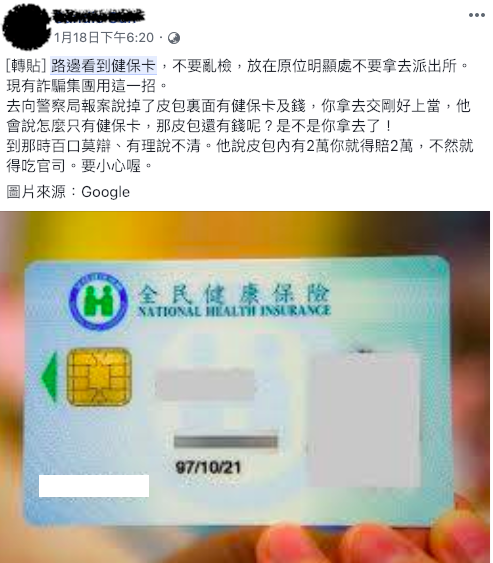
路邊看到健保卡不要亂檢...他說皮包內有2萬你就得賠2萬,不然就得吃官司
Publisher’s rating: 錯誤
The warning claimed that a person who found a health insurance card and took it to a police station could be accused by its owner of also taking cash from a wallet, then made to repay a claimed 20,000 yuan or face a lawsuit. The review investigated that specific scenario, while noting that the forwarded message named no police station or identifiable case. The Taiwan fact-checking center contacted the National Police Agency. Its spokesperson said the agency could not access records held by individual police stations and therefore could not verify whether a case matching the warning had occurred. The review thus did not establish that the alleged incident had never happened; it reported that the agency could not confirm one from the information provided. On the warning’s central claim about what happens when found property is turned in, the spokesperson described the required procedure: police are to count the property in the finder’s presence, make a record, register it, and issue a receipt. The spokesperson said that even if the contents reported by the owner differed from the property handed in, police would not require the finder to compensate the owner. The agency advised taking found identification to police, or calling police to handle the matter at the scene if concerned. The review concluded that the warning’s compensation claim was false.

Supreme court Kapil Sibal told a London court that liquor baron Vijay Mallya’s extradition to India should be delayed.
Publisher’s rating: FALSE

Claim : CBI raided Kolkata Police Commissioner's residence without a warrant
Publisher’s rating: Fact Crescendo Rating : True
Related reporting connects the claim to the CBI’s February 2019 visit to the Kolkata residence of Police Commissioner Rajiv Kumar, in connection with the Saradha scam. The available excerpt says CBI officers “arrived unannounced” at his residence. That supports the detail that their arrival was unexpected, but does not say whether they had a warrant. The supplied research therefore identifies the event but does not resolve the claim’s central legal point: whether the CBI searched the residence without a warrant. The excerpt provides no warrant, court order, search record, or other evidence addressing authorization. On this evidence alone, the warrant claim cannot be confirmed or disproved.
Cabinet secretary Rashid Echesa arrested and detained over human trafficking allegations
Publisher’s rating: False.

The video of a man hanging his kid upside down and beating him is from India.
Publisher’s rating: FALSE

El mensaje sobre la desaparición de Julen que incrimina a los padres
Publisher’s rating: Falso


Emergency number shared on social media for Riverside attack fake
Publisher’s rating: False.
Kenyan MP detained in Uganda over dissagreement on pay with prostitute
Publisher’s rating: False.
Home Affairs Minister Peter Dutton claims a publicly-accessible national register of child sex offenders will act as a deterrent to pedophiles.
Publisher’s rating: False – The checked claim is false.

Increase in drugs and crime
Publisher’s rating: Trump has tried to frame the "crisis" on the border in easy to understand terms. Much of that messaging has focused on the idea that lax security has led to drugs and crime "pouring" over the border. Trump bases the claim on the idea that members of the MS-13 gang have committed violent crimes in some parts of the United States. But there is missing context in Trump's characterizations. To begin with, the vast majority of illicit drugs captured at the border come through legal ports of entry, according to Trump's own U.S. Customs and Border Protection. For the first 11 months of the 2018 fiscal year, 90 percent of the heroin intercepted at the border and 88 percent of the cocaine, was captured at a legal port of entry rather than between those ports. There is a similar caveat to Trump's claim on crime. The president and Republicans frequently point to roughly 17,000 people trying to enter the country who had been convicted of crimes in the United States or abroad in the first 11 months of 2018. But more than 60 percent of those people came through legal points of entry, including airports, according to Customs and Border Protection data.

This video is recent and shows Pakistani police force brutally beating up Hindus, a minority in Pakistan.
Publisher’s rating: FALSE

रवीश कुमार ने NIA रेड में अरेस्ट हुए युवकों से हमदर्दी दिखाई.
Publisher’s rating: FALSE


கர்நாடகாவில் கோவில் பிரசாதத்தில் விஷம் கலந்து 15 பேரைக் கொன்ற கிறிஸ்துவ பெண் கிரிப்டோ சில்வியா கைது.
Publisher’s rating: Fake
El asesino de Marta del Castillo va a salir de la cárcel
Publisher’s rating: Falso
The claim concerned a message saying Miguel Carcaño would leave prison in three weeks. Newtral reports that it checked the claim with Spain’s Prison Institutions, part of the Interior Ministry. The department described the circulated notice as false and said Carcaño did not meet any requirement for release and had not been granted a prison leave. That directly contradicts the message’s assertion of an imminent release. The review states that Carcaño had been imprisoned since 15 February 2009 and was the only person convicted of murder in Marta del Castillo’s case. It gives his sentence as 21 years and three months. The article distinguishes the other people investigated: three were acquitted, while “El Cuco,” who was a minor at the time, served two years and eleven months in a juvenile facility for covering up Carcaño’s crime. Those details identify the person and case at issue; the decisive evidence about the alleged release is the prison authority’s confirmation that neither eligibility nor permission existed.