PeakMetrics / Fact Checks
Crime & justice fact checks
Explore claims publishers have checked about crime & justice. Read their original ratings and follow the evidence.
Search fact checks
Search by text or image6,854 published reviews in this topic

Só no Brasil um meliante preso em flagrante com 200 mil " Dólares " na cueca vira Deputado!!!".
Publisher’s rating: Falso


Promotor manda prender menina de 12 anos que se defendeu de estupro e atirou em criminoso que invadiu o sítio de seus pais. A promotoria da cidade de Alta Floresta-MT, pediu a prisão imediata da menina de 12 anos que atirou em um garimpeiro que tentava invadir a fazenda do pai da jovem. A adolescente estava sozinha no sítio quando percebeu que o homem tentava invadir o local pulando uma cerca. Com medo, a jovem se apossou de uma espingarda velha e ordenou para que o homem fosse embora, mas o homem a ignorou e pulou para dentro da fazenda, foi então que a garota atirou duas vezes e depois fugiu. Para a promotoria, a garota agiu com excesso de legitima defesa, sem dar chances de defesa à vítima, e irá responder pelo crime de tentativa de homicídio, porte ilegal de arma e omissão de socorro. Fonte .Painelcentral
Publisher’s rating: Falso

Claim Muslim man mob lynched at Mahua in Bihar
Publisher’s rating: FALSE
Promotoria de Justiça da Comarca de Alta Floresta pediu a “prisão” da Adolescente de 12 anos atirou em um garimpeiro
Publisher’s rating: False
Polisi dan pelajar terlibat keributan dalam rangkaian KRL di Stasiun Depok Baru
Publisher’s rating: Benar

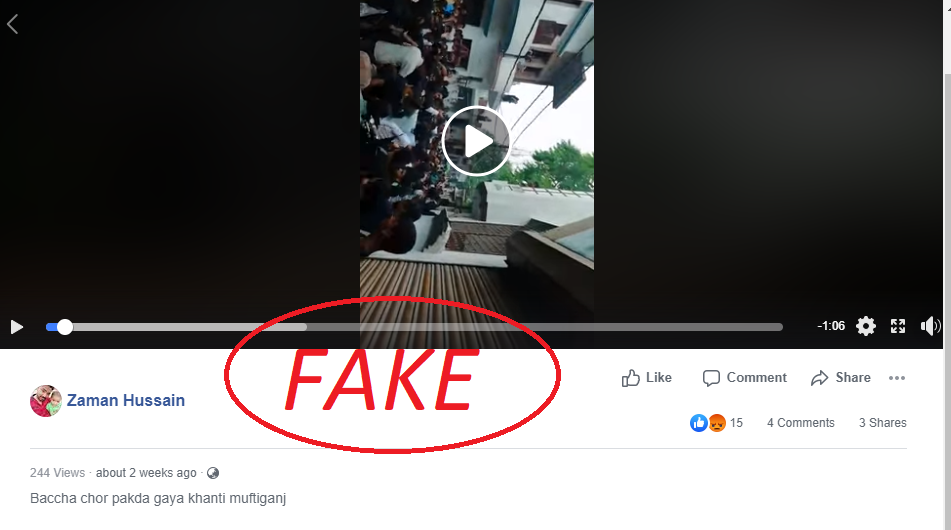
Claim child lifter caught in a village in Lucknow
Publisher’s rating: FALSE


Claim: Tirunelveli stands first in women safety
Publisher’s rating: FALSE

अखबार की क्लिप में हेडलाइन है: "मदरसे में यौन शोषण, मौलवी गिरफ्तार, 52 छात्राएं छुड़ाई गयीं"
Publisher’s rating: FALSE

Se ha intentado secuestrar a un niño de cuatro años en una tienda de ropa china de Reus
Publisher’s rating: Falso
The claim concerned a four-year-old who went missing in a clothing shop in Reus, Tarragona, and alleged that someone had tried to abduct him. The review reports that the Mossos d’Esquadra rejected the abduction account. According to police sources quoted by Newtral, the child’s father was nearby but briefly lost sight of him; police then helped locate the child hiding in a fitting room, with the father and other people present. The police account does not describe a child found in a basement or an abduction.


Claim newspaper article says 52 girls exploited by Maulvi in Madarsa
Publisher’s rating: FALSE
La Policía alemana publicará la nacionalidad de todos los sospechosos como medida de transparencia
Publisher’s rating: Engañoso
The claim presents the policy as applying across Germany and to all suspects. The review instead says the proposal was limited to North Rhine-Westphalia, a state in western Germany, and had not yet been implemented. It reports that the state’s Interior Ministry was working on a decree concerning police press and public-relations work, with completion expected by the end of that year. The stated purpose, attributed to state Interior Minister Herbert Reul, was to prevent the spread of false information—not to establish a nationwide transparency rule. The review describes a change to how police in that state communicate: previously, North Rhine-Westphalia police were not obliged to mention suspects’ nationalities. Under the proposed rule, the nationality would be mentioned for people whether German or foreign. The review also notes that Germany had no general law requiring or prohibiting disclosure of offenders’ nationalities, and that practices differed among states. For example, in Baden-Württemberg, disclosure was coordinated with prosecutors and courts and depended on whether nationality was considered important to assessing the crime. The proposal was contested, rather than presented as an agreed national policy. The police union GdP opposed it: spokesperson Oliver Malchow argued that nationality was relevant to police investigations, while the union’s statement said investigation results were released to the public only to a limited extent. The German press council supported the project, with spokesperson Volker Stennei saying editorial offices—not authorities—should decide whether nationality matters to coverage. These limits and disagreements make the claim’s nationwide framing misleading.
“Polis üzərinə düşən funksiyaları peşəkarlıqla yerinə yetirir”
Publisher’s rating: yalan

Caminhão que estava indo para Venezuela Em um “golpe de sorte” foi interceptado pela PRF, numa blitz. Depois de algumas perguntas para o motorista, como para onde ia vazio, este se mostrou muito nervoso. Foram encontrados centenas de milhares de dólares onde o motorista confessou que foi contratado para levar o caminhão até Caracas na sede do governo pelo escritório do instituto Lula em São Paulo. Nosso dinheiro sendo desovado pois o cerco está fechando.
Publisher’s rating: Falso
CAMINHÃO INTERCEPTADO SAÍA DO INSTITUTO LULA RUMO À VENEZUELA CHEIO DE DINHEIRO
Publisher’s rating: Falso

కౌశాంభి జిల్లాలో ఒక మైనర్ అమ్మాయిని గ్యాంగ్ రేప్ చేసిన ముగ్గురిని ఎన్కౌంటర్లో లేపేసిన యోగి సర్కార్
Publisher’s rating: MISLEADING