PeakMetrics / Fact Checks
Crime & justice fact checks
Explore claims publishers have checked about crime & justice. Read their original ratings and follow the evidence.
Search fact checks
Search by text or image6,837 published reviews in this topic
ESTE CIDADÃO NO CENTRO DA FOTO, É O ‘SENHOR MOACIR’, UM GRANDE TRAFICANTE INTERNACIONAL DE DROGAS, EM CONTAINERS PARA A EUROPA… FOI PRESO HÁ POUCOS DIAS, QUANDO ALMOÇAVA NA TOCA DA TRAÍRA, BARRA DA TIJUCA, RJ, FOI PRESO PELA POLÍCIA CIVIL, DISFARÇADA COM A CAMISA DO FLAMENGO E BOTAFOGO… AGORA, VOCÊ CONHECE ESTA SENHORA, QUE ESTÁ COM A MÃO NO SEU PEITO? Exatamente Ela.
Publisher’s rating: Falso
Gerald Bantag has been reinstated as Bureau of Corrections chief
Publisher’s rating: False

Witte Huis stafchef Ron Klain is gearresteerd.
Publisher’s rating: Dit verhaal is nergens op gebaseerd. Stafchef Ron Klain is op vrije voeten.
The claim was that Ron Klain, then White House chief of staff, had been arrested by military personnel. The review traces the allegation to an article from Real Raw News circulating on social media. That article placed the alleged arrest on January 21 and linked it to Klain supposedly preparing to leave his post. The review says it found no independent confirmation of the arrest. To check the allegation, the review points to Klain’s activity and public appearances after the date on which he was supposedly arrested. It reports that he continued posting on Twitter and attended a meeting of Democratic Party leaders on January 24. The article says his presence at the meeting was visible in a press photograph, a journalist’s tweets, and video footage. These reported activities after January 21 conflict with the arrest story’s timeline. The review also distinguishes reporting about Klain’s expected departure from evidence that he had been arrested. It says multiple media outlets had reported that he planned to step down, citing people familiar with the matter, but that Klain had not officially announced his resignation. The review therefore treats the resignation reporting as separate from—and not confirmation of—the arrest allegation.
“STF decide que furtos de celular não será mais considerado crime”
Publisher’s rating: Falso
The arrest of Thach Setha is justified according to Cambodia's law
Publisher’s rating: False

La policía de New York capturó a un grupo de palomas con mochilas en las cuales transportaban drogas.
Publisher’s rating: Falso

Yogi Adityanath government in UP has brought a new law under which anyone who sends a friend request three times to a girl will be put in jail for three years along with a fine of five lakh rupees
Publisher’s rating: MISLEADING
The claim combines a specific alleged penalty with the assertion that Yogi Adityanath’s government had newly introduced it in Uttar Pradesh. FACTLY’s review says the older reports it found described a different setting: a 2013 circular from the state Director General of Police, under which action under Section 66A of the Information Technology Act could be taken if a girl complained and provided proof of repeated friend requests. The review therefore says the measure was not a recent development brought in by Adityanath’s government. To check the claim’s history, the review reports searching online and finding similar social-media posts dating to 2013. It also identifies Dainik Bhaskar and Jagran as news agencies that published similar reports that year. Those reports, as summarized by FACTLY, described the circular and the complaint-and-proof condition; they did not establish a newly enacted law by the Adityanath government. The review adds an important legal qualification: the provision cited in those older reports, Section 66A, was struck down by the Supreme Court in March 2015 in Shreya Singhal vs. Union of India. FACTLY also says that in 2022 the Court ordered states and their police forces to stop prosecutions under that section, and concludes that Section 66A is no longer applicable. Thus the evidence presented points to an older, conditional police-circular report tied to a provision later struck down—not to the newly introduced law described in the claim.

Invadiram a sede da Polícia Federal [em dezembro de 2022], e ninguém foi punido”
Publisher’s rating: Falso
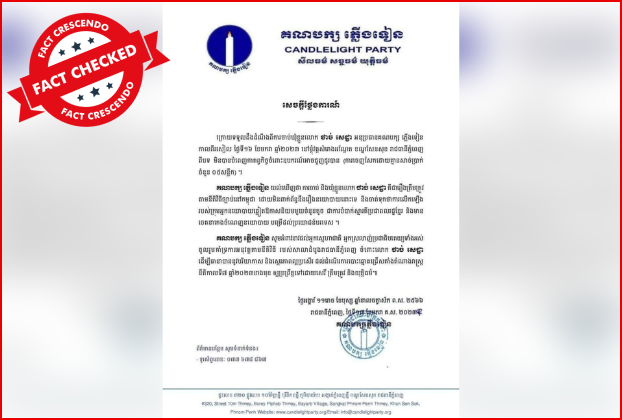
A photo showing a letter issued by the Candlelight party was posted by a Facebook user recently. It was mentioned and claimed that the arrest of Thach Setha is justified according to Cambodia's law. This letter attached to the claim was reacted to with mixed comments and shared by Facebook users who are speaking Khmer. However, after checking with the official letter released by the Candlelight party, it proves that the above post is false.
Publisher’s rating: False
The claim concerns a Facebook post showing a purported Candlelight Party statement that said the arrest of party vice president Thach Setha was justified and not political. Fact Crescendo reports that the post appeared on January 17, 2023, and that users shared it with varied reactions. Its review compared the circulated image and claim with a statement issued by the party; it concludes that the Facebook statement was not genuine. The review says the party’s Facebook page published its own statement on January 16, the day of Setha’s arrest. That statement described the arrest as a political story and “a picture of intimidation,” and condemned Phnom Penh authorities. This directly contradicts the circulated statement’s purported endorsement of the arrest as correct and unrelated to politics. Fact Crescendo also notes that VOD reported on the matter on January 18, characterizing the statement that the arrest was unrelated to politics as fake. The review’s stated conclusion is that the Facebook photos and statements were false. Its account supports the finding through the contrast between the circulated statement and the party’s January 16 statement; the supplied excerpt does not provide further document-authentication details.
(...) tem 1.300 pessoas presas [por conta dos atos golpistas do dia 8 de janeiro]”
Publisher’s rating: Verdadeiro

DANILO DO MST É O NOME DE UM DOS RESPONSÁVEIS POR QUEBRAR INSTALAÇÕES DO GOVERNO E CULPAR BOLSONARISTAS
Publisher’s rating: Falso

המערכת המשפטית משתמשת ב(עקרון) השוויון כפסיקה (כדי) לאסור שחייה בהפרדה
Publisher’s rating: לא נכון ברובו
The claim concerns remarks by Knesset member Yitzhak Pindrus in a Channel 13 interview. He argued that the legal system had used equality to forbid separate swimming, citing both public pools and springs. The review examined those settings separately, rather than treating every legal limit on a particular arrangement as a ban on separation in general. It concluded that his characterization was mostly inaccurate. For public pools, the review traced a petition concerning the only public pool in Kiryat Arba, which had operated only with separate swimming. After that case returned to the High Court in 2020, the court required two hours of mixed swimming on each day the pool was open. The review emphasizes that this did not prohibit separate swimming: the pool could still offer it for most of its operating hours, provided mixed-swimming hours were also available. It also notes that a later petition concerning the Rahat municipal pool was dismissed on procedural grounds, although the court described the petition as apparently meritorious. The springs issue was more qualified. The Nature and Parks Authority had conducted separate-swimming pilots, but the review says they were suspended after coordination problems involving the Civil Administration. A December 2020 opinion by Deputy Attorney General Dina Zilber said the authority lacked legal power to establish such an arrangement without express legislative authorization; it did not say separation was inherently unlawful. The review therefore distinguishes a requirement for legislative authority from a judicial prohibition, and concludes that the legal system had not categorically banned separate swimming.

"Están asaltando a domicilio con orden judicial".
Publisher’s rating: Falso

Nieuw-Zeelandse rechter verklaart dat twaalfjarige kinderen kunnen instemmen met seks met volwassenen.
Publisher’s rating: Een hiaat in de Nieuw-Zeelandse wet bracht dat een beklaagde van seksueel misbruik zich mocht verdedigen met het argument dat een twaalfjarige instemming had gegeven. De rechter van de zaak zorgde ervoor dat de jury begreep wat de wet, die van 1961 dateert, exact zegt. Hij zei niet dat kinderen daadwerkelijk met seks kunnen instemmen.
The review examines a screenshot shared by Dutch-language Facebook users, whose headline suggested that a New Zealand judge had recently declared that twelve-year-olds could consent to sex with adults. It identifies the underlying case as a 2022 trial of a man accused of sexually abusing two minor girls about ten years earlier. The prosecution brought 33 charges, and the defendant argued that one girl, who was twelve at the time, had consented to their sexual relationship. The issue was what the judge explained to the jury about New Zealand’s law—not a judicial finding that the girl could legally consent. The review says the minimum age for consenting to sexual activity in New Zealand is sixteen. It describes a gap in the 1961 Crimes Act: section 128 defines sexual violation in relation to absence of consent or reasonable belief in consent, while section 128A lists circumstances that do not constitute consent but does not specify what does. The review says this left the defendant able to argue that he believed the girl consented, without having to establish that belief with concrete evidence; the jury had to decide whether to believe him. The judge’s role, as described in the review, was to explain the law to the jury, not to endorse the defendant’s argument or alter the law. The jury rejected the defendant’s account and found him guilty on all 33 charges; the review says the judge then agreed with the verdict. Thus, the headline’s suggestion that the judge declared children could consent misrepresents the distinction between explaining a legal defence available under the statute and deciding that a child could legally consent.

STM DEU HABBEAS CORPUS COLETIVO PARA OS MANIFESTANTES DO QG. DE BRASÍLIA
Publisher’s rating: Falso
