PeakMetrics / Fact Checks
War & conflict fact checks
Explore claims publishers have checked about war & conflict. Read their original ratings and follow the evidence.
Search fact checks
Search by text or image5,848 published reviews in this topic
Der iranische Raketenangriff auf US-Soldaten im Irak in der Nacht vom 7. auf den 8. Januar 2020 schürt die Angst vor einer weiteren Eskalation im Nahen Osten. Im Internet werden viele Videos und Bilder verbreitet, die angeblich aus dem Iran oder dem Irak stammen sollen. Ein oft geteiltes Foto zeigt einen Feuerball am Nachthimmel über einer Stadt
Publisher’s rating: Das Foto zeigt nicht den iranischen Angriff. Es wurde 2019 im Gazastreifen aufgenommen.
The review examines a widely shared photograph of a fireball over a city that was being presented online as an image from the Iranian attack on US forces in Iraq during the night of January 7–8, 2020. It reports that a reverse-image search found the picture had already circulated in 2019, before the attack described in the claim. The review traces the photograph to Gaza: it identifies the scene as a city in the Gaza Strip and names AFP photographer Abed Rahim Khatib as the photographer. It says the image was taken on November 15, 2019, in Khan Younis, near the border with Egypt. That earlier date and location establish that this photograph does not document the later attack in Iraq. The review also supplies context for the original image. It reports that Israeli aircraft struck targets belonging to the Palestinian Islamic Jihad organization in Gaza that night. The Israeli military announced the strikes on Twitter and linked them to rockets fired from Gaza at Israeli civilians. This account concerns the photograph’s actual setting, not the January 2020 attack in Iraq.

Drone attack on the Iranian commander Qassem Soleimani
Publisher’s rating: FALSE
The post presented a video as footage of the drone attack on Iranian commander Qassem Soleimani and also claimed that the Pentagon had released it. FACTLY investigated whether the video showed that attack; its review says the clip instead came from a video game and was not released by the Pentagon. To check the clip, the review says it ran screenshots through Yandex Reverse Image Search. Among the results, it found the same video uploaded to YouTube in 2015. The upload described it as a development preview for the mobile game “AC-130 Gunship Simulator: Special Ops Squadron,” providing a pre-existing video-game source rather than footage of the attack. The review therefore identifies the video as an old game clip falsely presented as footage of the attack. It also notes that the same video had previously been used by Russia to make a different claim: that the US was working with ISIS. That history concerns the clip’s reuse, not evidence that it depicts Soleimani’s attack.
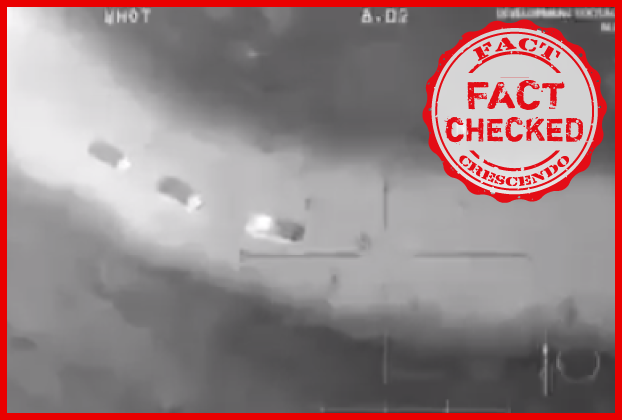
Claim: Iranian General Qasem Soleimani killing video
Publisher’s rating: Fact Crescendo Rating: False
The claim concerned a Facebook video presented as footage of the US killing Iranian military commander Qasem Soleimani. Fact Crescendo’s Tamil review says it investigated a post shared by Prakash Sugumaran and others, amid the aftermath of Soleimani’s death in a US airstrike. The review identifies the disputed video as a video-game scene, not a recording of the killing: it says the footage had been shared online since 2015, years before the event. The review distinguishes this mislabeled clip from video of Soleimani’s killing that it says Iranian television had released. It also points readers to a separate Marathi Fact Crescendo fact-check of the same video, but the supplied excerpt does not provide that check’s evidence or methods. The Tamil review’s stated basis here is the clip’s identification as video-game footage and its online circulation since 2015; it gives no further technical analysis of how that identification was made. Fact Crescendo concludes that the Facebook video was falsely linked to Soleimani’s killing. That conclusion addresses the video claim specifically; it does not dispute the killing itself. The review’s printed result is “False.”
Claim video of drone attack on Major General Qassem Soleimani
Publisher’s rating: FALSE

ఒక సైనికుడు మహిళా నిరసనకారురాలిని టీ-షర్ట్ పట్టుకుని లాగుతున్న ఫోటో
Publisher’s rating: FALSE

Die Polizei hat den Weihnachtsmarkt an der Berliner Gedächtniskirche am vierten Adventswochenende 2019 geräumt. Im Netz wurde daraufhin verbreitet, ein "Terroranschlag" sei vereitelt und "islamistische Gefährder" festgenommen worden
Publisher’s rating: Richtig ist, dass der Breitscheidplatz vorsichtshalber geräumt wurde, nachdem zwei Männer sich auffällig verhielten. Etwas Gefährliches wurde aber nie gefunden. Die Behörden sprachen auch nicht von einem "versuchten Terroranschlag", sondern vielmehr von einem "Fehlalarm".
The claim concerns the police clearance of the Christmas market outside Berlin’s Gedächtniskirche on December 21, 2019, and online assertions that a terrorist attack had been prevented and Islamist “Gefährder” arrested. The dpa account says police acted after a patrol saw two men moving away quickly and pushing people aside. Officers could not rule out that a suspicious object, possibly explosives, was on the market grounds, so they cleared the area. The account does not describe an attack or a dangerous object being discovered. [S1] The review reports that about 250 police officers, assisted by bomb-detection dogs, searched the market and church; nothing was found. It also quotes Berlin’s interior senator, Andreas Geisel, describing the clearance decision as right and calling the outcome a false alarm. Those details distinguish a precautionary response to uncertainty from evidence that an attack was underway or had been foiled. [S1] Police questioned the two men, who the review says were from Syria and belonged to the Salafist scene. A search for one man in an Islamist context was later found to be based on a mistaken identity. The review says police initially did not confirm whether the men were classified as Islamist “Gefährder”; both were released from custody that evening, and the market restrictions were lifted. Thus the account supports that the market was evacuated and the men questioned, but not the claim that authorities had established a thwarted terrorist attack or that the men had been confirmed as Islamist threat suspects. [S1]
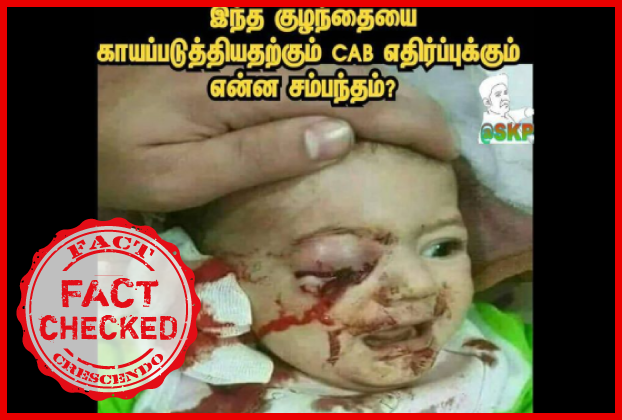
Claim: This child lost eye in West Bengal violence
Publisher’s rating: FALSE
The viral post claimed that a child in the image had lost an eye after Muslims pelted a train in West Bengal during protests against India’s Citizenship Amendment Act. Fact Crescendo reports that the image was shared with a caption linking the injury to those events, and that a Facebook page named Senthamizh Nanbargal posted it on December 17, 2019. The review’s conclusion is that the image was not from West Bengal: it had been misrepresented as showing a child injured there. To investigate the image’s origin, the review says it used reverse-image search and found an earlier post dated November 27, 2016. That post did not identify the child’s location or explain what had happened. The review then examined an earlier post on a Twitter-like platform, dated November 14, 2016, whose translated text referred to Syria and danger from Moscow. It says it subsequently found the original Twitter post and, based on that post’s wording and its investigation, concluded that the image was taken in Syria in 2016. The review therefore rejects the viral post’s attribution of the child’s injury to West Bengal violence: its stated evidence places the image in Syria years earlier. The supplied excerpt does not identify the child or establish the circumstances of the injury, so those details cannot be inferred from it.


A toddler travelling by train injured during the Citizenship Amendment Bill (CAB) protests by Muslims in West Bengal.
Publisher’s rating: FALSE
FACTLY examined a social-media post claiming that an image showed a toddler injured while travelling by train during the Citizenship Amendment Bill protests in West Bengal. Its central check was the image’s earlier circulation: the review says a reverse-image search returned versions of the image that had been shared on social media since at least 14 November 2016. That predates the 2019 protests named in the claim, so the image could not document an injury during those protests. The review adds an important qualification: it found no credible source authenticating the earlier versions either. Its conclusion is therefore about the mismatch between the image’s documented circulation and the claimed 2019 event, not about establishing when, where, or how the child was actually injured. FACTLY concludes that the image is old and unrelated to the West Bengal protests.
He's devastated ISIS & killed AlBaghdadi, building Wall
Publisher’s rating: Misleading

United Liberation Front of Assam (ULFA) firing in protest against Citizenship Amendment Bill (CAB).
Publisher’s rating: FALSE
The claim concerns a social-media video presented as showing the United Liberation Front of Assam (ULFA) firing in protest against the Citizenship (Amendment) Bill, 2019. FACTLY’s review examined that video and concluded that it was old, rather than footage of recent protests in Assam over the bill. The review says the same video had circulated for about a year with varying explanations.

In einem Artikel auf «anonymousnews.ru» wird behauptet, bei den Bombenangriffen auf Dresden im Februar 1945 seien «mindestens 500.000, wahrscheinlich aber sogar eine Million» Menschen ums Leben gekommen. Es handele sich um einen «Bomben-Holocaust». Als Indizien für die Zahl der Opfer werden unter anderem Zeitungsberichte aus den Jahren 1955 und 1965 herangezogen.
Publisher’s rating: Bei den Luftangriffen auf Dresden starben nach Angaben einer Historikerkommission weniger als 25 000 Menschen. «Bombenholocaust» ist ein Ausdruck, den der Verfassungsschutz als Beispiel für Antisemitismus aufführt.
The anonymousnews.ru article cited in the review alleges that at least 500,000 people, and possibly a million, died in the Allied bombing of Dresden in February 1945. It calls the attacks a «Bomben-Holocaust» and points, among other things, to newspaper reports from 1955 and 1965 as evidence for its death toll. The review places the attacks in their wartime setting: British and American bomber formations struck Dresden in waves from 13 to 15 February 1945, dropping incendiary and explosive bombs that caused a devastating firestorm and extensive destruction in the city centre. The review describes the death toll as disputed for decades, with estimates generally ranging from about 20,000 to 500,000. It says that in 2004 Dresden’s then-mayor, Ingolf Roßberg, appointed a historians’ commission to examine and assess the available sources. The commission concluded that no more than 25,000 people died in the attacks. The excerpt does not describe how the commission assessed the particular newspaper reports from 1955 and 1965, so it does not establish that those reports were individually examined or explain their evidentiary value. The review also reports that the expression «Bomben-Holocaust» was repeatedly used for the bombing by the NPD and other far-right extremists, and that Germany’s domestic intelligence agency lists the expression as an example in a brochure on antisemitism in political extremism. Thus, the article’s very high casualty figures are at odds with the commission’s conclusion as reported by dpa, while the review separately documents the term’s use in political-extremist contexts.

"The Ukrainians, third, didn’t know the aid was held up at the time of the phone call."
Publisher’s rating: Unclear When They Knew

Image showing an aircraft carrier belonging to the Indian navy
Publisher’s rating: Misleading

“When I came in [territory once held by ISIS] was virtually 100%. And I knocked it down to zero.”
Publisher’s rating: False
The claim concerns Donald Trump’s remarks at a NATO meeting in London on Dec. 3: he said that territory held by ISIS was “virtually 100%” when he took office and that he reduced it to zero. The review challenges the starting point of that account: it says territory had already been recaptured during Barack Obama’s presidency, so Trump’s description leaves out substantial earlier progress.
Captured Islamic State fighters in Syria "are from France, many are from Germany, many are from UK. They are mostly from Europe."
Publisher’s rating: False