PeakMetrics / Fact Checks
War & conflict fact checks
Explore claims publishers have checked about war & conflict. Read their original ratings and follow the evidence.
Search fact checks
Search by text or image5,847 published reviews in this topic

Claim: Iraq picture circulated now that this man escaping from Taliban's with his daughter
Publisher’s rating: FALSE

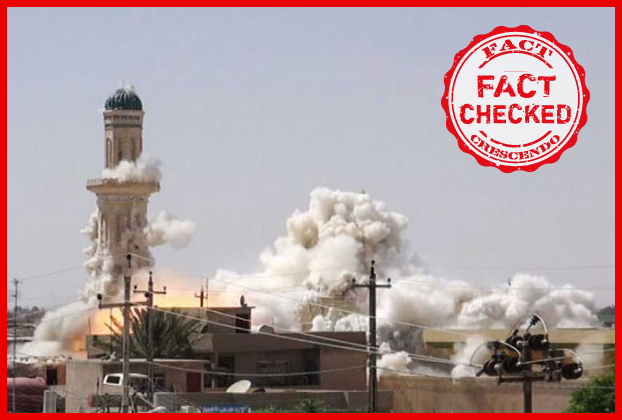
तालिबान ने पाकिस्तान की एक मस्जिद को बम से ध्वस्त कर दिया है
Publisher’s rating: False


Claim: misinformation circulated now that Talibans killed a lady pilot
Publisher’s rating: FALSE

তালিবান আতঙ্কে উড়ন্ত বিমানের টারবাইন ইঞ্জিনে শুয়ে একজন ব্যক্তি আফগানিস্তান ছেড়ে পালাচ্ছে
Publisher’s rating: FALSE
The claim concerns a viral video presented as showing someone fleeing Afghanistan by lying on an airplane’s turbine engine to escape the Taliban. Factcrescendo examined that video and concluded that its turbine-engine scene was digitally edited and misrepresented as an event in Afghanistan. The review notes that the video combined two clips: the turbine scene and footage of people walking, accompanied by narration about Taliban prisoners being released. To trace the turbine scene, the reviewers say they broke the video into key frames using InVID-WeVerify and searched the frames with Google reverse image search. They found a Pinterest post with a similar image, then followed a watermark in the footage to the Facebook profile of Vietnamese creator Huy Quan Hoa. The review describes him as a digital editor and reports finding the viral clip on his profile in a post dated August 17, 2020—before the Taliban takeover of Kabul described in the claim. The review also points to a December 17, 2020 video on Hoa’s YouTube channel showing him sitting and lying on the same turbine and doing other activities around it. This provenance supports the conclusion that the turbine scene was an edited creation, not footage of an Afghan resident escaping by airplane. The review distinguishes that false framing from the second clip: it says the footage concerning the release of Afghan prisoners was genuine and refers to a related report by The Quint.


Videos showing the recent visuals of violent clashes in Afghanistan
Publisher’s rating: FALSE
The claim concerns social-media videos presented as recent scenes of violent clashes in Afghanistan, including footage attributed to the Taliban taking Kabul’s presidential palace and footage said to show Afghan citizens firing at the Taliban. FACTLY reports that it investigated the videos in those posts and concluded they were not from Afghanistan: its account identifies them instead as older footage of fighting in Syria. The review describes two separate video checks, rather than treating similar scenes of violence as proof of the claimed location or date. [S1]

అఫ్గానిస్తాన్లో తాలిబాన్లు అక్కడి పౌరులను చంపుతున్న వీడియో
Publisher’s rating: MISLEADING

Photo of Taliban killing Afghan Airforce pilot, Safiya Firozi
Publisher’s rating: FALSE

"Our mission in Afghanistan was never supposed to have been nation building"
Publisher’s rating: This contradicts his previous postions on the US objective in Afghanistan.

తాజగా అఫ్గానిస్తాన్లో రాళ్లతో కొట్టి చంపేసిన సఫియా ఫిరోజి అనే అఫ్గాన్ ఎయిర్ ఫోర్స్ మహిళా పైలట్ ఫోటో
Publisher’s rating: FALSE
"The Afghan military collapsed, sometimes without trying to fight"
Publisher’s rating: It's true the collapse of Afghan forces was dramatic but this has to be seen in the context of the rapid, largely uncoordinated departure of international forces.
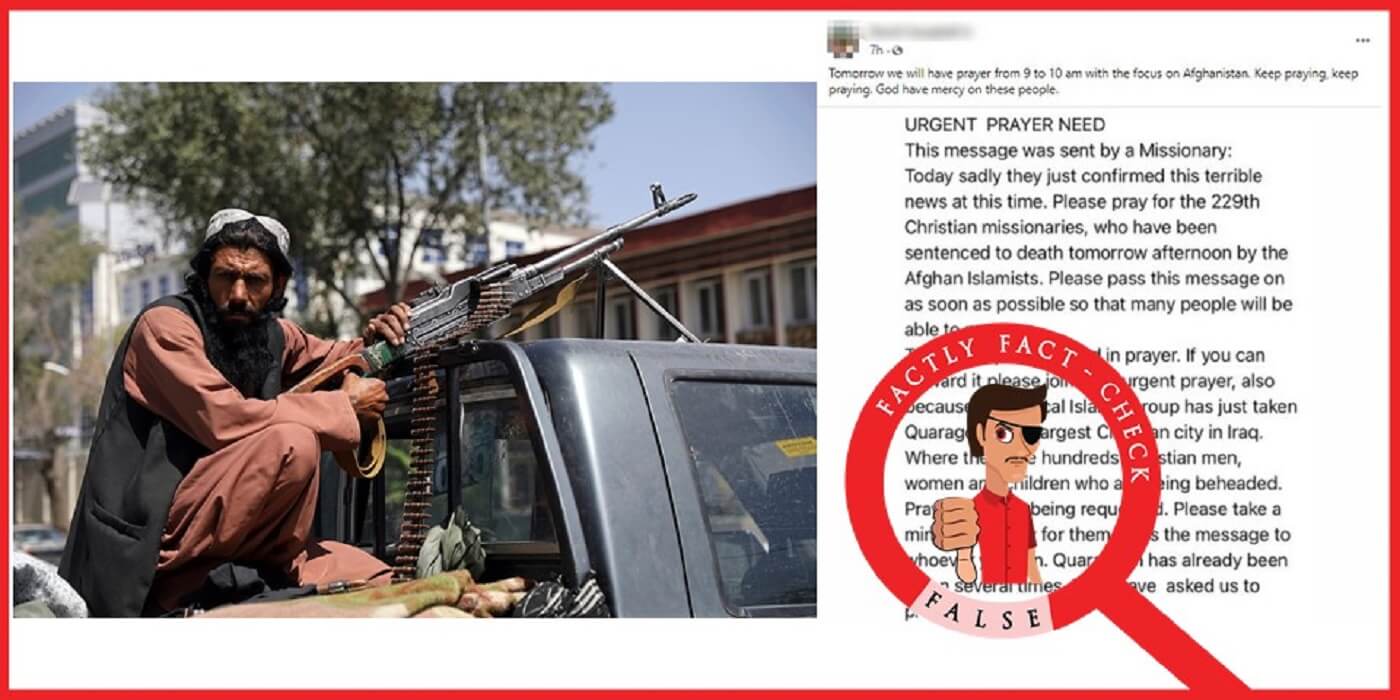
Taliban terrorists are about to execute 229 Christian missionary families in Afghanistan
Publisher’s rating: FALSE
The review addresses a social-media post claiming that the Taliban were about to execute 229 Christian missionary families in Afghanistan. It reports that the message urged people to pray for Christians said to be victims of radical Islamic groups, and describes its investigation as a search for reporting that could substantiate the alleged planned executions. The review says it found no news reports confirming that the Taliban intended to execute 229 families. It contrasts the viral claim with reports that, after taking control of Afghanistan on 15 August 2021, the Taliban were going door-to-door in certain provinces. It also notes that Christian websites had voiced concern about Christians’ fate, but says those reports did not report the alleged planned executions. The review traces the message to an earlier hostage-taking: in July 2007, the Taliban kidnapped 23 South Korean Christian volunteers and held them hostage for six weeks. According to the review, two were executed and the other 21 were released after the South Korean government paid the Taliban USD 20 million. It says a similar message began circulating on social media in 2009, and that the claim later reappeared in posts from 2017 and 2018. The review treats this history as distinct from evidence that the specific alleged execution plan was real.
আফগানিস্থান দখলের পর তালেবানদের হালাল ড্যান্সে আনন্দ
Publisher’s rating: Misleading

CNN Afghanistan tweet claiming that Taliban has executed CNN journlist Bernie Gores
Publisher’s rating: FALSE
The claim concerned a purported “CNN Afghanistan” tweet saying the Taliban had executed CNN journalist Bernie Gores and showing a photograph said to be of him. FACTLY’s review says the image was actually of YouTube vlogger Jordie Jordan, not a CNN reporter. Its reverse-image search led to Jordan’s YouTube channel, and the review reports that he had streamed himself playing a video game earlier that day. The review also examined whether the accounts behind the posts were genuine. It says a separate “BBC Afghanistan” handle circulated the same story, but neither account was associated with CNN or the BBC; both handles were later taken down. The review cites the networks’ official accounts’ verified status as part of its comparison. For corroboration, FACTLY reports that it found no reports of a CNN journalist—or any other American journalist—being executed by the Taliban after the takeover. It also quotes CNN’s head of strategic communications, Matt Dornic, who told Reuters the story was fabricated and the post was fake. Taken together, the image’s identification, the account checks, the absence of corroborating reports, and CNN’s response support the review’s conclusion that the tweet did not document a real execution.
"We trained and equipped an Afghan military force of some 300,000 strong"
Publisher’s rating: This figure is contested and considered by many experts to be a substantial overestimate.
The BBC Reality Check examined Joe Biden’s assertion that the United States had trained and equipped an Afghan military force of about 300,000. It traced the figure to the US Special Inspector General for Afghanistan Reconstruction (SIGAR), which reported 300,699 Afghan security-force personnel in April 2021. The central qualification is that this total was not a count of the military alone: it combined army and air-force personnel with police, who were not deployed as part of the country’s military. The article also notes that the total included “ghost” personnel—people who did not exist or whose names remained on records after they were no longer active. It reports SIGAR’s estimate that salaries for non-existent personnel cost more than $300 million annually. These limitations mean the headline figure does not establish that 300,000 active Afghan military personnel had been trained and equipped. As further context on the scale of the army, the BBC article cites a recent BBC Newsnight investigation that found evidence suggesting the army could have been as small as 50,000. The excerpt does not describe Newsnight’s methods or provide further details of that estimate, so it supports a reported lower estimate rather than a definitive count.

दिख रही महिला साफिया फिरोज़ी है, जिसकी हत्या तालिबान ने की है।
Publisher’s rating: False
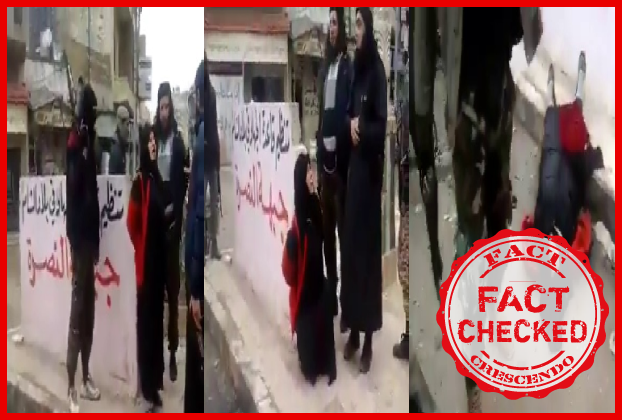
वीडियो वर्तमान अफगानिस्तान से है, जहाँ तालिबानियों ने एक महिला की गोली मारकर हत्या कर दी क्योंकि वह अपने घर से बाहर निकली थी
Publisher’s rating: False