PeakMetrics / Fact Checks
War & conflict fact checks
Explore claims publishers have checked about war & conflict. Read their original ratings and follow the evidence.
Search fact checks
Search by text or image5,847 published reviews in this topic
Gebombardeerd ziekenhuis in Marioepol is eigenlijk een kazerne van Azov met actrices die zich voordoen als patiënten.
Publisher’s rating: Er is geen enkel legitiem bewijs dat het gebombardeerde ziekenhuis in Marioepol dienst deed als uitvalsbasis voor het Azov-bataljon. Er is evenmin enige concrete aanwijziging dat de vrouw op de gedeelde foto's een crisisacteur is.
The claim combines two allegations about the hospital in Mariupol that was bombed on March 9, 2022: that it had become an Azov Battalion base rather than a functioning hospital, and that women photographed amid the destruction were actors posing as patients. The review identifies the bombed site as a hospital with pediatric and maternity departments and says the Ukrainian authorities reported that Russian forces carried out the attack. It also notes that claims about the hospital’s alleged military use circulated after the bombing. To check whether the hospital shown was the one discussed in claims about an evacuated maternity clinic, the review compared the building visible behind an injured woman with a video. It describes matching features: a bridge joining the left and middle buildings, and three yellow projections on the right-hand building. The review says the comparison identified the site as the bombed hospital, not Mariupol’s Maternity Hospital No. 1, which it locates at the other side of the city. The review also examined the cited accounts of an alleged Azov occupation: one interview was with a man whose mother reportedly worked at a clinic, not a clinic employee, and he could not say whether the forces were Ukrainian troops or Azov. Another cited article did not specify which hospital was involved. The review distinguishes the photographed women rather than treating them as one person. It says Marianna Podgurskaya, a pregnant beauty blogger whose Instagram location was tagged Mariupol, resembled a woman in a polka-dot hospital outfit; the review considers her presence at the hospital plausible but finds no evidence she was acting. It says the woman shown on a stretcher was a different person, citing differences in facial features and clothing. The review also notes that a request for fuel posted by the hospital on March 2 indicated it might still be operating, while acknowledging that its operating status at the time of the attack was difficult to establish.
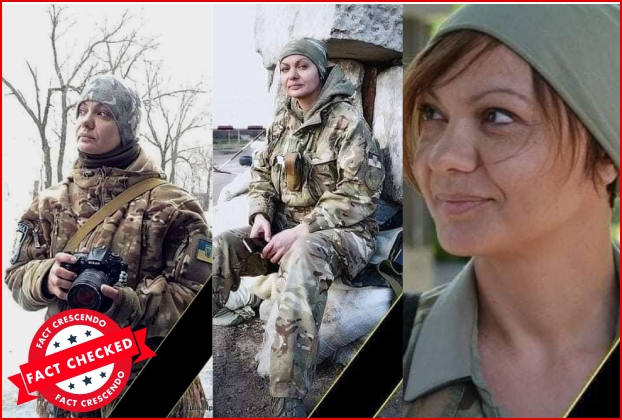
ភរិយារបស់អនុប្រធានាធិបតីអ៊ុយក្រែន និងយុវតីជាច្រើននាក់ស្ម័គ្រចិត្តបូជាជីវិតការពារជាតិមាតុភូមិរបស់ខ្លួន។ សូមឱ្យប្រទេសរបស់អ្នកមានសន្តិភាពឆាប់ៗដើមបីកុំឱ្យបាត់បង់មនុស្សជាទីស្រឡាញ់របស់អ្នកបន្តទៀត។
Publisher’s rating: False
Fact Crescendo examined social-media posts claiming that a woman in military uniform was the wife of Ukraine’s vice-president and that she, along with other young women, had voluntarily gone to the frontline to defend Ukraine. The review says the posts included seven images of the woman and notes that the same claim appeared in a post captured on February 27 and in further posts captured on March 05. Its investigation used Google Reverse Image Search to trace the images. The review identifies the woman as Iryna Tsvila, a poet and literature teacher, not a vice-president’s wife. It reports that media had published the images after Tsvila was killed in frontline fighting against the Russian invasion. The review attributes the account of her death on February 24, while defending Kyiv, to a March 07 report by Tribune de Genève. It also says ELLE reported that Tsvila and her husband died when their battalion tried to repel Russian tanks north of Kyiv, leaving their five children parentless. The review further explains that Ukraine has no office of vice-president under its constitution; it says executive power is exercised by the president and prime minister. It describes Tsvila as having joined the Ukrainian military in 2014, when fighting broke out in Donbas between the Ukrainian government and pro-Russian separatists. Thus, the images concern a real Ukrainian fighter, but the review’s account does not support the post’s identification of her as a vice-president’s wife.
CNN utilise des images d'une explosion en Ukraine datant de 2015 pour illustrer le conflit actuel.
Publisher’s rating: L'image partagée sur Facebook a été manipulée. La photo d'origine date bien de 2022, et non de 2015. C'est cette photo qui a été diffusée par CNN, dans son contexte, et non la version altérée vue sur les réseaux sociaux.

Video of a fake Ukrainian soldier getting blood makeup
Publisher’s rating: FALSE
The post presented a video as showing a fake Ukrainian soldier receiving blood makeup and alleged that Western media was using such staged soldiers to shape a narrative against Russia. FACTLY says the clip was being circulated in the context of the Russia–Ukraine conflict, but its review found that the footage was not related to that conflict: it was a behind-the-scenes clip from the show *Contamin*. To investigate, the review reports that it ran screenshots of the video through Google Reverse Image Search. It found similar posts and a comment identifying the footage as a movie-set scene for a Ukrainian TV series called *Contamin* in 2020. The review then searched using keywords and found a similar photo posted by a Twitter user with the description “Bts from set of Contamin tv series.” The review also reports finding similar photos in a *Contamin* album on the poster’s Facebook profile, and similar visuals in a YouTube video titled “CONTAMIN 25 minutes.” Taken together, these matches connect the circulated footage to the show’s behind-the-scenes material, rather than to a fabricated soldier in the Russia–Ukraine conflict. The review concludes that the post’s claim is false.

Claim: different videos being shared as russia ukraine conflict visuals
Publisher’s rating: FALSE
Une photo d'un immeuble en Ukraine soi-disant bombardé par Poutine qui date en fait de 2018.
Publisher’s rating: Il est faux d’accuser Bild d’une quelconque erreur ou manipulation avec la diffusion de cette image. La photo en question a bien été prise le 24 février 2022 à Tchouhouïv, en Ukraine, après que l’immeuble a été touché par une frappe aérienne.
The allegation was that Bild used a photograph of a Ukrainian building damaged in February 2022 even though the image supposedly came from a 2018 gas explosion in Magnitogorsk, Russia. The dpa review examined the two images being compared in social-media posts and concluded that they showed different buildings and different events. It places the Ukrainian image in Tchouhouïv, near Kharkiv, on 24 February 2022, after a strike damaged a residential building. The review compared photographs and videos of the locations. It reports that the Russian building had more floors and that the damage differed from that shown in the Ukrainian images. It also traced the purported 2018 comparison to a video screenshot shared online: the Russian text visible in that screenshot referred to a missile strike near Kharkiv, not a gas explosion in Russia. The review says the video was posted on Twitter on 24 February 2022 and could also be found on YouTube with the same text. The 2018 event was real but did not establish the image’s alleged provenance: a residential building in Magnitogorsk partially collapsed on 31 December after an explosion attributed to a gas leak. The review therefore distinguished the actual 2018 disaster from the 2022 damage shown in Bild’s image. It also notes that Bild had previously published images that did not illustrate the war in Ukraine, but says that did not apply to this photograph.
CNN gebruikt beelden van explosie in Oekraïne in 2015 voor het huidige conflict.
Publisher’s rating: De afbeelding is nep en werd nooit uitgezonden door CNN. Het gaat om een recent beeld uit Oekraïne waar een oude informatiebanner van CNN, oorspronkelijk uitgezonden in juni 2020, en een silhouette van president Biden op is geplaatst. Dat bericht ging een eigen leven leiden als meme. De foto toont geen expolsie in Oekraïne in 2015.
The image circulating online appeared to show a CNN banner describing a “fiery” explosion in Ukraine and was presented as evidence that CNN had reused footage from 2015. The review says the image was fabricated and was never broadcast by CNN. It describes the image as a recent photograph combined with an old CNN information banner and an added silhouette of President Biden. The photograph itself was not from 2015. According to the review, someone in Ukrainian President Volodymyr Zelensky’s government took it in Kyiv on February 24, the first day of the war. CNN did use the photograph, but in its correct context, in a photo article that the review says was regularly updated. The viral version also added silhouettes of Biden, Jill Biden and their dog, which were absent from the original. The banner’s wording drew on a separate CNN segment about protests in Kenosha, Wisconsin. The review dates that segment to August 25, 2020, and says the viral image combined that older banner with the Ukraine photograph. It also points to a temperature reading of 90°F for New York as inconsistent with February conditions. Together, the review’s account of the image’s provenance and the mismatched banner details contradict the claim that CNN used a 2015 Ukraine explosion image.

“Las Fuerzas Armadas rusas habían declarado un alto el fuego en varias ocasiones para evacuar a la población [en Ucrania] a lo largo de los corredores humanitarios".
Publisher’s rating: Engañoso
ইউক্রেনের ড্রোন হামলায় রাশিয়ার অনেক ক্ষতি হয়ছে
Publisher’s rating: Misleading
“Los batallones nacionalistas ucranianos lo impidieron (la evacuación de la población) recurriendo a la violencia contra la población civil".
Publisher’s rating: No hay evidencias
রাশিয়া এবার আক্রমন করলো অ্যামেরিকার ন্যাটো, রাশিয়া বিশ্বযুদ্ধ করতে চাই
Publisher’s rating: False
Ukraine-Krieg: Verwundete Kriegsopfer sind geschminkte Schauspieler.
Publisher’s rating: Falsch. Das Video ist bereits 2020 und bei Dreharbeiten zur ukrainischen TV-Serie "Contamin" entstanden.

Reportagem mostrando os mortos na guerra da Ucrânia, esqueceram de avisar pro morto o LUZ, CÂMERA, AÇÃO…”
Publisher’s rating: Falso

Claim: 2012 dated video being shared as Russia military equipment being transported to Ukraine
Publisher’s rating: FALSE
The review investigated a video circulated as showing Russian tanks and other military equipment being transported by rail toward Ukraine. It says the footage was posted by the Facebook page Gtamils Focus on March 6, 2022, with captions in Tamil and English presenting it as Russian equipment headed for Ukraine. The review compared that wartime claim with the video’s earlier provenance. To identify the footage, the investigators converted a frame from the video into an image and searched for matching material. They report finding the video on YouTube, where it was described as a rare Canadian military train. The review gives the YouTube upload date as August 30, 2012. That predates the Russia–Ukraine war, which the review says began in February 2022, by nearly a decade. On that evidence, the review concludes the footage was filmed in Canada in 2012, not of Russian equipment being moved toward Ukraine in the 2022 war. The misleading element was the later caption: the video’s appearance of military equipment did not establish the claimed country, destination, or wartime setting.
Affirmation : Cette photo montre une enfant blessée par des bombardements en Ukraine.
Publisher’s rating: Photo détournée et modifiée
সেনাবাহিনীতে যোগ দিয়ে রাশিয়ার বিরুদ্ধে অস্ত্র হাতে যুদ্ধের ময়দানে নেমেছেন মিস ইউক্রেন আনাস্তাসিয়া লেনা
Publisher’s rating: False
De vrouw die wordt gebruikt als 'slachtoffer van de Russische agressie' is eigenlijk militair in het Oekraïense leger. Foto bij verwoest appartementencomplex is in scène gezet.
Publisher’s rating: De vrouwen op de twee foto’s zijn niet dezelfde persoon. De foto van de vrouw met het geweer kan dus niet worden gebruikt om te beweren dat het veelgebruikte beeld bij het appartementencomplex in scène is gezet.
The claim combines two assertions: that the injured woman photographed near a damaged apartment building was a Ukrainian soldier, and that the widely circulated image of her injuries was staged. The review identifies the injured woman as Olena Kurilo and says the photograph was taken in Chuguev, in the Kharkiv region, on February 24. The comparison used to support the claim was a separate image showing a blonde woman with a rifle; the review finds the women are not the same person. To check the identification, the review compares visible features in the images. It reports that the blonde woman has light-brown eyes, while Kurilo’s eyes are light blue in video footage shared by Euronews, and also notes differences in their chins. The blonde woman’s photograph was taken in Kyiv on February 26, according to photographer Lynsey Addario’s Instagram post. The review says the blonde woman’s name is unknown and describes her as a volunteer sent to fight against the Russian army. The review also describes evidence addressing whether Kurilo’s injuries were real. It says Kurilo appears in a video discussing her destroyed home and that her daughter posted updates documenting the injuries. A photograph dated March 2 shows Kurilo with facial injuries, including an injury around her eye; the review contrasts this with the claim that the same woman appeared uninjured at the Kyiv front line two days after the February 24 attack. Kurilo also posed with her passport on February 27, according to the review. Taken together, the comparison undermines the identification on which the staging allegation depends, while the cited injury documentation supports that Kurilo was a real, injured person.

Clip del video con un hombre diciendo "esto es un p*to misil" es auténtico: es un periodista reportando desde Ucrania el día que comenzó la invasión de Rusia, el 24 de febrero
Publisher’s rating: Auténtico