PeakMetrics / Fact Checks
Climate & environment fact checks
Explore claims publishers have checked about climate & environment. Read their original ratings and follow the evidence.
Search fact checks
Search by text or image1,358 published reviews in this topic
Cumbria County Council's ‘net zero’ strategy will impose travel restrictions
Publisher’s rating: FALSE
நீர் நிலைகள் கால்வாய்கள் எவ்வாறு இருக்கிறது.. நம்பர் 1 மாநிலமாம்..
Publisher’s rating: False
Deutschlands Beitrag zum Co2 in der Luft beträgt nur 0,000028 Prozent.
Publisher’s rating: Die Berechnung hinter der Zahl ist falsch. Co2 macht ohnehin nur 0,04 Prozent der Luft aus - was nicht heißt, dass es wirkungslos ist. Richtig wäre: Deutschlands Beitrag zum jährlich von Menschen verursachten CO2-Ausstoß beträgt 1,8 Prozent.

Een Spaanse minister neemt een privé-vliegtuig naar een klimaattop om dan vlak voor de deur uit de limo op een fiets te stappen en zo te arriveren.
Publisher’s rating: Teresa Ribera, Spaans minister voor ecologische transitie, nam de auto naar de bijeenkomst van EU-klimaatministers. Dat vond plaats in Valladolid, in Spanje. Het laatste stukje deed ze met de fiets omdat de bijeenkomst plaatsvond in een verkeersvrije zone.
The Biden administration is planning to address global warming through solar geoengineering
Publisher’s rating: Misleading
La Unión Europea autorizó a Bill Gates a ayudar a ese organismo a “bloquear el Sol” para combatir el cambio climático.
Publisher’s rating: Falso

Toute moyenne globale de températures sur terre n'a aucune signification scientifique et climatique.
Publisher’s rating: Il existe bel et bien une température moyenne de la Terre. Son évolution a une incidence sur le climat, ainsi qu'une explication scientifique.
Antarctic ice has grown rather than melting
Publisher’s rating: Misleading
the Co2 level in atmosphere is negligible
Publisher’s rating: Mostly False

Em um vídeo retirado de um podcast, uma mulher identificada como advogada diz que “não é o mercúrio da mineração que contamina o peixe” ao falar da atividade garimpeira na região amazônica e que “não existe contaminação de mercúrio no garimpo”. Ela completa afirmando que a contaminação de mercúrio é provocada por rochas que liberam o metal tóxico na água.
Publisher’s rating: Enganoso
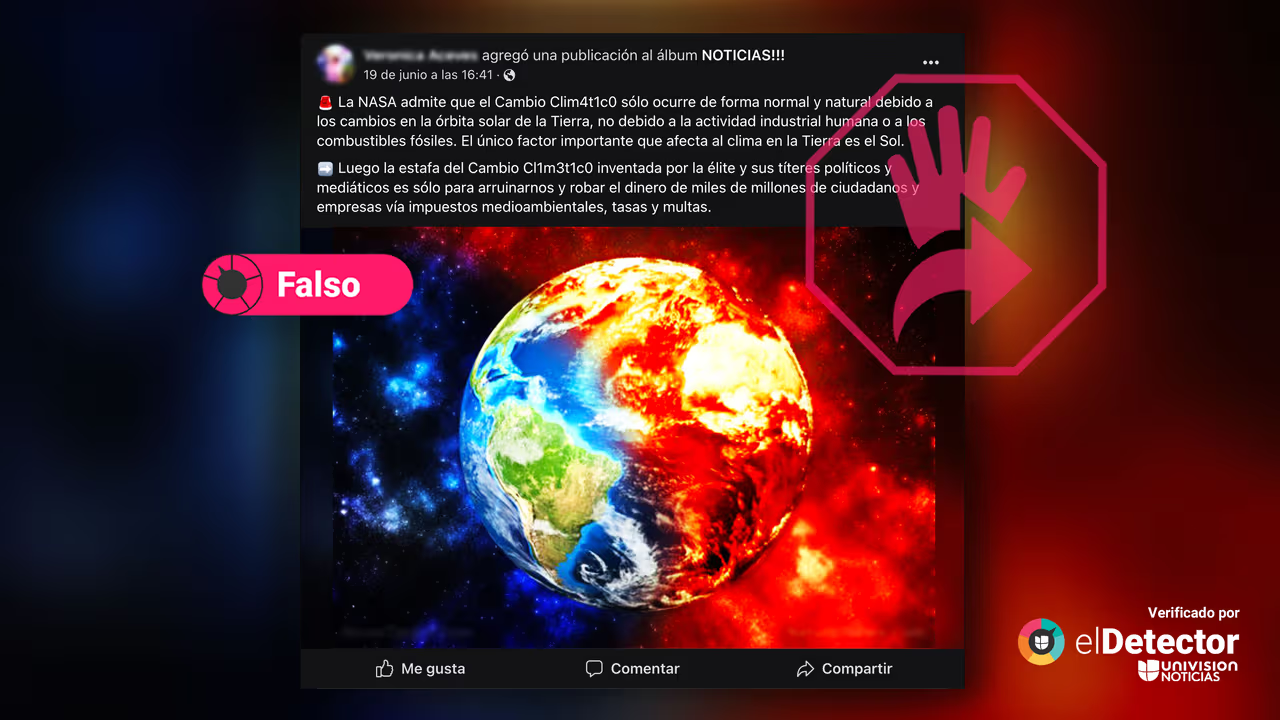
La NASA admitió que el cambio climático se produce por cambios en la órbita solar de la Tierra y no por la acción del hombre o los combustibles fósiles.
Publisher’s rating: Falso
Niveau des nappes phréatiques au 1er juin: A gauche la carte frauduleuse utilisée par les médias et le gouvernement. A droite la situation réelle et la carte du BRGM.
Publisher’s rating: Non, ces deux cartes ne peuvent être comparées, car elles illustrent l'état des nappes souterraines en France à des moments différents. Si l'une d'elles visualise des données collectées jusqu'au 31 mai 2023, l'autre représente la situation qui prévalait au 20 juin dernier.
The posts compared two maps of groundwater levels in France, claiming both showed conditions on 1 June 2023 and that the more alarming map on the left was fraudulent. The review identifies the maps as one from Info-Sécheresse and one from the Bureau of Geological and Mining Research (BRGM), which monitors groundwater levels in France. Its central finding is that the maps depict different dates, so they cannot be treated as a like-for-like comparison. The review distinguishes the maps by tracing the dates of the data they display. It reports that the BRGM map on the right used data collected through 31 May 2023, while the Info-Sécheresse map on the left was based on data collected through 20 June 2023. The latter date is also given by Sud Ouest, whose logo appeared on the viral image. Thus the claim that the left map represents 1 June is contradicted by the stated date of its underlying data; the different appearances do not establish that either map was falsified. The review also addresses the implication that the government ignored the BRGM or the “real” situation. It says the BRGM is under the supervision of several ministries and is one of the government’s main sources for assessing drought risk. The posts’ comparison therefore conflates maps based on different reporting periods and mischaracterizes the role of the agency whose map they present as the more reliable one.
The Inflation Reduction Act "cuts pollution by 1 billion tons, cuts emissions by 50% by 2030."
Publisher’s rating: Exaggerates

Deutschland führt einen Hitzeschutzplan ein, obwohl es nur auf Platz 188 der wärmsten Länder der Welt liegt.
Publisher’s rating: Die durchschnittliche Jahrestemperatur ist für die Frage, ob Hitze gefährlich werden kann, nicht von Bedeutung.
The claim combines two details from a social-media video: Germany appears at number 188 on a list of countries by average temperature, and the video links that ranking to the development of a heat-protection plan. The review reports that a Facebook post from Luxembourg shared the video, with the comment “We will all die” and laughing emojis. It says the list, attributed in the video to Wikipedia, ranked Germany among 217 states and dependent territories. The ranking is about annual averages, not the highest temperatures people may experience. The review explains that Germany’s listed annual average was 9.49°C, while Burkina Faso, the top-ranked country, was listed at 30.01°C. Those averages combine temperatures across the year and therefore do not establish that dangerous heat cannot occur in a country with a lower average. The review says the relevant considerations for heat protection are extreme temperatures and how often they occur. The plan reference concerned an announcement by German Health Minister Karl Lauterbach on June 26, 2023, that a national heat plan was being developed. The review describes proposed support for municipalities, care homes and hospitals in protecting people particularly vulnerable to heat, including through shade, green spaces and drinking-water fountains. It also cites the Robert Koch Institute’s estimate of about 4,500 heat-related excess deaths in Germany in the previous year. Thus, Germany’s position in an annual-average ranking does not answer whether a heat plan is warranted.
環保少女通貝利指中國用筷子是浪費資源,敦促中國盡快放棄筷子以保護樹木。
Publisher’s rating: 錯誤
The claim concerns posts attributing to Greta Thunberg a demand that China give up chopsticks to protect trees. Factcheck Lab traced one strand of the claim to a Chinese-language image circulating on Facebook from June 16, 2023, and to a June 16 Weibo post reproducing an English caption. The review also found a similar Twitter post dated June 12, 2023. These posts did not provide a source for the alleged statement. The review says it searched Google and Baidu for articles making similar claims and found no reliable source supporting them. It also examined earlier fact-checking by Reuters, AFP and Snopes, which traced a related version of the allegation to a January 14, 2020 Twitter post by an account named 郑明哲. That post paired a GIF of Thunberg with the words “How dare you!” and a claim that she opposed chopsticks. The review reports that Reuters could find no such statement and that Thunberg’s team confirmed she had never made it. The review further reports that AFP and Snopes traced the GIF to Thunberg’s 2019 address at the UN Climate Action Summit, while the address transcript did not mention chopsticks. It concludes that the claim that she urged people to stop using chopsticks lacked evidence and was false. The evidence described addresses the alleged statement itself; the posts’ added criticism of her environmental views does not establish that she made it.
හන්තාන සඳගිරි විහාරය ආශ්රිතව මහා පරිසර විනාශයක් සිදුවෙනවා ද?
Publisher’s rating: Explainer
Rainwater is now too polluted for drinking purposes due to the presence of per- and poly-fluoroalkyl substances (PFAS), according to a study by researchers from ETH Zurich and Stockholm University.
Publisher’s rating: Partially true
Nato-Luftwaffenübung hat in elf Tagen 222.000Tonnen CO2 produziert.
Publisher’s rating: Die genannte Zahl ist nicht nachvollziehbar. Die Berechnung beruht, soweit erkennbar, auf falschen Annahmen.