
As Turnaround Questions Mount, Is the World Cup Changing the Conversation Around Nike?
As the FIFA World Cup unfolds, Nike's marketing gains momentum, shifting consumer focus from financial struggles to brand engagement and culture.
Published
Amid earnings pressure, slowing growth, and renewed scrutiny of Nike's turnaround, PeakMetrics analyzed a month of online conversations to understand whether the FIFA World Cup is reshaping how consumers are talking about the brand.
Nike has spent much of the past month in the headlines, and not always for the reasons it would like.
Investors questioned whether the company's latest earnings signaled a true turnaround or were buoyed by one-time factors. Analysts debated slowing growth in China, leadership changes, and whether Nike can reclaim the product innovation and cultural momentum that once defined the brand.
At the same time, one of the world's biggest sporting events is underway.
As the 2026 FIFA World Cup kicked off, Nike launched a global marketing push featuring athletes and celebrities including Cristiano Ronaldo, Kylian Mbappé, Erling Haaland, Vinícius Júnior, LISA, Travis Scott, and Kim Kardashian. The campaign quickly became one of the brand's largest global marketing moments in years.
With two very different stories unfolding at once, we wanted to understand what was actually driving the online conversation.
Is the World Cup changing the conversation around Nike?
Using PeakMetrics, we analyzed online conversations from June 1 through July 1 across news and social media. Leveraging Smart Categories—AI-powered classifiers that organize conversations into the themes, narratives, tones, and signals that matter most—we identified which stories were driving discussion and whether the World Cup was helping shift attention away from Nike's turnaround.
The conversation is more positive than the headlines suggest
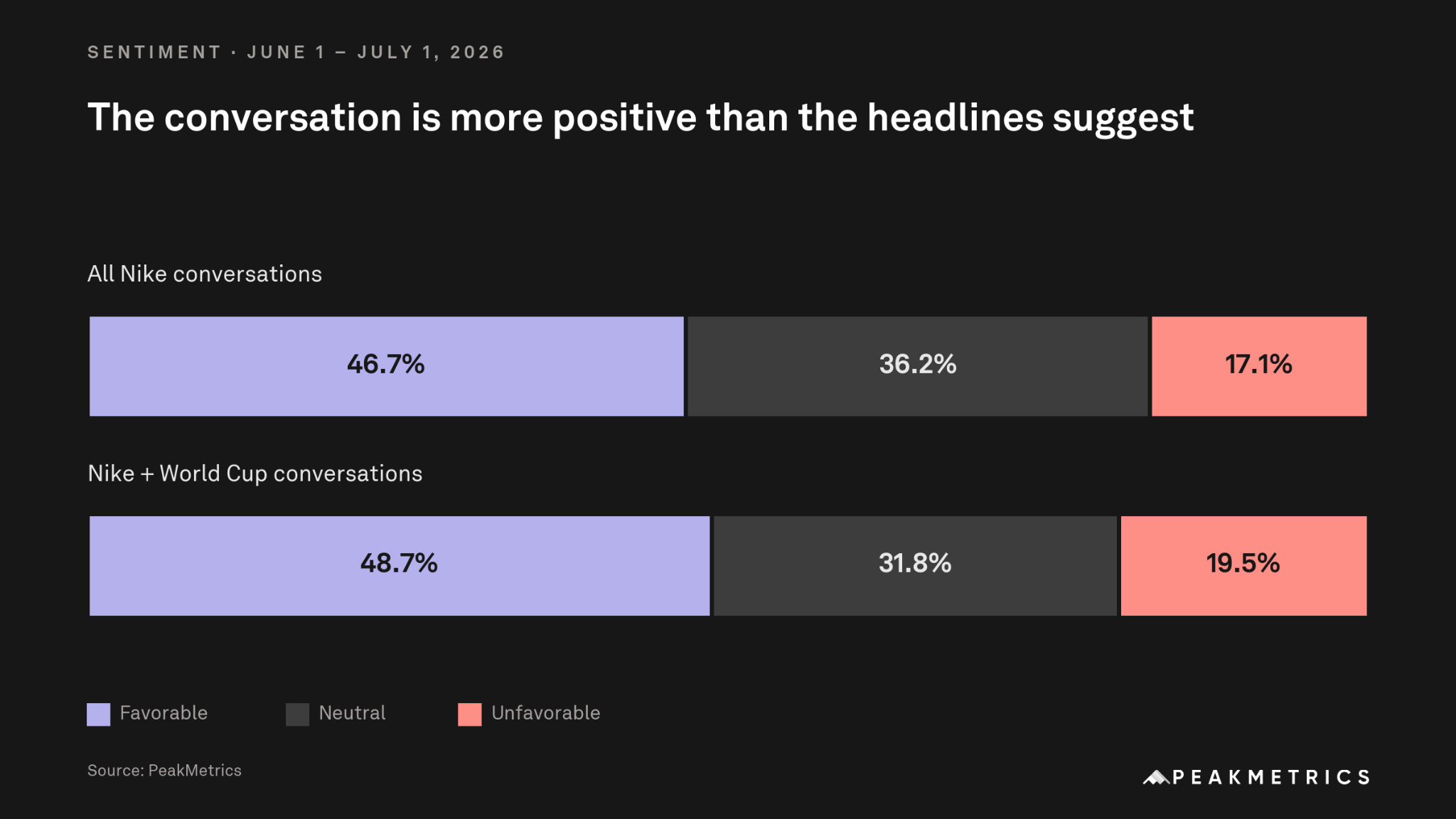
Despite weeks of difficult business headlines, the overall online conversation around Nike remained largely positive.
Among conversations relevant to Nike:
- 46.7% were favorable
- 36.2% were neutral
- 17.1% were unfavorable
That paints a different picture than financial headlines alone.
Much of the media coverage during the month centered on earnings, slowing growth in China, executive changes, and investor concerns about the pace of Nike's recovery. Across the broader internet, however, consumers were discussing a much wider range of topics—from World Cup campaigns and product launches to athlete partnerships and competition with Adidas.
The result is two parallel narratives: one focused on Nike's business performance and another focused on the brand itself.
The World Cup is creating one of Nike's strongest brand narratives
If there is one area generating momentum for Nike, it's football.
Within conversations specifically tied to Nike and the World Cup, favorability climbed slightly higher:
- 48.7% Favorable
- 31.8% Neutral
- 19.5% Unfavorable
Nearly half of all relevant World Cup conversations were favorable, fueled by campaign launches, athlete partnerships, product releases, and fan engagement.
Perhaps even more striking is how visible the brand has become throughout tournament content.
Among media associated with Nike and the World Cup:
- 65.2% included a visible Nike logo.
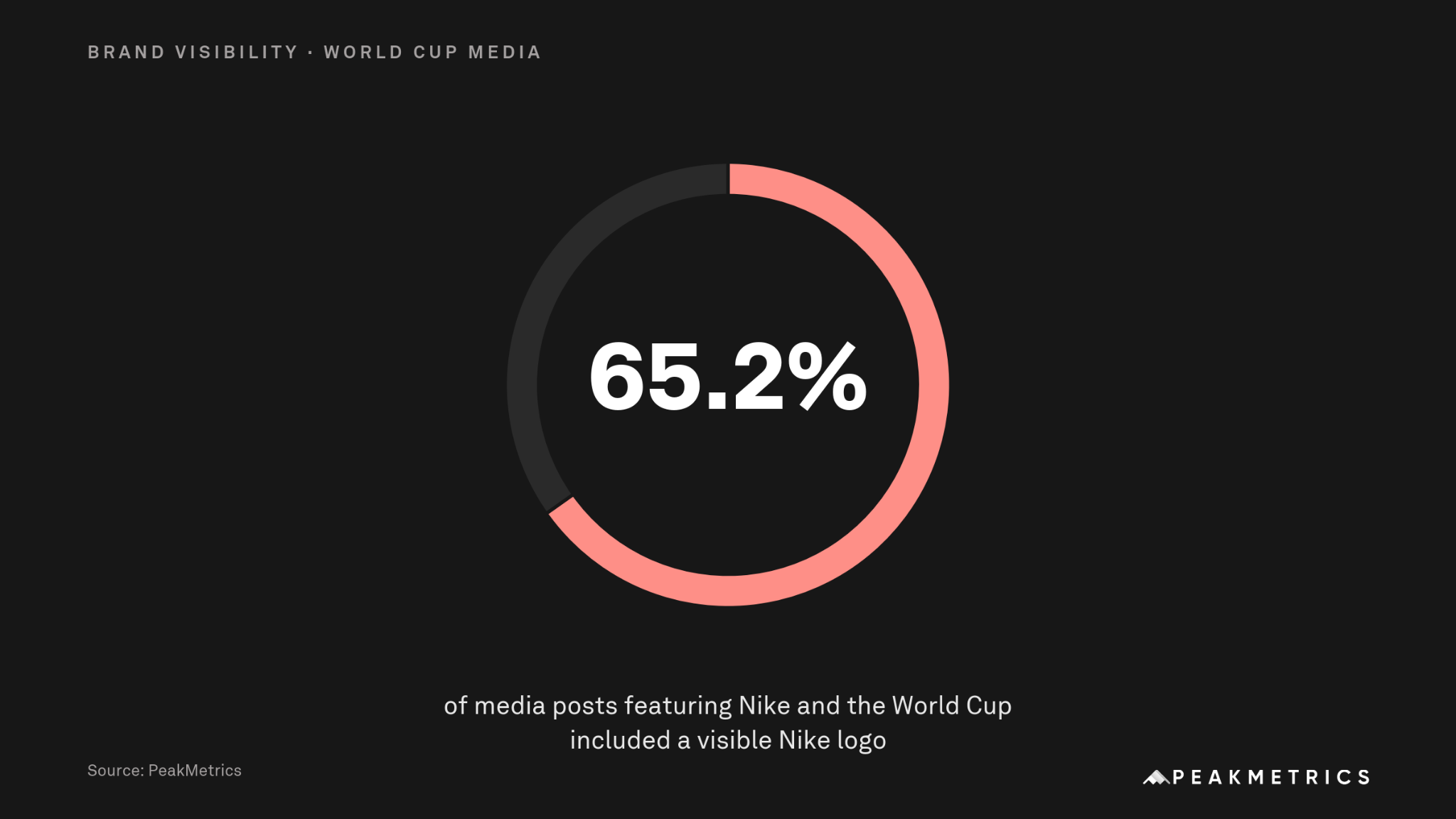
Whether through national team kits, boots, training apparel, athlete imagery, or campaign creative, Nike has become one of the tournament's most recognizable brands online.
For marketers, this highlights the value of major sponsorships beyond paid media. As fans share match highlights, athlete photos, kit reveals, and tournament moments, brand visibility extends organically across user generated content, creating exposure that traditional sponsorship metrics often miss.
News and social media are telling different stories
One of the biggest differences we found was between traditional news coverage and the broader online conversation.
Within news coverage, financial performance represented 33.4% of all brand risk themes tracked, making it by far the dominant storyline.
Across the broader online ecosystem, including social media, the conversation shifts.
The largest risk themes become:
- Competitive Conversations: 26.1%
- Brand Reputation Discussion: 25.3%
- Financial Performance Risk: 16.1%
Consumers aren't ignoring Nike's financial performance.
They're simply talking about something else.
Rather than debating quarterly earnings, they're comparing products, discussing sponsorships, evaluating campaigns, and asking whether Nike still leads culture the way it once did.
Adidas remains Nike's biggest competitive benchmark
Competition emerged as one of the defining narratives throughout June.
Among conversations mentioning Nike alongside a competitor, Adidas accounted for nearly 60% of all competitor mentions.
Much of that discussion centered on the World Cup, where fans compared national team kits, debated campaign creativity, discussed sponsorship portfolios, and argued over which brand was making the biggest impact during football's biggest stage.
Despite Nike's significant World Cup marketing push, Adidas generated roughly 10% more World Cup related posts during the period analyzed.
The number of brands participating in the World Cup conversation highlights the tournament's value as a global marketing platform. Official sponsors, apparel brands, and even non-endemic companies all competed for attention, making share of conversation increasingly difficult to win.
Marketing is breaking through—but innovation questions remain
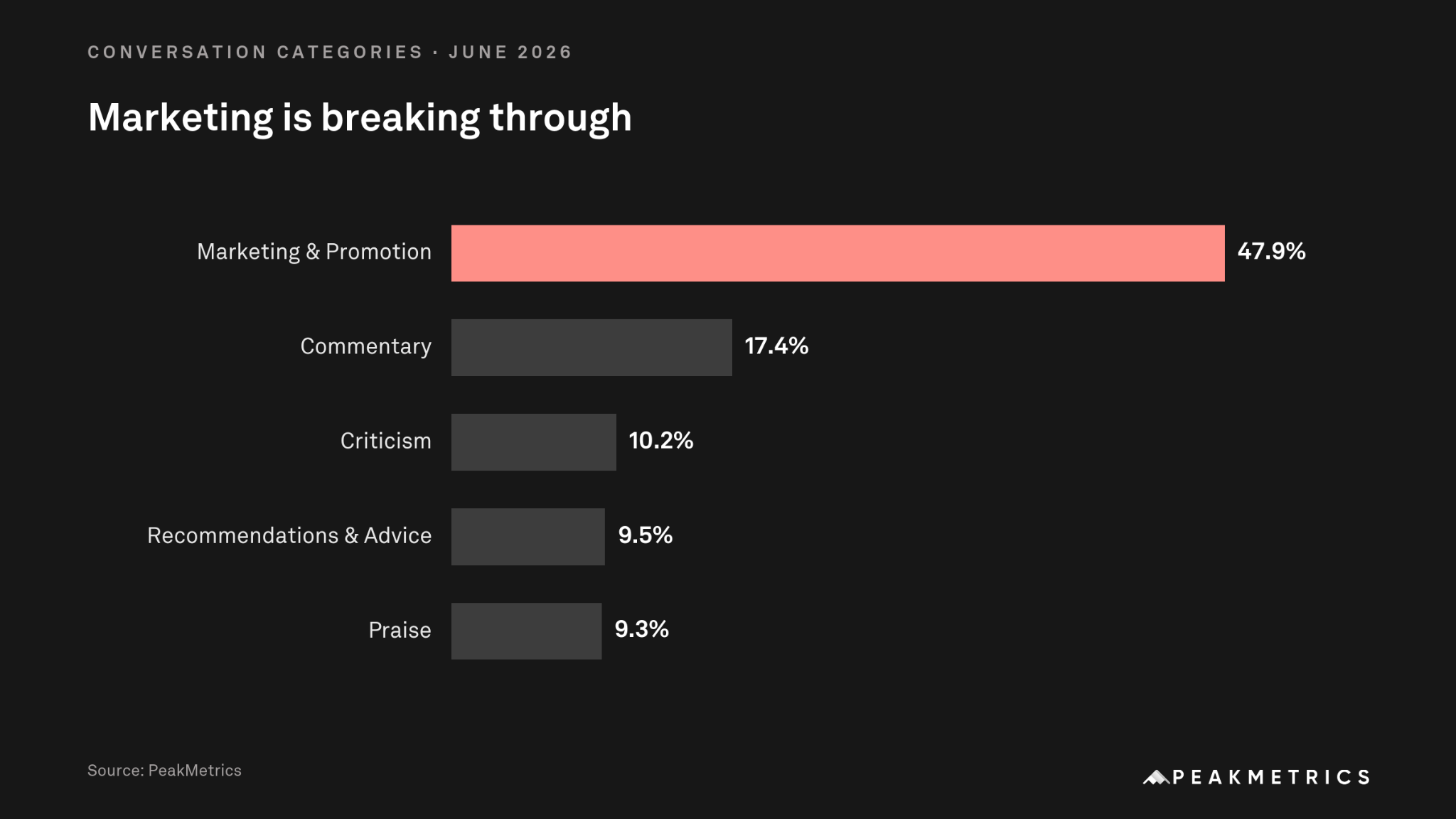
Nearly half of all categorized Nike conversations focused on marketing and promotion.
- Marketing & Promotion Discussion: 47.9%
- General Commentary: 17.4%
- Criticism: 10.2%
- Recommendations & Advice: 9.5%
- Praise: 9.3%
Nike's campaigns and celebrity partnerships are clearly capturing attention.
But underneath those campaigns, several recurring narratives continue to surface.
Consumers questioned product innovation, discussed frustration around limited releases and resale pricing, and debated whether Nike has maintained the cultural edge that once made every launch feel essential.
Women's basketball was one notable exception, generating consistently positive conversation around athlete partnerships and product launches, reinforcing the category as an area of momentum for the brand.
Automated Activity Skewed Toward Favorable Narratives Around Nike and the World Cup
Automated activity played a meaningful role in the Nike World Cup conversation, though not at an unusually elevated level. Accounts classified as Likely, Very Likely, or Almost Certain bots generated 33.2% of all conversation, slightly above typical benchmarks for major brand moment discussions. Given the scale of the tournament and the dominance of algorithm-driven discovery, these numbers are not particularly surprising.
What those accounts were amplifying was more notable. Rather than disproportionately driving criticism, bot-like accounts were far more active in promoting favorable narratives around Nike and the World Cup. 38.6% of favorable conversation originated from likely bot accounts, compared with 21.7% of unfavorable conversation.
What marketers can learn
Nike's turnaround story isn't being written by a single headline.
While investors continue to scrutinize earnings and analysts debate the company's recovery, our analysis suggests that isn't the only story shaping brand perception.
The World Cup is creating a parallel narrative—one centered on athletes, marketing, competition, and culture—that is both more favorable and more reflective of how consumers are engaging with the brand.
For Nike, that doesn't mean turnaround questions have disappeared. But it does suggest that major cultural moments like the World Cup can broaden the conversation, creating opportunities to reinforce brand relevance even as business performance remains under scrutiny.
As brands increasingly invest in sponsorships and global events, measuring what people actually see, share, and discuss—not just what earns headlines—provides a more complete understanding of sponsorship value, brand perception, and the narratives shaping consumer opinion.
To learn more, connect with PeakMetrics.
Sign up for our newsletter
Get the latest updates and publishings from the PeakMetrics investigations team.
Loading the newsletter sign-up form…