
Neutrogena’s Statement Slowed the Hayden Panettiere Backlash, but Didn’t Change Minds
PeakMetrics analyzed reaction to Neutrogena’s Hayden Panettiere statement. While 58% called it inadequate, boycott calls still fell by 20%.
Following Hayden Panettiere’s passing, a story she had previously shared about Neutrogena resurfaced online. Panettiere said the brand tried to end its longtime partnership with her after she spoke publicly about receiving treatment for postpartum depression in 2015. As the story spread, calls to cancel or boycott Neutrogena grew, with the brand waiting several days before issuing a response.
Neutrogena’s response to the recent controversy appears to have helped contain the immediate volume of conversation. It did not, however, meaningfully improve how people viewed the company or its handling of the situation.
PeakMetrics analyzed online reaction following the beauty brand’s statement to understand whether it changed public opinion, reduced calls for a boycott or altered the trajectory of the broader conversation.
For communications leaders, it shows the power a statement can have in slowing the conversation, but also that slowing a controversy isn’t the same as resolving it.
The statement was widely viewed as inadequate
Among posts directly evaluating Neutrogena’s response, 58% characterized it as insincere or inadequate. Much of the criticism centered on a perceived lack of genuine accountability or evidence that anything would change.
Another 36% described the statement as “too little, too late,” with critics arguing that Neutrogena responded only after the company faced significant public pressure.
Just 4% viewed the response as meaningful or sincere. In other words, the statement did little to change the prevailing opinion of the company or ease dissatisfaction among those already engaged in the controversy.
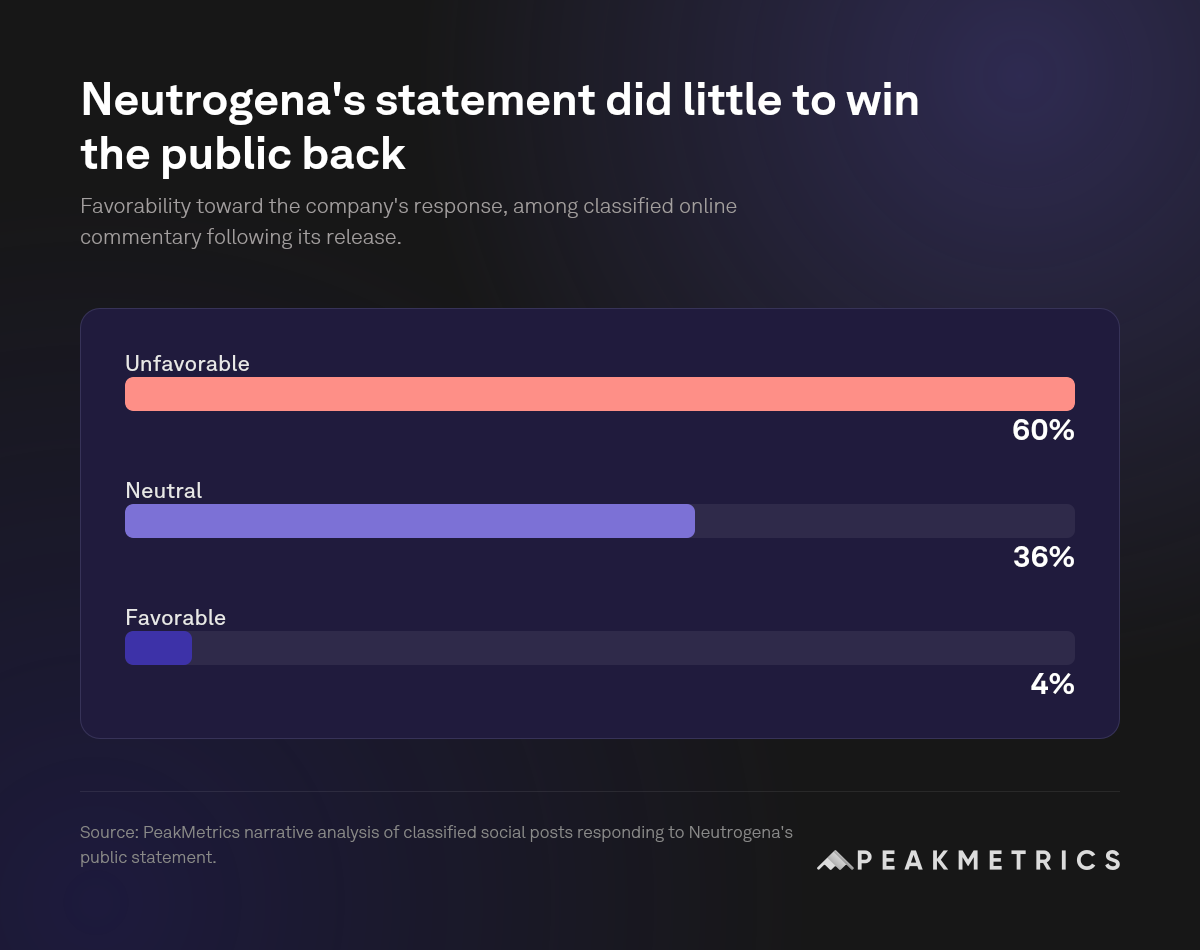
Overall favorability toward the statement reflected the same pattern:
- 60% unfavorable
- 36% neutral
- 4% favorable
The rhetoric surrounding the response was also predominantly negative, with critical rhetoric accounting for 61.4% of classified posts.
Together, these findings suggest that audiences largely interpreted the statement through the context of what had already happened. By the time Neutrogena responded, many people had formed strong opinions about the controversy, the company’s role in it and what an adequate response should include.
The response still helped slow the conversation
Although the statement did not repair public sentiment, it appears to have helped contain the immediate attention surrounding the controversy.
Conversation volume declined meaningfully after the response was released. That drop was likely driven by a combination of the news cycle moving forward and the statement addressing some of the immediate demand for the company to respond.
Calls to cancel or boycott Neutrogena also fell from 40% before the statement to 32% afterward. That represents an eight-percentage-point decline, or a 20% relative decrease.
This is an important signal. A response can have an operational communications benefit even when audiences react negatively to its content. Neutrogena did not win over most critics, but its statement may have reduced the urgency driving people to post, share and actively call for action against the brand.
Still, the decline should be interpreted carefully. Conversation remains above Neutrogena’s typical daily volume before the controversy, and lower activity does not necessarily indicate that perceptions have improved. People may simply be discussing the issue less frequently.
The reputational risk has not disappeared
The immediate conversation is slowing, but the controversy may continue to follow Neutrogena in less visible ways.
Boycott messaging can persist long after the initial news cycle ends, particularly in social media comments. It may resurface when Neutrogena launches a new campaign, announces a spokesperson or partnership, responds to a related cultural conversation, or receives renewed media attention.
That creates a longer-term monitoring challenge. Looking only at total mention volume could suggest that the issue is largely over. Tracking the themes, intent and rhetoric within those mentions may reveal that the underlying criticism is still present and waiting for a new moment to reemerge.
For Neutrogena, the statement appears to have helped de-escalate the immediate conversation. But the data does not show the same improvement in public perception.
The larger lesson for communications teams is that response effectiveness cannot be measured by volume alone. A decline in conversation can tell you that attention is fading. It cannot tell you whether trust has been rebuilt, criticism has been addressed or the reputational risk has truly passed.
To learn more, connect with our team.
Sign up for our newsletter
Get the latest updates and publishings from the PeakMetrics investigations team.
Accept statistics cookies to load the newsletter sign-up form.