World Cup Hydration Breaks Face Growing Fan Backlash Online
Exploring the sentiment around World Cup Hydration Breaks
As temperatures climb across the United States during the 2026 FIFA World Cup, hydration breaks have become a regular feature of tournament play. Introduced as a player safety measure to protect athletes competing in extreme heat, the pauses were intended to prioritize health and performance.
However, according to new analysis from PeakMetrics, fans online are increasingly viewing the breaks through a different lens.
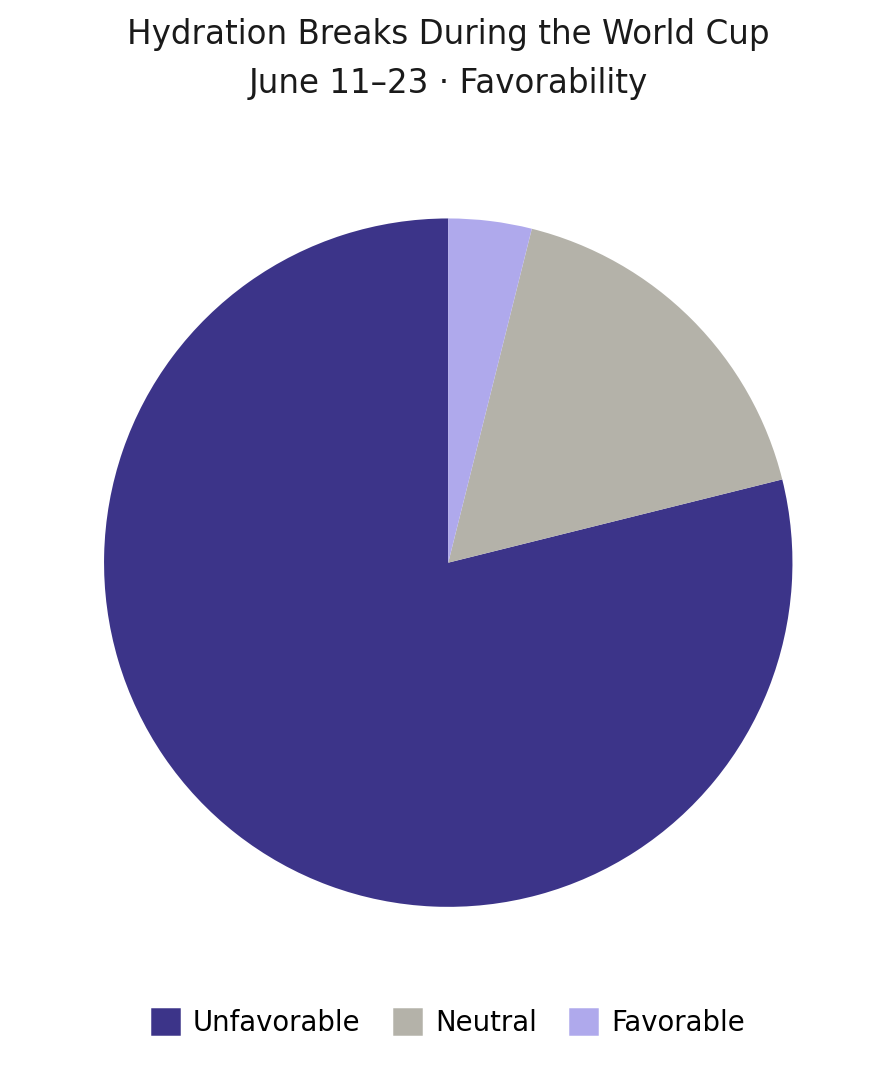
Between June 11 and June 23, 2026, 75% of online conversation surrounding World Cup hydration breaks was unfavorable across X, Instagram, Facebook, Reddit, TikTok, Threads, and Bluesky.
While discussions occasionally acknowledged the importance of protecting players from dangerous heat conditions, the dominant narratives focused on concerns around commercialization, sponsorship visibility, and disruptions to the viewing experience.
The Dominant Narrative: Commercialization Over Player Welfare
The most common criticism centered on the perception that hydration breaks have evolved into sponsorship opportunities rather than purely health-focused interventions.
One widely shared post summarized the sentiment bluntly:
"The FIFA hydration break is pure capitalism."
Many fans pointed specifically to the branding and sponsorship integrations surrounding the breaks, arguing that the pauses feel more like advertising opportunities than necessary safety measures.
This narrative consistently appeared across platforms, often accompanied by criticism of FIFA's commercial partnerships and broader concerns about the growing commercialization of the sport.
Fans Say the Breaks Interrupt the Flow of Matches
Beyond sponsorship concerns, many viewers expressed frustration with the impact hydration breaks have on the match experience itself.
Comments frequently described the additional stoppages as disruptive, arguing they interrupt momentum, break immersion, and diminish the natural flow of the game.
While some supporters viewed the pauses as a reasonable accommodation given the tournament's weather conditions, those voices represented a relatively small portion of the overall conversation.
Player Safety Still Matters, But Isn't Driving Discussion
Importantly, the conversation was not entirely one-sided.
A smaller share of posts emphasized the importance of protecting players from heat-related illness and acknowledged that hydration breaks are a necessary response to challenging environmental conditions.
However, these favorable discussions represented only a limited portion of overall engagement and were largely overshadowed by broader criticism surrounding sponsorship and commercialization.
What About Powerade?
Despite sponsorship concerns appearing throughout the conversation, break sponsor Powerade — a sports drink owned by Coca-Cola — has remained a surprisingly small part of the discussion.
Only about 1% of all hydration break mentions also referenced Powerade.
Among those brand-specific conversations, sentiment still skewed negative, with approximately 66% of discussion classified as unfavorable. However, that figure was notably less negative than the overall hydration break conversation, which reached 75% unfavorable.
Perhaps more importantly, the overall volume of conversations directly mentioning Powerade remained relatively limited, suggesting that criticism has been aimed more broadly at the concept and presentation of hydration breaks than at the sponsor itself.
A Reputation Challenge for FIFA
The conversation highlights a broader challenge facing major sporting organizations: even initiatives introduced for legitimate safety reasons can become reputation risks if fans perceive commercial interests as taking priority.
As the tournament continues, hydration breaks remain an important example of how audience perception can diverge from intent. While FIFA may view the pauses primarily as a player welfare measure, much of the online audience currently sees them as another manifestation of the sport's growing commercialization.
For brands and organizations operating on the world's biggest stages, perception often matters just as much as purpose.
Methodology
PeakMetrics analyzed online conversations related to World Cup hydration breaks between June 11 and June 23, 2026, across X, Instagram, Facebook, Reddit, TikTok, Threads, and Bluesky. Favorability classifications were generated using PeakMetrics' Smart Categories.
Sign up for our newsletter
Get the latest updates and publishings from the PeakMetrics investigations team.
Accept statistics cookies to load the newsletter sign-up form.