
What the Internet Actually Said About the McDonald’s CEO Big Arch Burger Moment
PeakMetrics analyzes the viral McDonald’s Big Arch burger moment to reveal what actually drove the conversation online—from humor to the Burger King spoof.
Published
In early February, a video of Chris Kempczinski tasting McDonald’s new Big Arch burger began circulating online. The clip, intended to promote the company’s latest menu item, became a talking point across social media as users debated the CEO’s reaction and what it said about the brand.
But unlike many viral brand moments, the conversation didn’t spike instantly. Instead, the narrative spread gradually as clips and commentary moved across platforms, with users reacting, joking, and adding their own interpretations.
To better understand how the internet was actually discussing the moment, PeakMetrics analyzed the conversation using its Smart Categories feature.
Smart Categories use AI prompts to organize large volumes of online posts into structured intelligence based on themes, tones, and signals within the conversation. Instead of relying only on traditional metrics like mention volume or overall sentiment, this approach breaks the conversation into the specific types of discussion happening around a topic.
For this analysis, PeakMetrics examined a sample of posts across X, Reddit, TikTok, Instagram, Bluesky, Facebook and YouTube from February 3 through March 3 that referenced McDonald’s and Kempczinski.
Using a Smart Category prompt, the conversation was grouped into themes and tones reflecting the way people were reacting to the video, including:
• Humorous or mocking reactions
• Political or economic commentary about leadership
• Competitive comparisons with other brands
• Direct personal criticism of the CEO
• Commentary on the backlash itself
• Supportive or defensive reactions
Organizing the conversation this way makes it possible to move beyond surface level metrics and see what themes are driving the discussion, how people are reacting, and which narratives are gaining traction online.
The results reveal a discussion that was far more layered than a typical “backlash” headline might suggest.
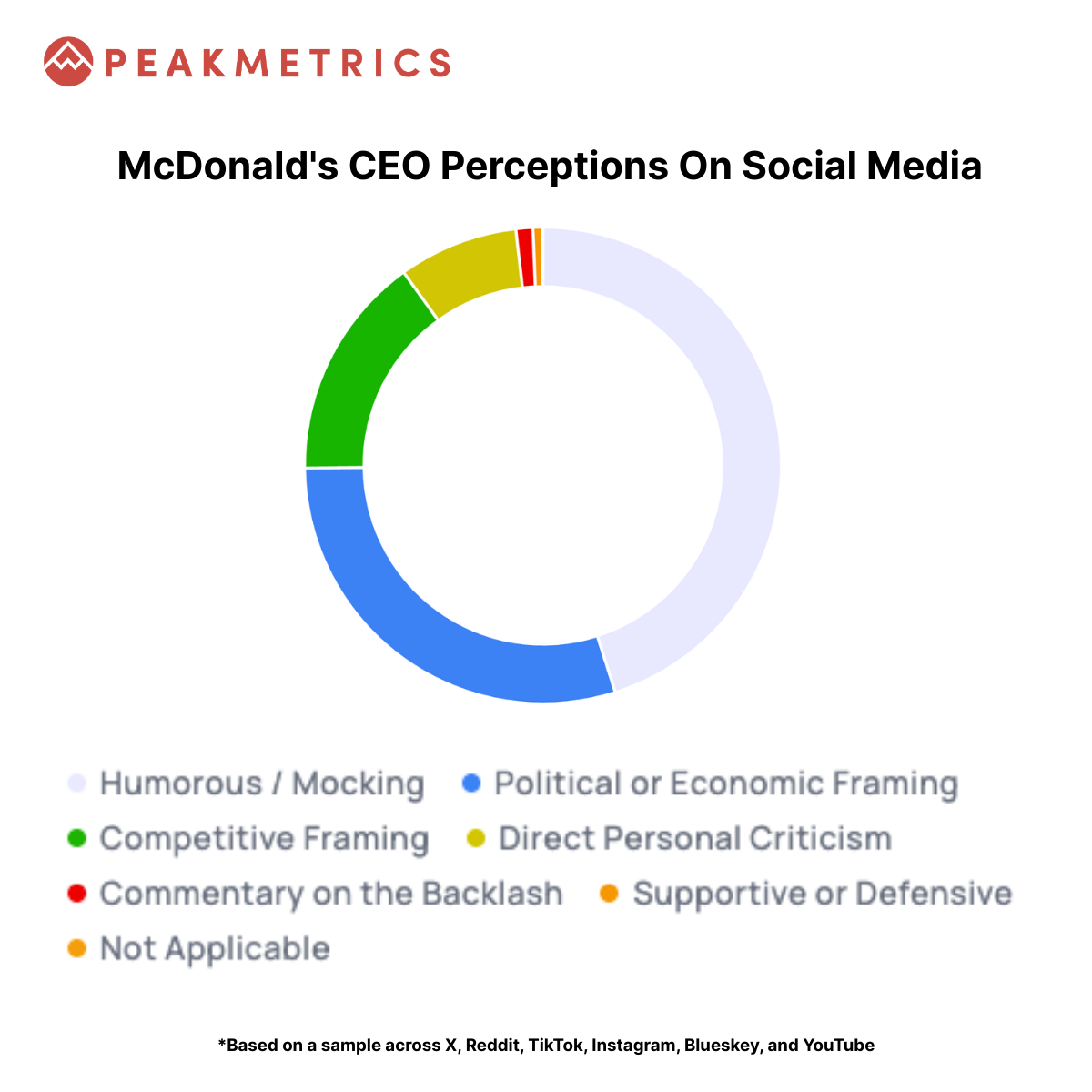
How People Framed the Moment
Using Smart Categories, we categorized the conversation into several narrative themes.
|
Narrative Frame |
Share of Conversation |
|
Humorous / Mocking |
35.3% |
|
Political or Economic Framing |
19.6% |
|
Competitive Framing (Burger King comparisons) |
18.8% |
|
Direct Personal Criticism |
15.6% |
|
Commentary on the Backlash |
9.5% |
|
Supportive or Defensive |
1.2% |
Looking at the discussion this way provides a clearer understanding of how the narrative evolved, rather than just how much attention it received.
Humor Drove the Conversation
The largest portion of posts, 35.3% of the conversation, fell into a humorous or mocking framing.
Many users focused on the perceived awkwardness of the video, joking about Kempczinski’s reaction to the burger and the irony of a CEO appearing uncomfortable promoting his company’s newest product.
Memes, reaction clips, and sarcastic commentary circulated widely, turning the moment into a form of internet entertainment.
This dynamic is common in viral brand moments. While headlines often describe these situations as backlash, the majority of engagement frequently comes from people participating in humor rather than expressing anger.
Broader Leadership and Economic Conversations Emerged
Nearly one in five posts (19.6%) framed the moment through a political or economic lens.
These posts moved beyond the video itself and discussed larger themes around McDonald’s leadership and strategy. Conversations in this category included commentary on:
- Brand positioning
- Corporate leadership decisions
- Executive compensation
- The company’s pricing strategy
In many cases, the video served as a starting point for a broader conversation about the company’s direction and leadership.
Competitors Became Part of the Narrative
Another 18.8% of the conversation referenced McDonald’s competitor Burger King.
Much of this discussion centered around a spoof video released by Burger King that playfully mocked the original Big Arch clip. The parody quickly circulated online and prompted users to compare the two brands, adding a competitive layer to the conversation.
Moments like this illustrate how quickly competitors can enter and reshape a narrative once a brand begins trending online. What began as commentary about McDonald’s CEO quickly evolved into a broader discussion about the rivalry between the two chains.
Direct Criticism Was Still Present
With headlines suggesting widespread backlash, direct criticism of Kempczinski accounted for roughly 15.6% of posts.
These mentions focused on critiques of his leadership style, his background in brand management rather than restaurant operations, or perceptions that the video felt overly corporate.
While criticism was certainly present, it represented a smaller portion of the overall conversation than humor or competitive commentary.
The Internet Also Commented on the Reaction
Another 9.5% of posts focused less on the video itself and more on the reaction surrounding it.
These posts analyzed why the moment went viral, debated whether the criticism was fair, or discussed how social media often amplifies relatively small moments into major narratives.
This type of meta-discussion is becoming increasingly common online, as audiences reflect on the mechanics of internet discourse itself.
Supportive Voices Were Rare
Only 1.2% of posts actively defended Kempczinski or pushed back against the criticism.
Supportive content rarely spreads as widely as humor or critique online, which helps explain why positive commentary represented such a small portion of the discussion.
Why Narrative Intelligence Matters
Moments like this highlight a challenge many organizations face.
Traditional monitoring tools focus on volume and sentiment, which can show that a conversation is happening but not necessarily why it is spreading or how it is being framed.
PeakMetrics’ Smart Categories change that by allowing teams to categorize discussions by narrative theme using AI prompts.
This makes it possible to answer questions such as:
- Is this moment driven by humor or genuine criticism?
- Are competitors entering the conversation?
- Is a reputational threat emerging, or is the internet simply entertaining itself?
Instead of reviewing thousands of individual posts, Smart Categories help transform chaotic online data into clear insights about the narratives shaping a conversation.
Seeing Through the Noise
The Big Arch burger moment illustrates how quickly a single piece of content can evolve into a layered online narrative.
Humor, competitor engagement, leadership commentary, and meta discussion about the backlash all emerged simultaneously across platforms. Without structured analysis, these dynamics can be difficult to separate from the overall volume of conversation.
By organizing online discussion into themes and tones, organizations can move beyond surface-level monitoring to understand what is actually shaping the narrative and where attention is coming from.
In today’s increasingly complex information environment, that level of clarity is critical for responding to moments before they escalate.
Sign up for our newsletter
Get the latest updates and publishings from the PeakMetrics investigations team.
Loading the newsletter sign-up form…