
What Is Narrative Intelligence? The Complete Guide
Narrative intelligence is how organizations see through the manipulated internet. Learn what it is, how it works, and what it unlocks.
Published
In 2026, 90% of online content is expected to be synthetically generated. Coordinated bot networks can seed a false narrative in hours. A single misattributed quote, a deepfaked video, a manufactured boycott campaign: any of it can reach millions of people before your team has time to verify what's real.
Traditional media monitoring wasn't built for this. Keyword alerts don't tell you who's behind a narrative, whether it's organic or manufactured, or how fast it's moving. They tell you a conversation is happening. They don't tell you what to do about it.
That's the gap narrative intelligence was built to close.
This guide covers everything you need to know: what narrative intelligence is, why it matters, how it works, who needs it, and how to build a strategy that actually protects your organization.
Most Organizations Are Operating Blind
Your media monitoring tool told you a conversation was happening. It didn't tell you that 40% of the accounts driving it were bots. It didn't tell you the narrative had been seeded three weeks earlier on a Telegram channel your tool doesn't cover. And it definitely didn't tell you that the same story was already being served in AI-generated search summaries before a single journalist picked it up.
That's not a monitoring gap. That's a category gap.
Traditional tools search for keywords. Keywords are a surface-level signal: they tell you what is being said, not why it's spreading, who is behind it, or what it's doing to your brand. Keyword monitoring misses the narrative layer entirely: the tone, the intent, the manipulation, and the meaning underneath the words.
Narrative intelligence is what lives at that layer.
What Is Narrative Intelligence?
Narrative intelligence is a strategic capability that organizations use to detect, decipher, and defend against online narratives before those narratives cause financial or reputational harm.
Unlike traditional media monitoring, which tracks what is being said, narrative intelligence focuses on how stories form, who's driving them, whether they're authentic or manipulated, and where they're headed. It uses AI, machine learning, and data science to surface the hidden signals behind public discourse, giving organizations the intelligence to act before threats escalate.
Narrative intelligence definition: The strategic solution organizations use to detect, decipher, and defend their reputation from online narratives. By analyzing how narratives form and spread across the internet, narrative intelligence empowers brands to gauge threats, shape effective response plans, and make informed decisions swiftly.
Why Narrative Intelligence Matters More Than Ever
The financial stakes are enormous.
- Reputation accounts for 63% of a company's market value
- Misinformation costs organizations an estimated $78 billion annually
- Publicly traded companies lose approximately $39 billion per year due to narrative-attack-related stock market losses
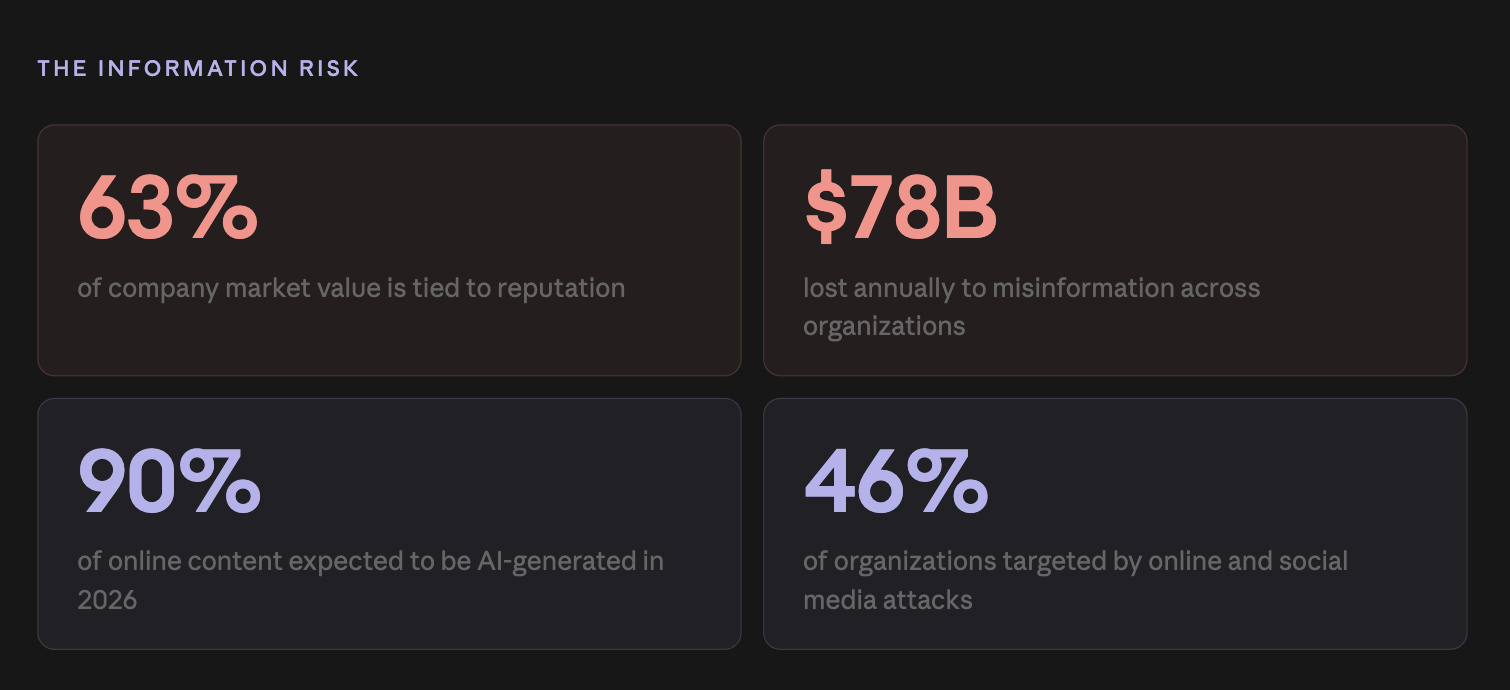
AI has changed the speed and scale of the problem.
Generative AI makes it trivially easy to produce realistic fake images, videos, and text at scale. Narrative attacks that once required coordinated human effort can now be launched, amplified, and sustained by automated systems in ways that are nearly indistinguishable from authentic discourse.
The analyst community has taken notice.
Gartner predicts that by 2029, 45% of Chief Communications Officers are expected to adopt narrative intelligence tools to combat disinformation, with enterprise spending on misinformation defense projected to exceed $30 billion by 2028. Forrester identifies narrative attacks as one of the top five cybersecurity threats.
The Keyword Layer vs. The Narrative Layer
Keyword monitoring tracks whether specific terms appear in coverage or conversation. It answers: Did anyone mention us? It doesn't answer: What story are they telling? Is that story growing? Who's driving it? Is the amplification real?
The narrative layer is everything beneath the keywords: the intent behind a piece of content, the emotional register it's designed to trigger, the network effect amplifying it, and the coordinated behavior (human or automated) that's making it spread. A narrative can be building serious momentum around your brand without ever triggering a single keyword alert, if the language being used is slightly adjacent to your monitored terms, or if the conversation is happening on platforms your tool doesn't cover.
Consider what keyword monitoring misses:
- Bot-amplified sentiment that looks like organic criticism but is manufactured outrage
- Deepfakes and synthetic media that put words or images in front of audiences before any text-based monitoring can flag them
- Fringe platform activity on Telegram, Discord, or niche forums where narratives incubate weeks before they reach mainstream channels
- AI search layer influence where false narratives about your brand are already being served in LLM responses and AI-generated summaries, shaping what people believe before they ever visit a news site
- Narrative velocity and trajectory: the difference between a conversation that's trending toward crisis and one that's peaking and fading
True narrative intelligence covers all of this. The AI understands the narrative being constructed, not just the words being used to construct it.
How Narratives Actually Form: Themes, Moments, and Context
Here's where most frameworks get it wrong. They treat narratives like a hierarchy: a broad topic that narrows into a story, which then generates commentary. Clean, logical, and not how the internet actually works.
PeakMetrics thinks about it differently: a narrative is built from a theme and the moments that activate it. Context is what determines whether those moments become a crisis or just noise.
A theme is a sustained area of public tension around an organization, industry, or issue. Themes can be long-running, baked into how audiences already see your brand. Or they can be entirely new, seeded by an unexpected moment and solidified by the ones that follow. The difference between a theme and a one-off incident is accumulation: when multiple moments start pointing in the same direction, a theme is forming. That's when perception starts to harden.
Moments are the specific events that either activate an existing theme or begin seeding a new one. They're discrete and dateable. A policy announcement, an earnings call comment, a viral customer post, a leaked internal document: any of it can be the first moment that introduces a new narrative frame, or the third moment that makes an emerging one feel permanent.
Southwest Airlines is a useful recent example. The theme: Southwest as the customer-first airline. In March 2025, the airline announced it was ending "Bags Fly Free," the 54-year-old policy that had been the single biggest reason millions of customers chose Southwest over competitors. The CEO had promised as recently as the prior year it was untouchable. That announcement was a single moment within a bigger theme. And it didn't produce one narrative: it produced several. Southwest betrayed its most loyal customers. Southwest is becoming Spirit. Wall Street killed a beloved brand. Depending on who you were and where you were paying attention, you were living inside a completely different version of the same story.
That's how narratives actually work. The theme is the tension. The moments are what activate it. And the narratives are what different communities make of those moments, shaped by their own context, their own grievances, and their own information environments.
This is why context isn't a footnote. It's the whole game. Keyword monitoring tells you "Southwest" is trending negatively. Narrative intelligence tells you there are multiple distinct conversations happening, which communities each one lives in, which is growing versus peaking, and what each actually requires in response.
What Is a Narrative Attack?
A narrative attack occurs when malicious actors deliberately manipulate narratives to damage an organization's reputation, undermine trust, or influence behavior.
Narrative attacks don't require a single big lie. They exploit existing anxieties, amplify half-truths, and leverage coordinated networks to make a minority view appear like a majority consensus. The anatomy of a typical attack follows a predictable pattern:
1. Seeding. False or misleading content is introduced, often through fringe platforms like Telegram, Discord, or niche forums where moderation is limited. These environments are breeding grounds for narratives before they reach mainstream channels.
2. Amplification. Coordinated bot networks and inauthentic accounts amplify the narrative, creating the appearance of viral spread. At this stage, the content often gets picked up by unwitting real users who share it without understanding its origins.
3. Mainstreaming. Once a narrative has sufficient momentum, it attracts legitimate media coverage and influencer attention, lending it credibility it wouldn't otherwise have.
4. Impact. By the time most organizations detect the attack, it has already shaped public perception. The damage to reputation, stock price, employee morale, or customer trust is done.
The key insight: the window for effective intervention is narrow. Organizations that wait for a narrative to hit mainstream media before responding are already behind. Narrative intelligence is about compressing that window, detecting emerging threats early enough to change the outcome.
What Narrative Intelligence Actually Unlocks
For years, the questions organizations most needed to answer were the ones their tools couldn't touch. Keyword monitoring could tell you volume. Sentiment analysis could tell you positive or negative. But the questions that actually drive decisions were effectively unanswerable at scale.
Narrative intelligence changes that by operating at a different layer of the data entirely, one that understands meaning, context, and intent rather than just words. The questions it can answer are almost limitless. Some examples of what becomes possible:
Favorability and trust, tracked by audience subset. Not just "sentiment is down" but which communities are losing trust, how fast, and why. A brand can be gaining favorability among one audience while quietly hemorrhaging it among another, and those two signals averaged together look like nothing. Narrative intelligence disaggregates them, tracking how trust shifts across different groups over time as new moments enter the conversation.
Rhetorical tone, not just positive or negative. There's a meaningful difference between an audience that is critical of your organization and one that is using violent rhetoric. Between commentary and coordinated attack. Between frustration and radicalization. Narrative intelligence classifies rhetorical tone at scale, separating critical from violent, complimentary from performative, genuine concern from manufactured outrage, so organizations can calibrate their response to what's actually happening rather than a flattened sentiment score.
The political and ideological lean of your online conversation. Understanding how an organization is perceived across the political spectrum isn't just a communications question: it's a policy question, a product question, a partnership question. Narrative intelligence surfaces how different ideological communities engage with your brand and your issues, giving leaders real data to inform decisions that used to rely entirely on instinct.
Core themes pulled out of narrative clusters. Instead of manually reading thousands of posts to understand what people actually care about, narrative machine learning surfaces the underlying themes driving conversation: the real concerns, the recurring frames, the latent tensions that keyword monitoring buries in noise.
The difference between what bots are amplifying and what real people actually think. Manufactured outrage and genuine public sentiment can look identical in a keyword dashboard. Narrative intelligence separates them, so organizations stop making decisions based on a picture of public opinion that was engineered to mislead them.
This is a fundamentally new dimension of data. The organizations that learn to ask questions of it will have a completely different level of intelligence than those still counting mentions.
Who Needs Narrative Intelligence?
Narrative intelligence is not a tool for one team. It's an organization-wide capability.
For many years, media monitoring was treated as a communications and PR function, siloed from the C-suite, disconnected from security, invisible to finance. That model doesn't hold anymore. The narratives shaping your organization's reputation are simultaneously a strategic risk, an operational risk, and a security risk. They require a cross-functional response.
C-Suite Leadership
Leaders are the most visible faces of their organizations and the most targeted by narrative attacks. Executives need a clear, real-time view of the narratives at play: not just around their brand, but across their industry, competitive landscape, and broader political environment. Reputation drives revenue; understanding the narratives shaping both is a strategic imperative.
Communications and PR Teams
Comms teams sit at the center of narrative intelligence strategy, responsible for monitoring industry and brand narratives, interpreting the forces behind them, and guiding the organization's response. The shift from reactive media monitoring to proactive narrative intelligence changes the function fundamentally: from tracking what happened to anticipating what's coming.
Social Media Teams
The conversations that eventually become crises almost always start on social media, and increasingly on platforms that traditional monitoring tools don't cover. Telegram, Discord, Reddit, VK, Weibo, and others are where narratives incubate. By the time they appear on major platforms, the window for early intervention has often closed.
Security Teams
Narrative attacks are a cybersecurity issue, not just a PR problem. CSOs and CISOs need narrative intelligence to detect information operations, identify coordinated inauthentic behavior targeting their organization, and protect against the intersection of physical and cognitive threats. Disinformation campaigns can precede physical security incidents, stock manipulation, or cyberattacks, making narrative intelligence a critical input to security posture.
Analytics and Data Teams
Narrative intelligence generates rich, structured data about public discourse that can inform strategic decisions across the organization, from product launches to market expansion to crisis planning. Analytics teams play a key role in translating narrative signals into quantitative insights for executive decision-making.
The PeakMetrics Approach: Detect. Decipher. Defend.
PeakMetrics was built from the ground up for this problem, with roots in defense and national security, where the stakes of getting narrative intelligence wrong are measured in lives and geopolitical outcomes, not just quarterly earnings.
Detect
The first challenge is seeing everything. PeakMetrics monitors more than 1.5 million media sources and social platforms in real time, including emerging and fringe channels where narratives typically originate before reaching mainstream audiences. Narrative machine learning goes beyond keyword matching to understand context, intent, manipulation, and meaning. The result: your team sees threats forming, not just threats that have already formed.
- Real-time monitoring across social, news, broadcast, fringe platforms, and the dark web
- Coverage across 100+ languages
- Bot and coordinated inauthentic behavior detection
- Deepfake and synthetic media identification
- Custom alerts triggered by velocity, reach, or severity thresholds your team defines
Decipher
Identifying a narrative is the beginning, not the end. The harder question is: what does it mean? Is it organic or manufactured? Is it gaining momentum or fading? Which audiences does it affect and how?
- Authenticity: Is this trend driven by real people or coordinated bot activity?
- Velocity: How fast is this narrative spreading, and who is accelerating it?
- Impact: Which audiences are being affected, and how is trust and favorability shifting?
AI-generated threat scores evaluate each narrative against parameters your organization actually cares about, distinguishing smoke from fire and helping teams allocate attention where it matters.
Defend
Intelligence only creates value when it drives action. The Defend layer translates narrative analysis into concrete steps before damage is done.
This includes rapid response briefings with recommended actions grounded in what the data shows, executive-ready situation reports that synthesize intelligence and context, talking points and counter-narrative guidance, and GEO-optimized brand fact centers designed to ensure accurate information surfaces in AI-powered search results and LLM responses. As AI increasingly shapes how people discover and assess information, owning the accurate narrative in that layer is a new front in reputation defense.
PeakMetrics is not a self-serve dashboard with a support desk. The platform is backed by solutions engineers who function as analysts, advisors, and architects, building custom analytical workflows, configuring intelligence pipelines specific to your threat landscape, and delivering the kind of deep, flexible analysis that no product UI can replicate on its own. Your job is one conversation. Ours is everything after that.
What an Effective Narrative Intelligence Strategy Looks Like
They operate from leading indicators, not lagging ones. Weekly reports, coverage summaries, and keyword dashboards are retrospective. Effective narrative intelligence strategy is built around real-time signals, early detection on fringe platforms, and trajectory modeling, so the team is making decisions based on where a narrative is going, not where it's been.
They've broken the silo. The most resilient organizations have connected communications, security, legal, and the C-suite into a unified narrative intelligence function, with shared data, shared protocols, and shared authority to act.
They invest in the upstream. Detection and response are necessary but insufficient. The organizations that lead in narrative intelligence also invest proactively: building authoritative content that establishes sources of truth, ensuring accurate narratives surface in AI-powered search and LLM responses, and creating the information infrastructure that makes it harder for attacks to take hold in the first place.
They treat narrative intelligence as an intelligence function, not a PR function. The instinct in many organizations is to hand narrative monitoring to the communications team and treat it as an extension of media relations. That framing undersells the capability and misaligns the organizational response. Narrative intelligence at its best is an enterprise-wide intelligence function, one that informs strategy, shapes crisis preparedness, and drives decisions at the executive level.
Narrative Intelligence FAQ
How quickly can narrative attacks spread online?
Extremely fast. Narratives can reach millions of people within hours of initial seeding, and research shows that false narratives typically spread faster than true ones. The emotional charge of manipulated content drives engagement in ways that accurate, measured communication rarely matches. This is why early detection, before a narrative reaches critical mass, is the only reliable way to limit damage.
What's the difference between narrative intelligence and social listening?
Social listening tracks mentions and sentiment across social platforms. Narrative intelligence goes significantly deeper: it analyzes how stories form, models the networks that spread them, distinguishes authentic discourse from manufactured outrage, scores threats by their potential impact, and produces actionable guidance for response. Think of social listening as knowing a fire exists. Narrative intelligence tells you where it started, how fast it's moving, who lit it, and how to put it out.
What's the difference between narrative intelligence and media monitoring?
Traditional media monitoring aggregates coverage and flags keywords. It's retrospective: it tells you what has already been published. Narrative intelligence is prospective: it detects patterns, models trajectories, and surfaces threats before they peak. The distinction matters most during the earliest phase of a narrative attack, when intervention is still possible.
Can narrative intelligence prevent attacks entirely?
What narrative intelligence changes is the outcome: detecting early enough to intervene before a narrative reaches critical mass, responding with sufficient context and speed to limit its spread, and building the infrastructure to counter false narratives effectively when they do emerge.
Who should own narrative intelligence inside an organization?
Narrative intelligence cuts across communications, security, legal, and executive leadership. In practice, communications and PR teams often serve as the operational center of gravity, but the most effective implementations are cross-functional, with defined protocols for escalation, response authority, and executive visibility.
What makes PeakMetrics different from other narrative intelligence platforms?
PeakMetrics was built from defense and national security environments, contexts where the stakes of missed intelligence are categorically higher than brand reputation. That foundation informs the platform's depth of analysis, its coverage of fringe and emerging channels, and its ability to distinguish authentic discourse from sophisticated manipulation. Beyond the technology, PeakMetrics deploys forward-facing solutions engineers who work directly with clients as analysts, engineers, and advisors, delivering flexible intelligence tailored to each organization's specific threat landscape, not a generic dashboard.
The Bottom Line
The internet is not just noisy. It's manipulated at scale, using increasingly sophisticated tools, by actors who understand the gap between what traditional monitoring covers and what's actually happening in the information environment.
Narrative intelligence is how you see through it.
Not by monitoring more. Not by hiring more analysts to read more reports. But by operating from a layer of analysis that actually understands how narratives form, who's driving them, whether they're real, and what they're going to do, with enough lead time to change the outcome.
See how PeakMetrics gives your team the intelligence to act before threats escalate. Request a demo.
Sign up for our newsletter
Get the latest updates and publishings from the PeakMetrics investigations team.
Loading the newsletter sign-up form…