
Spotify’s Disco Ball Logo Backlash Reveals How Protective Audiences Have Become of Brand Identity
Spotify’s temporary disco-ball logo sparked widespread backlash online
Another brand logo is back in the crosshairs.
Just months after the Cracker Barrel branding conversations sparked debate online, Spotify found itself at the center of its own internet-wide backlash after temporarily swapping its iconic green app logo for a glittery disco ball version tied to the company’s 20th anniversary campaign.
The move was meant to be celebratory. As part of Spotify’s “Your Party of the Year(s)” anniversary experience, the company introduced a temporary disco-ball logo treatment on mobile alongside nostalgic listening features and retrospective experiences for users.
But what Spotify appears to have viewed as a playful anniversary moment landed a bit differently online.
Almost immediately, users across social media began criticizing the logo change, with many describing it as distracting, ugly, confusing, or off-brand. Others joked that the app looked like it was stuck downloading or updating on their home screens. Within days, Spotify acknowledged the backlash publicly, posting that “glitter is not for everyone” and confirming the original icon would return.
What makes the reaction notable is not simply that users disliked a temporary design tweak. It’s that the response reflects a broader pattern emerging online: audiences increasingly treat familiar brand assets less like corporate property and more like shared infrastructure. When brands alter highly recognizable visual cues — especially ones consumers interact with daily — reactions can become emotional, immediate, and highly amplified.
To analyze the Spotify logo backlash, PeakMetrics used its AI-powered Smart Categories technology to automatically parse thousands of posts across X, TikTok, Facebook, Reddit, Instagram, Bluesky, and Threads. Rather than relying on rigid keywords or traditional sentiment analysis, Smart Categories uses AI to understand the context, tone, and intent behind conversations — identifying themes like direct criticism, humor and memeing, complimentary reactions, marketing analysis, and debate-driven discussion. The system also evaluated favorability shifts across the conversation and layered in bot detection analysis to understand whether engagement appeared authentic or artificially amplified. This allowed PeakMetrics to move beyond surface-level mentions and uncover the deeper narratives, behaviors, and amplification patterns driving the Spotify logo discourse in real time.
The Conversation Skewed Heavily Negative
.png)
Among original posts related to the Spotify logo update, the conversation skewed overwhelmingly negative.
- Unfavorable: 51.5%
- Neutral: 24.9%
- Favorable: 23.6%
Negative reactions outpaced favorable sentiment by more than 2:1, showing that while some users appreciated the playful branding experiment, the dominant online response was criticism.
The findings suggest that even temporary changes to deeply familiar visual assets can generate outsized backlash when audiences feel a brand has disrupted something habitual or recognizable.
Direct Criticism Dominated the Narrative
Among seven major themes identified in the conversation, direct criticism of the disco-ball logo overwhelmingly led discussion volume.
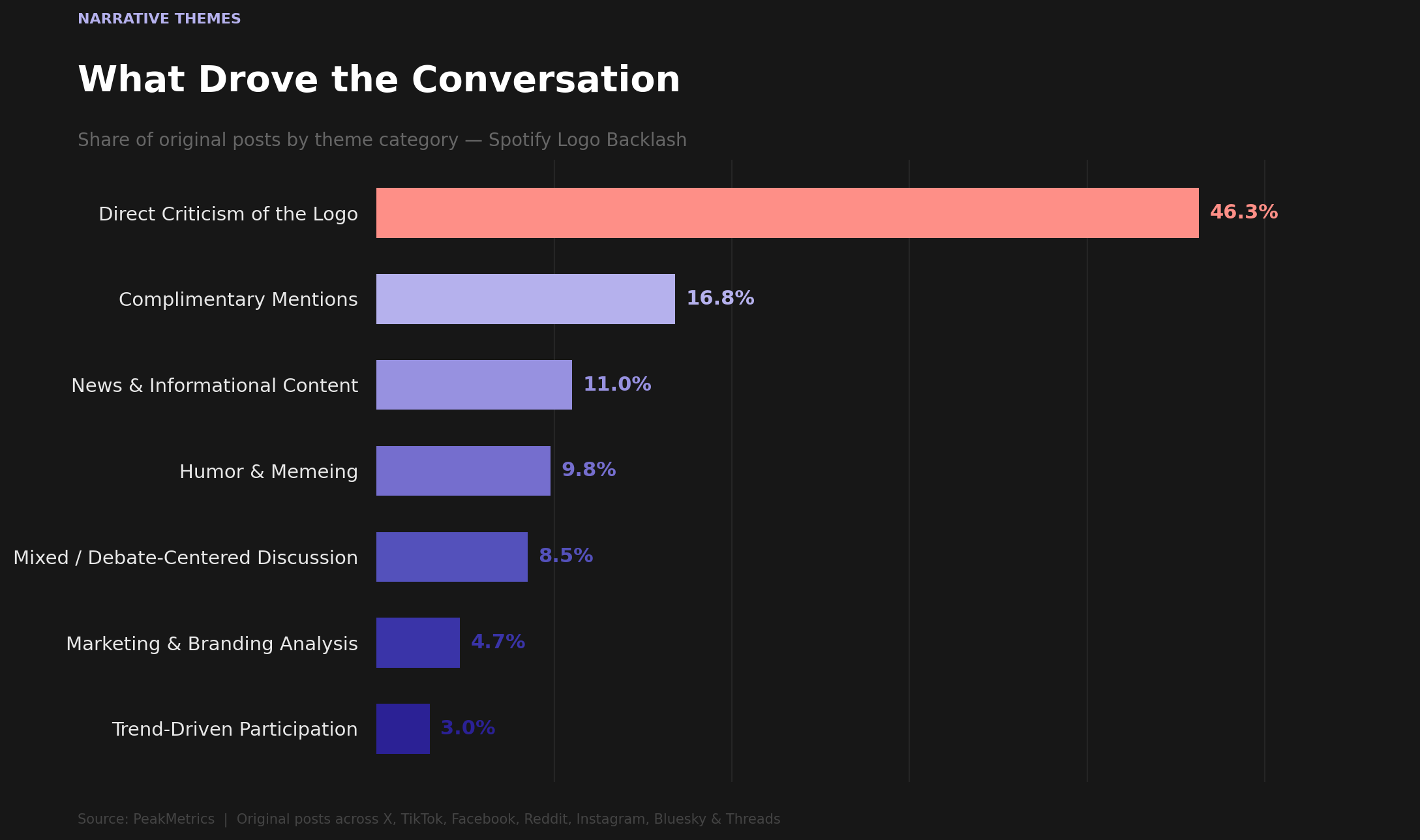
Direct Criticism of the Logo (46.3%)
The largest share of posts centered around dissatisfaction with the new icon itself. Users criticized the design as visually cluttered, cheap-looking, confusing, or difficult to recognize quickly on mobile devices.
A recurring pattern across platforms was users expressing frustration that the app icon no longer felt instantly identifiable — an important detail for a platform people access daily.
Many reactions framed the logo less as a fun campaign execution and more as an unnecessary disruption to a familiar digital habit.
Complimentary Mentions (16.8%)
Despite the backlash, a meaningful portion of users appreciated the temporary branding update.
Supportive commentary often framed the disco-ball logo as playful, celebratory, nostalgic, or creatively aligned with Spotify’s music-first identity. Many favorable posts also emphasized that the change was temporary and viewed criticism as overblown.
News & Informational Content (11%)
A sizable portion of discussion came from news accounts, creators, and informational pages documenting the backlash itself and Spotify’s subsequent response.
These posts helped accelerate awareness of the controversy beyond the initial user complaints and contributed to the rapid spread of the narrative across platforms.
Humor & Memeing (9.8%)
As with many modern branding controversies, humor quickly became a layer of the conversation.
Users created memes comparing the logo to:
- apps stuck updating
- disco-themed parody brands
- glitter filters
- outdated design aesthetics
- fake app clones
This meme layer extended the lifespan of the conversation and transformed the backlash from simple criticism into participatory internet culture.
Mixed or Debate-Centered Discussion (8.5%)
Another segment of users engaged in broader debates around branding, consumer reactions, and whether audiences were overreacting to a temporary icon change.
These conversations often evolved into larger discussions about:
- brand loyalty
- internet outrage culture
- consumer ownership of brand identities
- how attached people become to familiar digital experiences
Marketing & Branding Analysis (4.7%)
Marketing professionals, designers, and branding commentators also weighed in on the controversy.
These discussions focused less on whether the logo “looked good” and more on what the backlash revealed about:
- consumer psychology
- app icon recognition
- emotional attachment to brand consistency
- the risks of altering highly habitual visual assets
Trend-Driven Participation (3%)
Some brands, creators, and users joined the conversation opportunistically through trend-driven content creation.
This included parody logos, reaction content, and engagement farming posts that used the Spotify discourse as a broader social trend rather than participating in the branding debate directly.
Bots in the Room: Nearly 30% of the Conversation Was Likely Bot-Driven
One of the more interesting findings in the analysis was the role automation may have played in shaping the broader conversation.
Among all posts related to the Spotify logo change, nearly 30% of the discussion (28.2%) showed signs of likely bot-driven activity.
However, unlike many high-profile online controversies where suspected bot activity amplifies outrage, the Spotify conversation revealed a more nuanced dynamic.
Analysis of posts rated as “Almost Certain” bot activity showed that highly suspected bot accounts were actually more likely to amplify neutral or favorable narratives around the branding change.
While some negative commentary existed, many suspected bot-driven posts focused on:
- balanced discussion
- support for the branding direction
- resharing Spotify’s explanation
- amplifying Spotify’s acknowledgment and reversion announcement
Many of these accounts specifically highlighted Spotify’s response that the logo was temporary and that the original icon would return.
Overall, the findings suggest that highly suspected bot activity contributed more to neutralization and amplification of Spotify’s messaging than to intensifying the backlash itself.
The Bigger Takeaway
Spotify’s disco-ball logo may have only been temporary, but the reaction to it underscores something much larger about modern branding in the social era.
Logos are no longer just design systems or marketing assets. On phones, apps, and platforms, they become habits. Shortcuts. Daily touchpoints people interact with constantly.
That familiarity creates emotional ownership.
When brands alter those assets — even briefly and even playfully — audiences increasingly respond less like passive consumers and more like stakeholders protecting something recognizable to them.
And in today’s online environment, even a temporary app icon can become a full-scale narrative event within hours.
Unlike some recent brand logo controversies, however, the Spotify backlash largely stayed contained within branding and internet culture conversations rather than escalating into broader political discourse. Because the disco-ball logo was clearly tied to a temporary anniversary marketing campaign — not a brand repositioning — criticism focused more on aesthetics, usability, and familiarity than ideology or corporate signaling. That stands in contrast to cases like Cracker Barrel, where branding conversations quickly became politicized online.
Sign up for our newsletter
Get the latest updates and publishings from the PeakMetrics investigations team.
Accept statistics cookies to load the newsletter sign-up form.