
When “Healthy” Brands Get Bought, Does Trust Transfer?
Learn how comms teams can prepare for acquisition backlash, address ingredient concerns and boycott calls, and build trust in new ownership.
An acquisition announcement can represent years of work for a founder. For the acquiring company, it can signal an opportunity to grow. For a customer, it can raise a much more personal question: Can I still trust this brand?
That question deserves a place in the announcement strategy.
When people choose a brand because of its ingredients, values, or independence, a change in ownership gives them a reason to reconsider those promises. The same deal that generates congratulations can also prompt predictions about cheaper ingredients, accusations of selling out, and requests for alternatives.
PeakMetrics analyzed conversations around acquisition announcements involving Goodles, Thorne, Grüns, Lesser Evil and Purely Elizabeth, alongside an earlier analysis of Siete Foods. These examples reveal several narratives communications teams should prepare for, plus opportunities to explain what customers stand to gain.
|
Brand |
Acquiring company |
|
Goodles |
|
|
Thorne |
|
|
Grüns |
|
|
Purely Elizabeth |
|
|
LesserEvil |
|
|
Siete Foods |
The implications extend to both sides of the deal. The acquired brand needs to explain why this decision fits the relationship it has built with customers. The buyer needs to show how it will earn a place in that relationship.
About the data: This data covers the announcement week for each brand acquisition across X, Reddit, TikTok, Instagram, Threads, and Bluesky.
The acquiring company becomes part of the product story
Before announcing a deal, both teams should ask what customers already associate with the buyer.
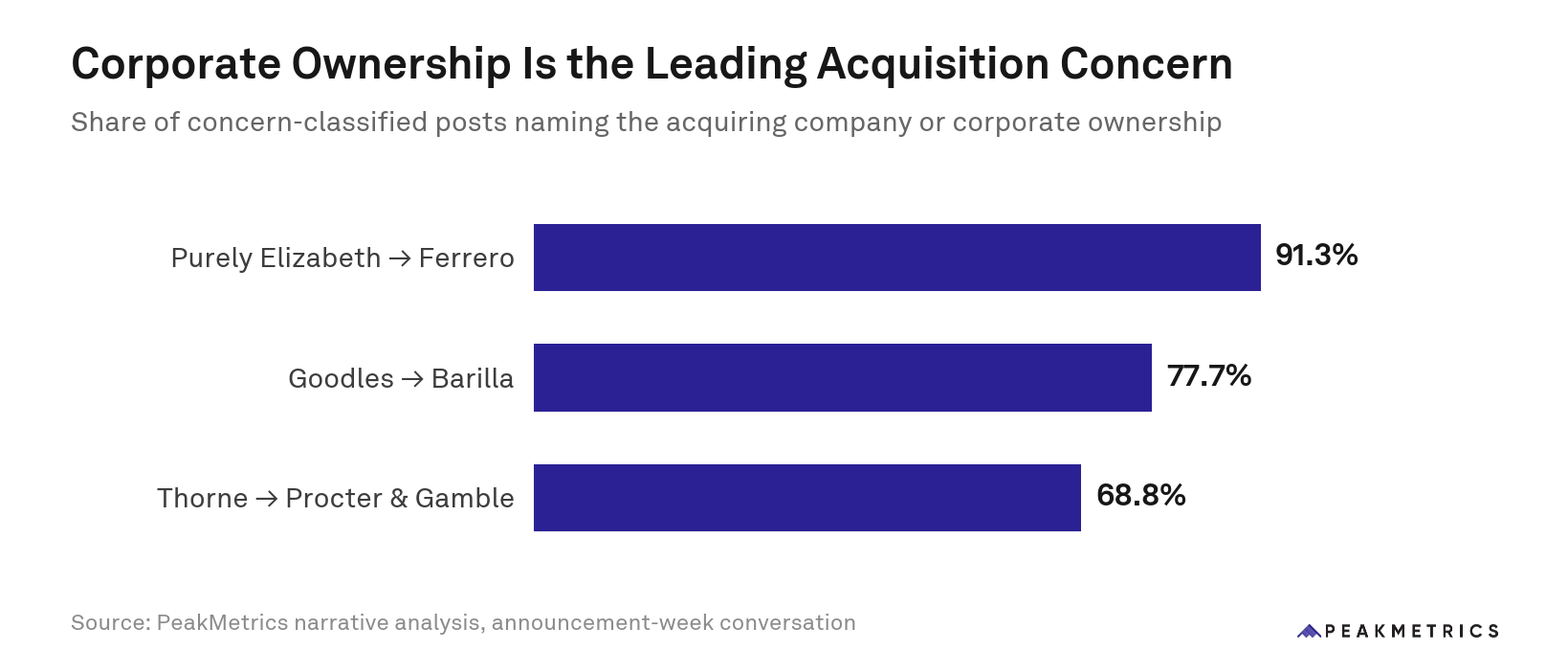
In the posts classified for acquisition-related concerns, acquiring-company or corporate-ownership concerns accounted for 77.7% for Goodles, 68.8% for Thorne, and 91.3% for Purely Elizabeth. Those figures describe each brand’s concern-category subset, which also includes an “explicitly unconcerned” classification.
Across these examples, the identity of the buyer was a prominent part of the discussion. That makes the relationship between the two companies a central communications issue.
A release that explains the commercial fit can still leave the customer fit unresolved. Why did this brand choose this buyer? What does the buyer value about it? Who will make decisions about the products people already love?
For the acquired brand, the answer should connect the decision to its existing mission and customer commitments. For the acquirer, it should identify the qualities it intends to preserve and the specific capabilities it brings.
There is a useful example in the Goodles deal: the transaction announcement specified that, following closing, Goodles would continue as a standalone brand, remain in Santa Cruz, and retain co-founder Jen Zeszut as CEO. These details make the proposed relationship tangible. They show customers something more concrete to evaluate than a broad promise to preserve the brand.
Leadership continuity alone cannot answer every product question. Explain what that continuity means for the decisions customers care about.
Prepare for fears about ingredient changes before changes are established
For brands built around nutrition or specific dietary needs, ownership news can create uncertainty about the product itself.
Following the announcement that Ferrero would acquire Purely Elizabeth, the large majority of posts discussing the brand’s perceived healthiness described it as becoming less healthy. Ferrero’s association with candy and chocolate brands such as Kinder, Tic Tac, and Ferrero Rocher may help explain that reaction: ownership by a confectionery company could feel at odds with Purely Elizabeth’s wellness positioning. The finding captures perceptions around new ownership; it does not establish that ingredients or nutritional quality had changed.
For vitamin and supplement brand Thorne, analysis captured a different question: would the brand stay the same under P&G’s ownership? Among posts expressing a view on that question, 92.8% anticipated that Thorne would change. For a vitamin and supplement brand, that could mean worries about different formulations, ingredient sourcing, or quality standards as the business grows. Customers may wonder whether the new owner will prioritize cost savings over the qualities they value.
For comms teams, these findings point to questions worth answering in the announcement: What does new ownership mean for the products customers already buy? Which standards will be maintained? Who will make decisions about future changes?
The earlier Siete analysis adds context: conversations included concerns about ingredient quality and whether products would remain suitable for people with dietary restrictions. For someone who depends on a familiar product, uncertainty about its formulation has practical consequences.
Prepare answers about recipes, sourcing, testing, certifications, and manufacturing before the announcement. Have the relevant product and quality teams substantiate those answers.
Be precise about the difference between a current fact, a future commitment, and a decision that has not been made. “There are no planned changes to these recipes” and “nothing will ever change” make very different promises.
Put those answers where customers can find them: in an announcement FAQ, on relevant product pages, and in customer-support responses. A corporate release should not be the only place people can check a claim about something they buy.
“You sold out” calls the brand’s relationship with its customers into question
Some reactions focus on what the decision says about the founders and their values.
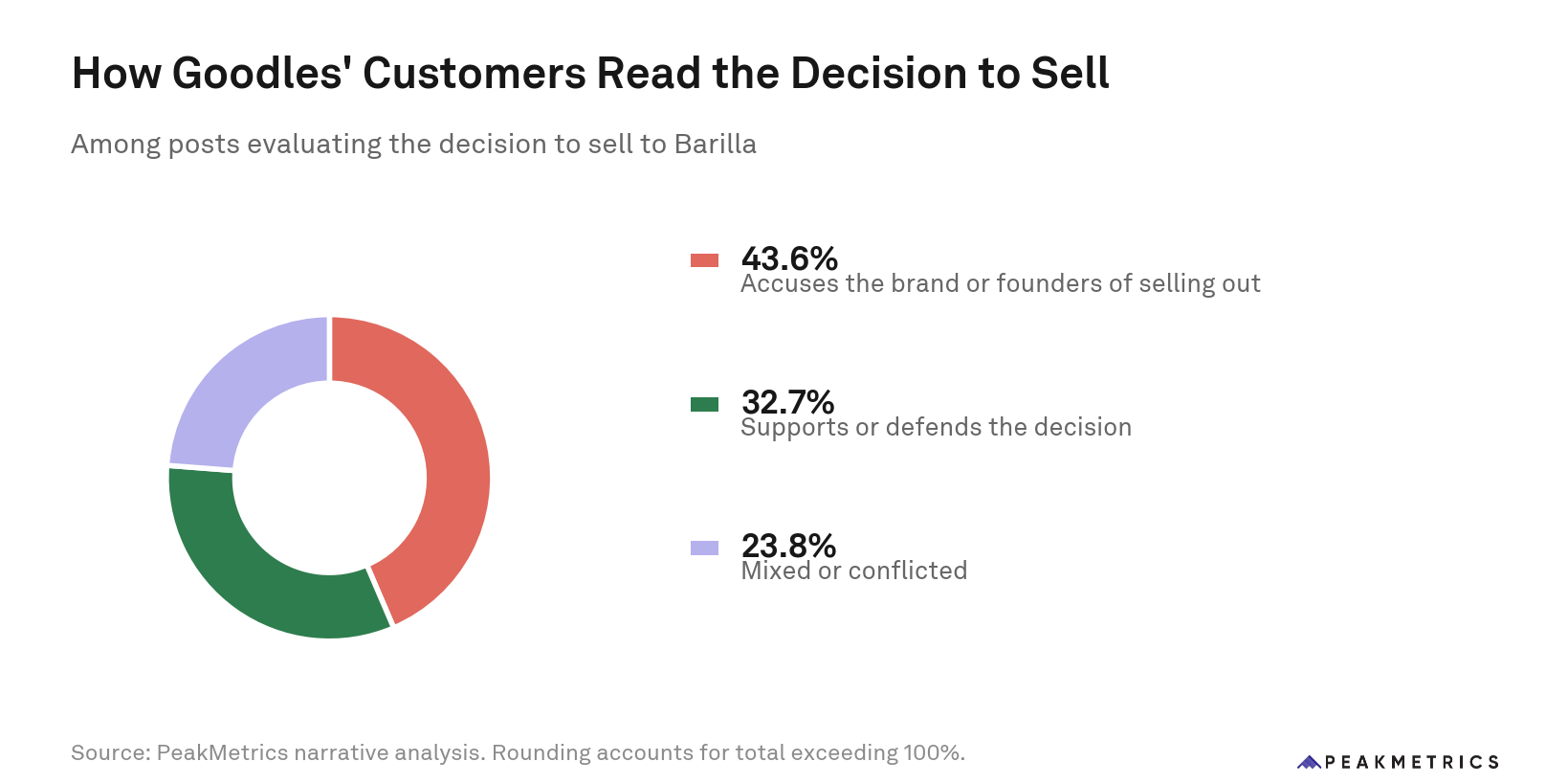
Among Goodles posts evaluating the decision to sell, 43.6% accused the brand or founders of selling out, while 32.7% supported or defended the decision and 23.8% were mixed or conflicted.
That split gives comms teams something useful to work with. The conversation contains criticism, support, and uncertainty. Each deserves a different response.
A founder message can explain why this buyer was chosen, what the team wanted to protect, and what the deal makes possible. It should acknowledge customers’ role in building the business and address the commitments behind their loyalty.
The acquiring company should reinforce that explanation with specifics about its role. If the founder emphasizes creative independence while the buyer emphasizes standardization and cost savings, customers are left to reconcile the two stories themselves.
Align both companies around a shared explanation of the relationship, while allowing each to speak naturally to its own audience.
Boycott calls, switching, and waiting for more information require different responses
After an acquisition announcement, some people may say they will stop buying. Others may look for another brand or wait to see whether anything changes. Understanding those differences helps comms teams decide how to respond.
For vitamin and supplement brand Thorne, within the smaller subset of posts describing specific consumer responses included:
- 26.0% discussing stopping purchases or boycotting.
- 19.5% discussing switching to another brand.
- 25.2% discussing monitoring products or ownership.
(They describe responses expressed in posts, rather than confirmed purchasing behavior.)
For someone taking a wait-and-see approach, clear information about ingredients, quality standards, and future updates may help address uncertainty. Someone considering another brand may need answers about the specific product qualities they fear losing. If boycott calls focus on distrust of the buyer, both companies need to address why that buyer was chosen and what commitments will protect the brand.
Start with the reason behind the reaction. Are people worried about a recipe change? Do they distrust the acquiring company? Are they asking where to find an alternative? Use those questions to shape the FAQ, customer-support responses, and conversations with relevant communities.
Then watch how the discussion develops. Are the same questions going unanswered? Are more people sharing alternatives or encouraging others to stop buying? Those patterns can help the team decide where to focus its response and what additional information customers need.
Give customers a concrete reason to see the upside
Backlash is not inevitable. The Grüns analysis offers a useful contrast: 62.7% of posts with an identifiable emotional reaction expressed excitement or optimism, compared with 17.7% expressing skepticism or concern. Disappointment or sadness accounted for just 0.7%.
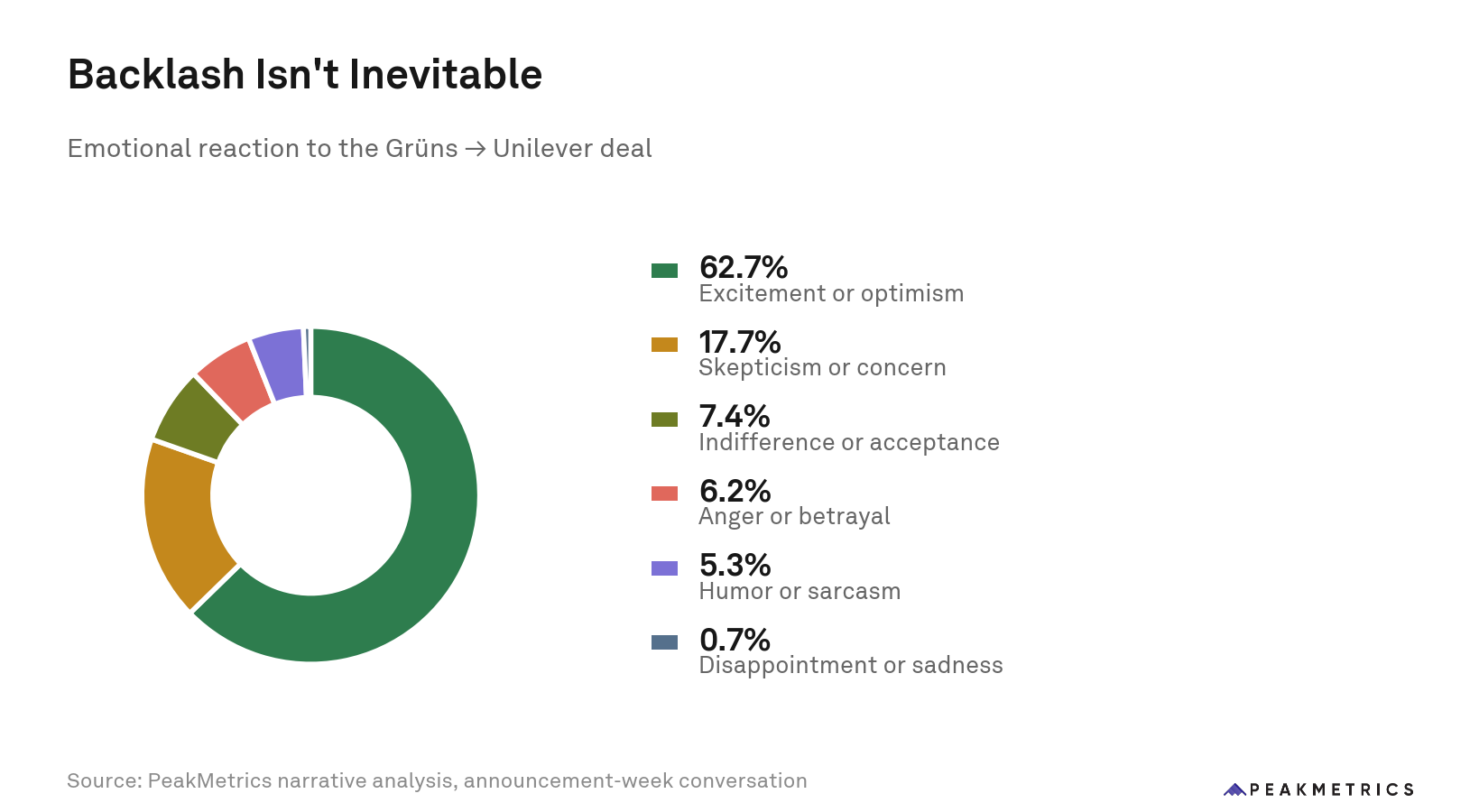
One possible explanation for that low disappointment is the fit between Grüns and Unilever’s existing wellness portfolio. Unilever had already acquired brands including OLLY, Nutrafol, and SmartyPants. That experience gave the company a concrete basis for presenting Unilever as a partner familiar with the category and its customers.
The announcement messaging also emphasized continuity and customer benefits. In his announcement post, founder Chad Janis confirmed he would remain CEO and described Unilever as a partner that shared the team’s approach to wellness. The press release connected the deal to reaching more customers and improving their daily wellness experience.
Together, the buyer’s experience in wellness, the founder’s continued involvement, and the explanation of customer benefits may have eased concerns about losing what made Grüns appealing. Among Grüns posts expressing an expectation about future change, 75.3% expected the brand not to change.
For comms teams, this offers a useful approach: explain why this particular buyer is a good fit, make leadership commitments explicit, and show how the partnership supports the reasons customers chose the brand in the first place.
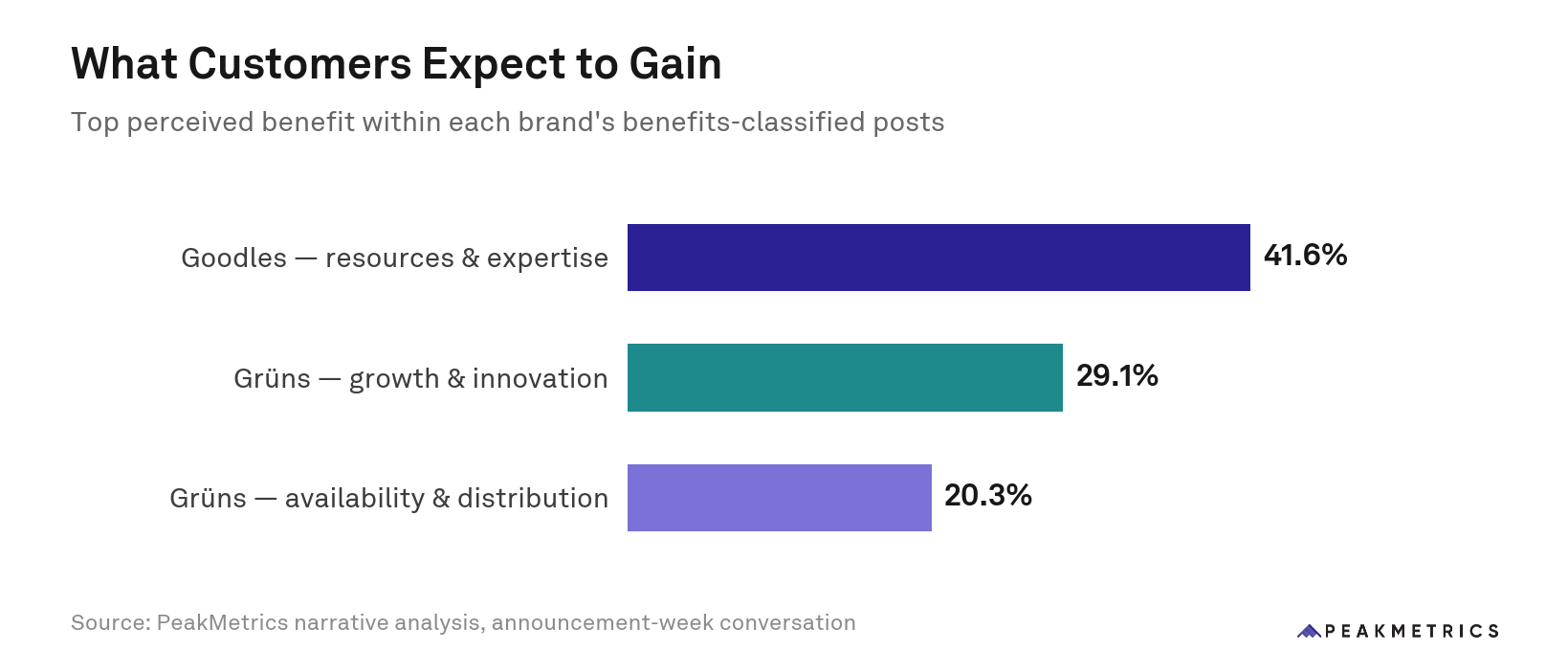
The perceived benefits also offer messaging clues. In the Grüns benefits subset, growth, innovation, or new products represented 29.1%, and greater availability or distribution represented 20.3%. For Goodles, resources, expertise, or operational support led its benefits subset at 41.6%.
Translate the business rationale into a customer outcome. If distribution is a confirmed priority, explain where improved access is expected. If investment will support product development, describe what the brand will be better equipped to do. Distinguish planned benefits from outcomes that are already secured.
Customers need enough detail to judge whether the deal could make their experience better. “An exciting new chapter” leaves that work to them.
Build the announcement around the questions each company needs to answer
Both teams should agree on the facts, commitments, and unresolved questions before choosing headlines and executive quotes.
One question deserves an explicit answer: Why should I trust the company buying this brand? Customers may already have opinions about the buyer’s products, values, or past acquisitions. Address those associations directly and support the answer with relevant examples, specific commitments, and clear accountability for maintaining the standards customers care about.
|
Customer question |
Acquired brand’s role |
Acquiring company’s role |
|
Why this deal? |
Explain why this buyer fits the brand’s mission and next stage. |
Explain what it values about the brand and why it wants to invest. |
|
Why should I trust the acquiring company? |
Explain what gave the team confidence in this buyer and which commitments it secured to protect the brand’s standards and values. |
Address existing concerns about its reputation. Provide relevant evidence from its track record with acquired brands, explain safeguards for product standards, and name who is accountable for following through. |
|
What happens to the products? |
Address recipes, sourcing, certifications, and quality commitments with verified specifics. |
Explain how it will support those standards and who is accountable. |
|
Who is in charge? |
Clarify leadership continuity and decision-making authority. |
Define the operating relationship and the scope of integration. |
|
What do customers gain? |
Connect planned improvements to customer needs. |
Substantiate the resources, expertise, or distribution it will provide. |
|
Where can I get answers? |
Provide an accessible FAQ and responsive customer channels. |
Keep answers consistent and help resolve questions requiring parent-company input. |
Before announcement day, review existing narratives around both companies and identify the promises most closely tied to the acquired brand’s reputation. Use those findings to prepare the release, founder message, FAQ, and responses for employees, retailers, and customer-facing teams.
On announcement day, publish the customer explanation alongside the deal news. Make the transaction’s status clear, including what is proposed and what takes effect only after closing. Watch which questions gain traction and update the FAQ when the same uncertainty appears repeatedly.
After the initial coverage, keep tracking ingredient claims, boycott calls, switching intentions, and perceptions of both companies. Closing, packaging updates, and product launches are useful moments to revisit the commitments made at announcement and provide evidence of progress.
Meet customers where they are already talking
The response plan also needs to account for where customers go to discuss the products, ask questions, and decide what to buy. Identify those communities before the announcement so your team knows where to listen and where useful answers are needed.
For a brand like Siete, that includes communities built around gluten-free eating and specific dietary needs. PeakMetrics’ earlier Siete analysis identified concerns in Reddit communities such as r/Celiac, where people discussed whether products they relied on would retain their gluten-free credentials. A customer asking that question needs a specific, verified answer about the product they buy.
Build community engagement into the announcement plan. Listen to the questions being asked in relevant subreddits, customer groups, and creator communities. Where brand participation is welcome, engage transparently as a company representative and answer those questions directly. Work with moderators on an appropriate format, whether that is a dedicated Q&A, an expert response, or a resource the community can reference. Bring in product and quality specialists when questions require their expertise.
The acquired brand’s team can help identify the communities and relationships that already matter to customers. The acquiring company should help supply the evidence and decision-makers needed to answer questions about new ownership. Keep the answers consistent across community conversations, customer support, and the public FAQ.
PeakMetrics helps communications teams identify these narratives across news and online conversations, understand the concerns behind them, and see which communities are discussing them. That context can inform both what the announcement needs to say and where the team needs to show up afterward.
The announcement is the first opportunity to explain what new ownership means for the people who made the brand valuable. Give them a clear account of what they can continue to count on, what they can look forward to, and how both companies will follow through. Then keep that conversation going in the places they already turn to for advice.
Sign up for our newsletter
Get the latest updates and publishings from the PeakMetrics investigations team.
Loading the newsletter sign-up form…